September 7, 2026
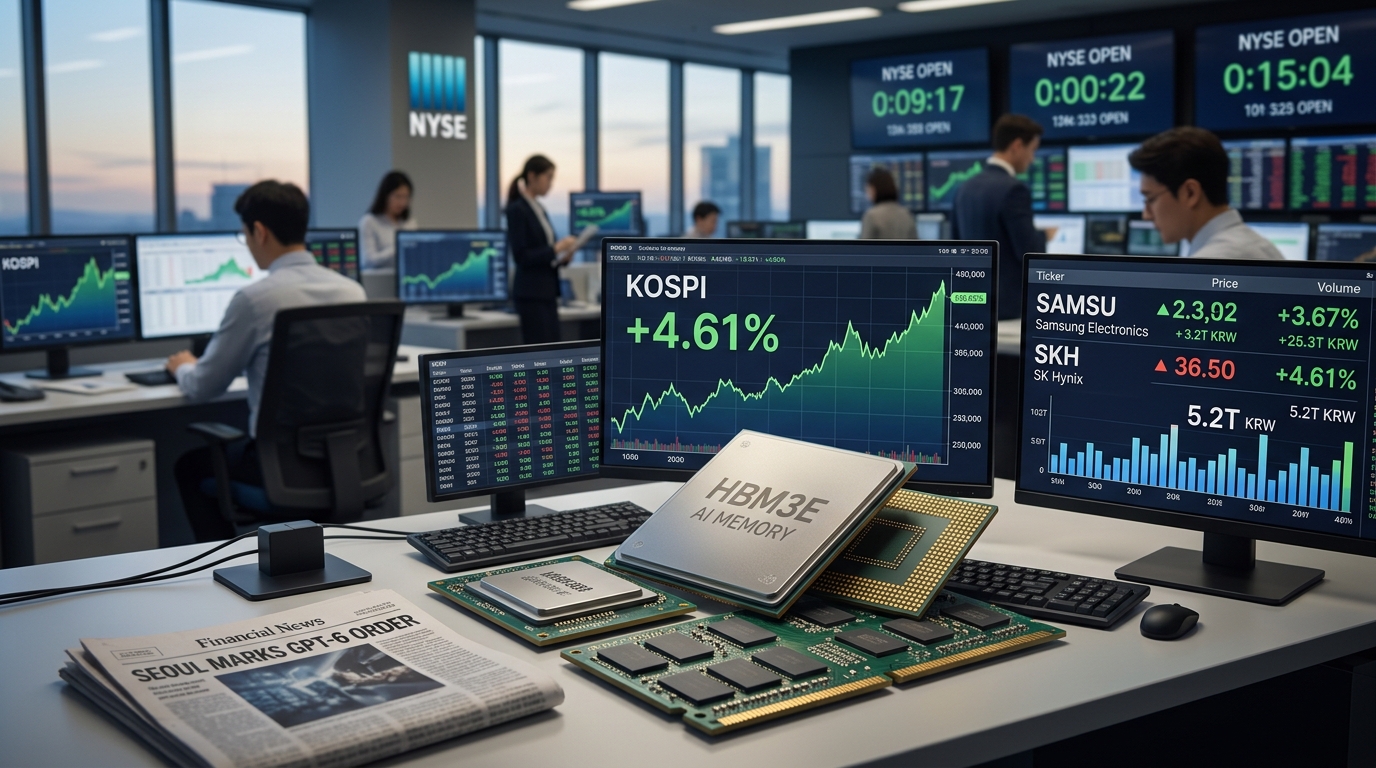
Seoul Just Paid 4.6% for GPT-6 Astra’s Memory Order.
Foreign and institutional investors poured roughly 5.2 trillion won into Samsung and SK Hynix on Monday.
US equity markets are closed today for Labor Day. That did not stop the world’s largest memory trade from shifting. By the time NYSE and Nasdaq reopen Tuesday morning, Seoul will have already delivered a verdict on GPT-6 Astra worth reading carefully.
Elon Musk Just Called the Dollar “Hopeless” – Then Reinvented It
What’s going on with Elon Musk? Last year, he launched a full-blown attack on the U.S. dollar, calling it “hopeless.” And within months, he hatched a plan to reinvent the world reserve currency. Now, with the blessing of President Trump and the U.S. Treasury, it’s coming to life. And investors who grasp what’s going on could make a fortune.
Market Context
South Korea’s KOSPI jumped 4.61 percent to 6,995.39, moving close to the psychologically important 7,000 level. Tokyo’s Nikkei 225 closed at 66,399.84, up 1,378.90 points, or 2.12%, as buying in artificial intelligence and semiconductor-related shares lifted the headline index. The catalyst was not a macro release. It was a model card.
OpenAI released GPT-6 Astra on September 3, 2026, as a limited preview for trusted partners. API pricing landed at $10 per million input tokens and $50 per million output, with a 1,050,000-token context window. That is 2.5x GPT-5.6 Sol’s list rate on both input and output. The market read that pricing structure as a direct signal on memory consumption. Longer context windows require more high-bandwidth memory per inference pass, and Wall Street had already begun positioning on Friday. On September 4, the Philadelphia Semiconductor Index surged over 3%, even as broader indices sold off on strong jobs data. Asia picked up that signal overnight and ran with it.
The gains followed a rally in US chipmakers and memory stocks on Friday as sentiment toward the sector improved, although broader markets remained under pressure after strong US jobs data reinforced expectations that the Federal Reserve could stay restrictive into the September meeting. Investors also remained cautious as oil prices extended their advance after the US and Iran exchanged strikes on ships over the weekend, stoking fresh inflation concerns.
Sector Breakdown: Memory Leads the Region
SK Hynix and Samsung Electronics advanced 8.26 percent and 5.68 percent, respectively. The flow data behind those moves is what demands attention. Foreign investors net purchased 2.59 trillion won worth of shares, and institutional investors net bought 2.63 trillion won, while retail investors net sold 6.82 trillion won. That is roughly 5.2 trillion won of combined professional buying concentrated almost entirely in two names.
KB Securities said memory inventories at Samsung Electronics and SK Hynix fell below 10 days in the third quarter, and Nomura Securities said both stocks were undervalued. Analyst revaluation calls and tight physical supply, layered on top of the Astra context-window announcement: those three inputs compressed into a single session.
In Tokyo, top tech gainers included Kioxia Holdings at 7.2%, SoftBank Group at 6.1%, Advantest at 2.6%, Fujikura at 5.9%, and Tokyo Electron at 5.3%. Overseas investors increasingly treat Japanese semiconductor equipment makers, South Korean memory producers, Taiwanese foundries, and US AI shares as one connected technology trade.
Nuclear Energy’s Comeback Could Spark Before 2026
Global energy demand is surging and one overlooked power source is quietly returning to the spotlight. New policy support and supply constraints are setting the stage for a surprising shift in the energy markets.
Stock-Specific Financial Context
The memory angle matters because of the supply structure GPT-6 Astra is landing into. SK Hynix’s revenue for the second quarter of 2026 was 79.3187 trillion won, and operating profit margin reached 76%.
Micron is up roughly 228% year to date. Fiscal Q4, landing September 30, is guided to $50 billion in revenue, plus or minus $1 billion, with gross margin of approximately 86%.
Nvidia closed last Tuesday at $227.98. The Q2 FY27 report delivered $96.2 billion in revenue with data center at $89.0 billion, and the company guided Q3 to $108.0 billion, plus or minus 2%. Analyst consensus sits at a $305.79 target. Forward P/E is 24, reasonable for a business running 65.6% operating margins.
Technical Framework
The KOSPI’s single-day structure carries direct implications for Tuesday’s US open. The index opened at 6,910.78 and closed at 6,995.39, and finished essentially at the intraday high. That kind of directional consistency suggests institutions were not just reacting to headlines but adding size throughout the session, consistent with the 5.2 trillion won of confirmed professional net buying.
For US names, the critical question Tuesday is whether the SOX can sustain its Friday 3%-plus gain or whether the holiday weekend, combined with the rate overhang from the September jobs print, produces a fade at the open. The SOX range coming into the session was 11,467 to 11,750. The 200-day moving average remains a reference for whether the AI trade is recovering or simply bouncing. Volume on Tuesday will be the first confirmation. Post-holiday sessions frequently produce exaggerated opening moves that do not hold through the afternoon.
Scenario Modeling
Bull Case
The SOX opens above 11,750 on heavy volume, confirming Friday’s move. Nvidia, Micron, and SanDisk each gap higher with the Asian session as the reference. The KOSPI’s 4.61% and 5.2 trillion won of institutional buying is read as legitimate price discovery, not thin-market noise. SK Hynix’s sub-10-day inventory figure, combined with Astra’s 1.05M-token context window demanding more HBM per inference call, prompts a fresh round of analyst upgrades. SOX targets a retest of the 12,000 area.
Inside the Nuclear Revival Reshaping Energy Markets
Governments worldwide are investing billions to revive a proven energy source. Supply chains are tightening, demand is rising, and select companies stand to benefit. The Nuclear’s Second Act report explains what’s happening next.
Base Case
US semis open 1 to 2% higher, reflecting the Asian overnight move with a discount applied for the Fed risk. The broader market remained pressured by stronger-than-expected US jobs data that boosted expectations for tighter financial conditions. Chip stocks outperform but the session narrows by midday as bond yield pressure reasserts. The Astra trade becomes a catalyst for memory specifically, with Nvidia consolidating near current levels. SOX holds above its 50-day moving average.
Bear Case
The Labor Day return session sells the news. Professional investors who were buying Samsung and SK Hynix in Seoul use the US open to reduce Nvidia and Micron positions taken earlier. China data center compute revenue is excluded from Nvidia’s Q3 guide, and gross margins are expected to bottom in Q4 in the 71% to 72% range as Vera Rubin ramps. Rising 10-year Treasury yields above 4.80% and geopolitical risk from the Iran situation weigh. SOX breaks back below 11,467.
Active Trader Strategy Framework
The core positioning question for Tuesday is not whether GPT-6 Astra matters for memory demand. It plainly does. The question is how much of that demand signal is already reflected in prices after the Kospi’s 4.61% single-session move and $50-per-million Astra API output pricing. Traders entering Tuesday’s session are not buying fresh information; they are deciding whether Seoul’s session was correctly sized or whether it overshot.
Key levels to monitor: the SOX 11,750 area as opening resistance; Micron’s implied move against its September 30 earnings guide; and the 10-year Treasury yield, which at 4.76-4.82% is the instrument that could accelerate or halt the entire trade. The first session after a long weekend can sometimes produce sharper opening moves because investors are reacting to several days of news at once. Sizing accordingly and waiting for the first 30 minutes to confirm direction before adding is a more defensible approach than chasing the open tick. Oracle reports September 10; that cloud spending data point will either validate or complicate the AI infrastructure argument that is driving memory positioning.
Conclusion
Seoul spent 5.2 trillion won of institutional capital arguing that a 1.05-million-token context window and 2.5x pricing on Astra’s API translates directly into sustained, structurally tight memory demand. That is a specific thesis, expressed in real money, in a market that was open while New York was not. Tuesday’s US open is where that thesis gets cross-examined. Preparation means knowing the reference levels, the macro headwinds, and the exact earnings catalysts on the calendar. The move is already partially in the price. How much remains is the only question that matters.