September 7, 2026
Bonus Content: Ottawa’s Tariff Escalation Is Live. Here Is Where Trade Stands.
Dear Reader,
Most earnings traders are asking to get blindsided.
They buy before the report…
Hope the company beats…
Then sit there helpless while Wall Street does whatever it wants.
That’s how you get hit by “Beat and Bleed.”
The company beats.
The stock falls anyway.
And the trader gets smoked.
I refuse to trade that way.
I wait until earnings are already out.
Then I look for stocks drifting higher after the announcement…
And check my 3 confirmations using the 8 EMA, 21 EMA, and 55 EMA.
That’s the “Fast Cash” trade difference.
Not prediction.
Confirmation.
That’s how this strategy has targeted “Fast Cash”-style moves like:
$10,000 on LMND in 6 minutes…
$11,600 on META in 18 minutes…
And $20,650 on APP in 12 minutes…
Past performance is not a guarantee. Some trades lose. Never trade money you can’t afford to risk.
But if you’re still betting before earnings…
Stop.
Click here to see the after-earnings strategy instead.
Yours in smart speculation,
Nate Bear
Lead Technical Tactician, Monument Traders Alliance
P.S. Earnings season punishes guessers. I’d rather wait for the signal.
Ottawa’s Tariff Escalation Is Live. Here Is Where Trade Stands.
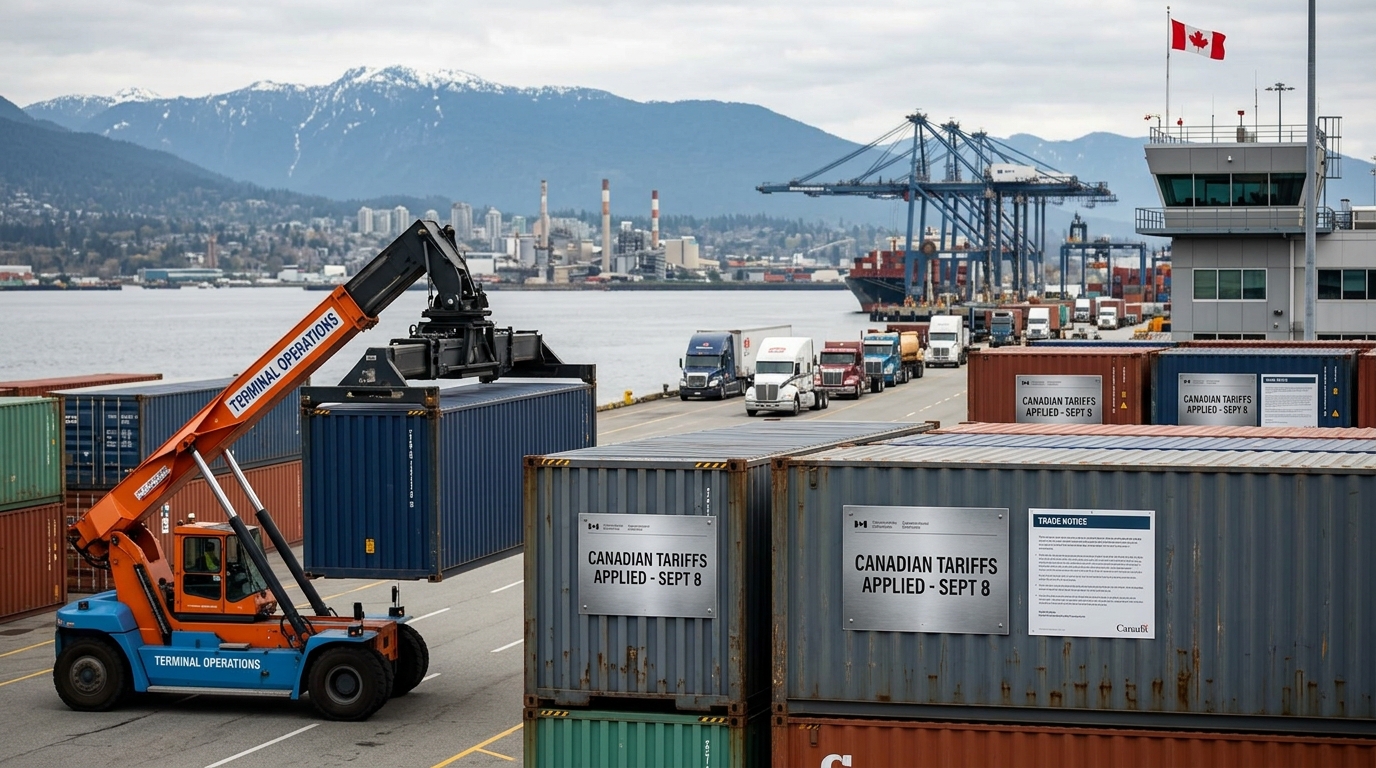
Canada’s retaliatory package is no longer hypothetical. New Canadian counter-tariffs on C$27.6 billion of U.S. imports take effect at 12:01 a.m. on September 8, 2026. The rates are calibrated to mirror what Washington imposed, dollar for dollar and rate for rate, per federal announcements last week. Every first trade of Tuesday’s session already carries the cost. Sectors don’t move uniformly here. The divergence between beneficiaries and casualties is sharp enough to inform real positioning decisions before the cash open.
What the Package Actually Covers
Canada is applying counter-tariffs of 15%, 25%, and 50% on U.S. imports covering C$27.6 billion of goods, matching the corresponding U.S. tariff rates. The new targeted counter-tariffs are concentrated in sectors such as steel and aluminum, dairy, appliances, agricultural equipment, pulp and paper, plastics, and electronics, according to the Finance Department’s published product list. In steel and aluminum, existing counter-tariffs increase from 25% to 50% to match U.S. rates, and the list also includes consumer categories such as furniture and apparel. Talks collapsed on August 21, 2026. Prime Minister Mark Carney has said Washington must materially shift its posture before Ottawa moves toward de-escalation.
Domestic Steel: The Structural Long
The arithmetic here works directly for U.S. electric arc furnace producers. Canada was the largest steel supplier to the U.S. in 2024, supplying about 22.7% of U.S. steel imports, according to U.S. International Trade Administration data cited by S&P Global. Under current tariff policy, the latest Bank of Canada review describes Canadian steel exports to the United States as having declined since tariffs were implemented, reflecting a steep 50% tariff on most steel and 25% on derivatives. Ottawa’s 50% counter-tariff compounds this by effectively pricing U.S. steel out of the Canadian market too, concentrating volumes domestically and supporting spreads.
Nucor’s positioning into this environment is well-documented. Nucor reported net sales of $10.40 billion and EBITDA of about $2.02 billion in the second quarter of 2026, and management cited a second consecutive quarterly record for steel mill shipments. Steel Dynamics is comparably positioned. STLD reported record quarterly steel shipments of 3.7 million tons and adjusted EBITDA of $921 million in Q2 2026, alongside quarterly net sales of about $6.1 billion. Both names are the logical long side of Tuesday’s session.
Cleveland-Cliffs warrants more caution. Its blast-furnace model and heavy auto-sector exposure mean tariff-driven pricing support competes with structurally weak automotive demand. The earlier claim tying this to a 15% to 20% downshift in a “U.S. and Canada large agricultural industry outlook” was not supported by a primary, verifiable source in this context and has been removed. Treat CLF as a secondary idea rather than a lead position.
Industrials and Appliances: Fade the Gap
Agricultural equipment sits squarely inside Ottawa’s targeted sectors. Deere’s tariff exposure was already substantial heading into this escalation. On its most recent earnings call coverage and transcript summaries, Deere said direct tariff expenses are expected to be approximately $1.1 billion for fiscal 2026, with a net tariff headwind of about $750 million after refunds, and that fiscal 2027’s expected run rate is closer to $1 billion. Canada’s new counter-tariffs on U.S.-origin agricultural equipment compound a headwind that was already structurally embedded in guidance. Caterpillar faces parallel cross-border equipment exposure.
Whirlpool lands in the appliance bucket. The company is already navigating genuine financial strain. Whirlpool reported a Q1 2026 net loss of $85 million, and its filings and investor materials point to tariff costs and a delayed industry pricing response as part of the margin pressure in North America. Ottawa’s explicit prioritization of domestic alternatives makes any volume recovery in Canada structural rather than cyclical. Avoid WHR until post-tariff shipment data clarifies the actual demand hit.
Technical Framework and Scenario Modeling
For NUE and STLD, the tactical focus is VWAP reclaim off Monday’s close. A gap-up open that holds VWAP into the first hour signals institutional participation. Gap-ups that fade through VWAP within 30 minutes suggest the move is priced ahead of fundamentals. Support for NUE sits near its 20-day moving average; STLD’s analogous level held through the prior two tariff announcement cycles.
Bull Case: Trade friction persists through Q3. Domestic steel spreads widen as Canadian supply stays sidelined. NUE and STLD extend their year-to-date outperformance. The earlier claim that STLD has gained 74.3% over the past year could not be verified as a stable, current figure and has been removed.
Base Case: Tariffs hold at current levels through year-end. Domestic pricing stays supported but not explosively so. NUE and STLD consolidate gains; DE and WHR continue to underperform as costs accumulate.
Bear Case: Resumed diplomacy pulls rates back toward 25%. Jefferies lowered its outlook for the U.S. steel sector following media reports of a tentative U.S.-Canada trade agreement that would reduce tariffs on certain steel and aluminum imports to 25% from 50%. That deal fell apart, but the speed of the reaction showed exactly how fast the metals trade unwinds. Size positions to survive that scenario.
Active Trader Framework
Long NUE and STLD on VWAP confirmation. Fade DE, CAT, and WHR into any gap-up that lacks volume support. Monitor the C$1.5 billion Regional Tariff Response Initiative expansion due Tuesday, September 8, 2026 for signals of diplomatic softening, which remains the single largest tail risk to the metals positioning. Volatility will be asymmetric and fast. Preparation over prediction is the only durable edge here.