
September 12, 2026
Tuesday’s cloture vote on the CLARITY Act is the last gate before midterms.
Tuesday is not a vote on whether the Digital Asset Market Clarity Act becomes law. It is a vote on whether the Senate is even allowed to discuss it. That distinction matters for positioning, because the gap between clearing cloture and a signed statute is wide, and the market has spent all summer struggling to price that gap correctly.
He went 11-for-11 during the last Fed shock. Another one is about to hit.
In 2022, when the Federal Reserve made its most dramatic pivot in history and the S&P lost nearly 20%, Larry Benedict didn’t lose a single trade.
He knew where the money was going and positioned his readers to profit.
Trump is now installing his own Fed Chair, something Wall Street is already calling a generational shift.
Larry says his readers will be ready for it.
Click here to find out the one ticker he’s positioning in, completely free.
The Gate
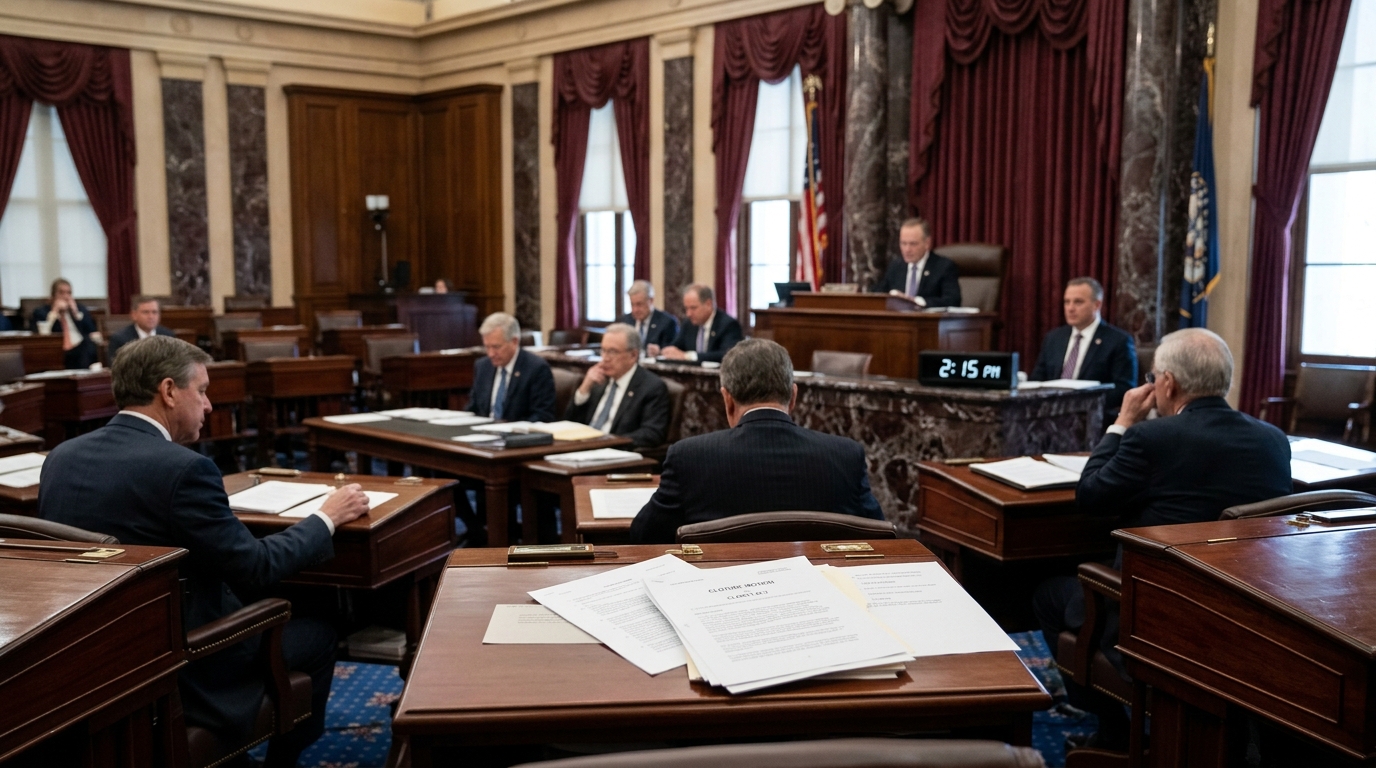
The cloture motion ripens at 2:15 p.m. ET on September 15. Senate Majority Leader John Thune filed it on August 8, just before the chamber left for recess, locking in the procedural clock. Sixty votes are required. Republicans hold 53 seats, which means at least seven Democrats or independents must cross. Stablecoin rewards provisions, ethics disclosures, and the allocation of authority between the SEC and CFTC remain unresolved, and those are exactly the pressure points keeping Democratic votes soft.
Galaxy Research tracked the deterioration in real time: 75% passage odds in May after the Senate Banking Committee’s 15-9 bipartisan vote, then 50% in late June as the calendar tightened, 30% in late July after the 616-page combined text landed without a vote count behind it, and 10% in an August 14 note citing unresolved political disputes and a compressed timeline. Polymarket independently tracked the same path, falling from roughly 82% to around 16% over the same arc. The Motley Fool, citing online prediction markets as of early September, put 2026 passage odds at approximately 20%.
What Coinbase Is Actually Worth at $175
COIN closed Friday at $175.29, a market capitalization of $46.2 billion, against a 52-week range of $139 to $402. The distance from the high reflects both bitcoin’s retreat from its October 2025 all-time high near $126,000 to its current range around $77,000 to $78,000 and the compression in crypto trading revenue. Q2 2026 revenue came in at $1.2 billion, down from $1.5 billion a year earlier, with a net loss of $359.5 million versus a $1.43 billion profit in the year-ago period. Q1 2026 was similarly constrained: $1.4 billion in total revenue and a $394 million GAAP loss, though adjusted EBITDA held positive at $303 million, the 13th consecutive quarter in the black on that measure.
The non-trading build is real. Stablecoin revenue hit $305 million in Q1 on average USDC held in Coinbase products of $19 billion, a new all-time high, with Coinbase capturing roughly 50% of total USDC economics through its Circle revenue-sharing arrangement. Institutional transaction revenue grew 31% year-over-year in Q1 to $185 million, supported by the Deribit derivatives acquisition. Prediction markets scaled to over $100 million in annualized revenue in less than two months. CEO Brian Armstrong has said the company is building what it calls an “everything exchange” spanning crypto, stocks, and commodities, with non-trading revenue positioned as a structural offset to spot crypto cycles. A 48-analyst consensus median price target sits at $400, with Bernstein’s bull case at $510 and Goldman at $235.
Miss These 10 Stocks… Miss the Rally
What are the “Double Engine” stocks for the rest of 2026? Instead of settling for income or growth, these are stocks that deliver both. Our Top 10 Best Stocks to Own in the Second Half of 2026 report includes companies that are the perfect combination of steady payouts and explosive capital appreciation potential – all in one portfolio-ready list. This is how you position ahead of a market tailwind.
The Cascade Into HOOD and CRCL
A failed cloture vote does not hit all three names equally. Circle (CRCL) has the most direct legislative dependency: its stablecoin franchise already operates under the GENIUS Act, but the CLARITY Act would extend that framework to trading venue oversight and clarify the regulatory perimeter around USDC-denominated products. CRCL gained nearly 10% in a single session in late August on optimism around the September 15 date. A failure reverses that premium immediately.
Robinhood (HOOD) has a similar binary profile. The company favors clearer federal rules because they reduce the risk of abrupt regulatory changes and expand the product surface for tokenized assets. A failed vote pushes crypto product expansion timelines out past the midterms and likely past the new Congress.
Scenario Modeling
Bull Case. Cloture clears with 60 or more votes. COIN moves toward the $210-$220 range on multiple expansion and institutional re-rating. CRCL and HOOD follow with 10-15% moves. Bitcoin holds $78,000 and tests $85,000 if institutional capital accelerates. Conditions required: at least seven Democrats vote yes, suggesting backroom agreement on ethics provisions was reached during the recess.
Base Case. Cloture fails narrowly, but Armstrong’s fallback holds: the SEC and CFTC use existing authority to fill the vacuum. COIN stabilizes in the $155-$175 range as markets price agency rulemaking as the slower but still viable path. Galaxy’s 10% odds suggest this outcome is consensus. Bitcoin drifts in the $74,000-$80,000 band through October.
Inside the Nuclear Revival Reshaping Energy Markets
Governments worldwide are investing billions to revive a proven energy source. Supply chains are tightening, demand is rising, and select companies stand to benefit. The Nuclear’s Second Act report explains what’s happening next.
Bear Case. Cloture fails and the FOMC, meeting September 15-16, delivers a hawkish hold or hike signal. The double-header lands simultaneously: legislative failure plus tightening risk sentiment. COIN tests the $139 52-week low. CRCL and HOOD see 15-20% drawdowns. Bitcoin breaks $74,000, where the next structural support on weekly charts sits.
Active Trader Framework
The vote resolves at 2:15 p.m. Tuesday. That creates a defined volatility window. Traders should monitor COIN’s behavior relative to its $171 intraday low from September 11: a hold above that level into the vote signals the market is pricing in at least partial cloture probability. A break below $171 before the vote suggests institutional positioning for failure.
Sector rotation out of AI and into crypto-linked equities was cited by Clear Street analyst Owen Lau as a contributing factor to the late-August COIN and CRCL rallies. That rotation trade unwinds fast on a failed cloture, so watch AI-adjacent flows in the 30 minutes after the gavel drops. Size risk accordingly around the FOMC overlap. Preparation, not prediction, is the discipline this week demands.