September 20, 2026
Bonus Content: Three Sectors Hold the Midterm Trade. Here Is the Scoreboard.
Dear reader,
On June 12th, SpaceX went public.
At $2.1 trillion, it was the biggest IPO in Wall Street history. Bigger than Apple. Bigger than Amazon. Even bigger than the Saudi Aramco listing.
An entire group of millionaires were created overnight.
Dr. Mark Skousen called the SpaceX listing almost to the exact day. Months in advance.
How?
He had the pleasure of meeting Elon Musk face-to-face, at a private gathering of the world’s financial elite. That meeting, combined with his three years inside CIA headquarters analyzing intelligence and spotting patterns, is what allowed him to call the SpaceX listing before almost anyone else on Wall Street.
It’s how he helped 45,000 readers discover a backdoor way into the IPO. An opportunity normally reserved for hedge funds and Wall Street big shots.
Now Dr. Skousen is predicting Elon’s next three moves.
He’s put together a special briefing that lays out exactly what he believes Elon is doing next… and how you could position yourself for the chance at 100% overnight gains, with the potential to 10X your money over the next 12 months.
In short, Dr. Skousen has discovered what he calls Elon’s $2.1 trillion “hit list.”
Because with these three pieces in place, Elon would lock in a monopoly on the entire 21st century space economy. From the raw materials he needs to build his rockets… to the compute that runs his AI… to the satellites that beam his data back to Earth.
Every link in the chain.
Each is a publicly traded company you can buy today.
Good investing,
Rachel Gearhart
Publisher, The Oxford Club
P.S. Elon’s spending spree has already started. He just bought a $40 billion AI firm. And his own power company for another $1 billion. But, according to Dr. Skousen, he’s just getting started. Click here to see what he targets next for the chance at 100% overnight gains.
Three Sectors Hold the Midterm Trade. Here Is the Scoreboard.
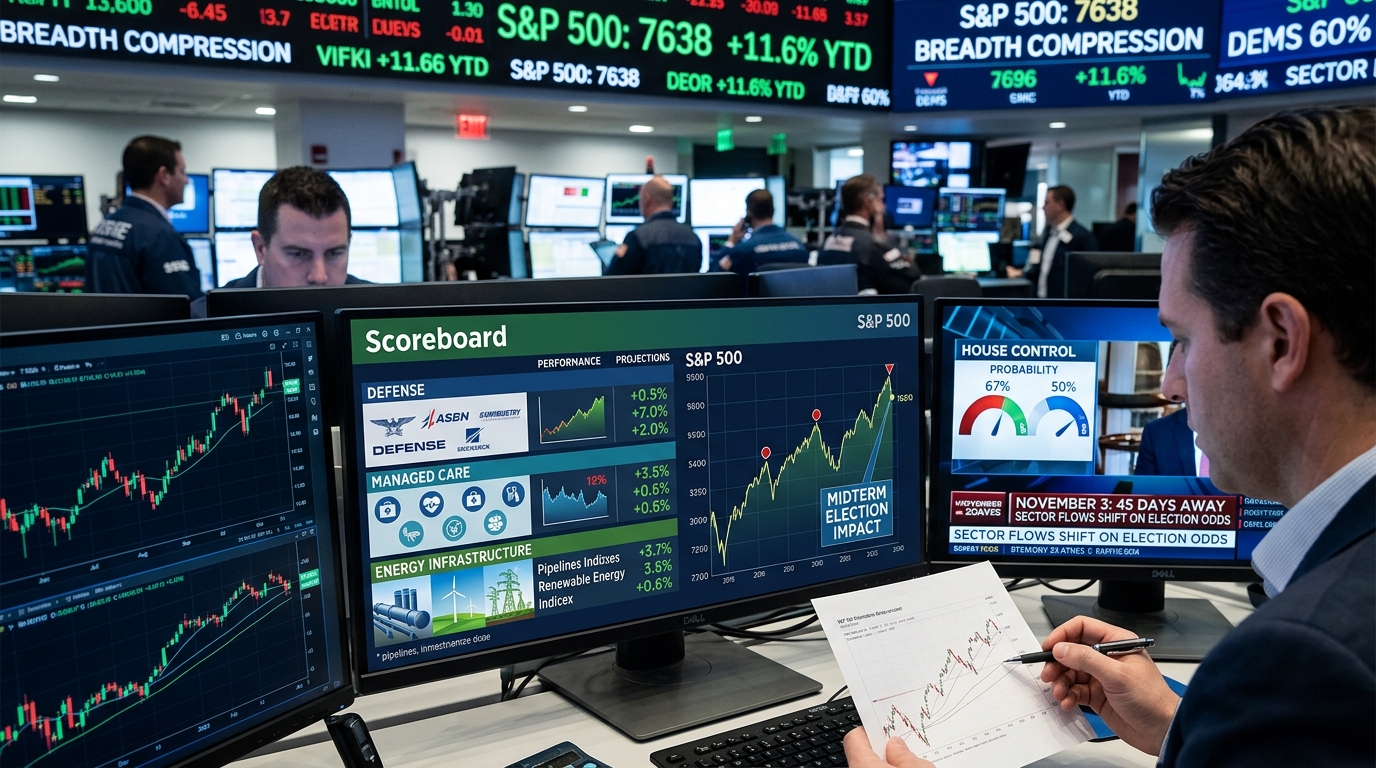
The S&P 500 closed Thursday at 7,638, up roughly 11.6% year to date but sitting with only about 31% of constituents above their 50-day moving average. That breadth compression, combined with a November 3 election date that prediction markets have recently put at roughly 60% odds for Democrats to win both chambers, is reshaping sector flows in real time.
The political math is specific. House control sits at 220 Republicans to 215 Democrats. Democrats need three net seats to flip the chamber. Polymarket has recently priced a Democratic sweep at about 60% probability. That single probability distribution, updated daily, is a key input for sector positioning, but it is also volatile and can move quickly with polling and headlines.
Defense: Bipartisan Contracts, Binary Rhetoric
RTX raised its full-year 2026 revenue guidance to $95-96 billion on Q2 earnings, and its backlog hit a record $289 billion, up 22% year over year. Lockheed Martin posted $65 billion in new Q2 orders. The defense budget for 2026 is roughly $1 trillion, with the Trump administration pushing a $1.5 trillion military budget proposal for 2027.
Here is the midterm-specific point: defense budgets do not contract meaningfully after power shifts. Existing contracts generally stay on the books regardless of which party runs the Appropriations Committee. The midterm risk for LMT and RTX is not cancellation. It is pace. A Democratic House could slow supplemental spending packages and complicate the Golden Dome missile defense program, which the Pentagon has discussed at an estimated $185 billion but which outside estimates have placed far higher over longer horizons. RTX’s analyst consensus target sits near $216, implying roughly 25% upside from recent levels. LMT trades at 16.75x forward earnings with a mean target around $641. Both stocks have rallied on geopolitical demand, and both carry execution risk on the production ramp the administration’s executive orders have emphasized.
Managed Care: The Sector That Votes on Itself
This is where the midterm signal is loudest and most actionable. UnitedHealth Group is down roughly 30% year to date after warning of its first annual revenue decline in more than three decades, tracing directly to OBBBA-driven Medicaid pressure and a near-flat 2027 Medicare Advantage rate update of just 0.09%. Humana fell 22% on that same rate announcement in January. CVS dropped 13.3%.
The midterm variable: ACA subsidy reinstatement remains politically viable before November, and any Democratic House majority would move that immediately. Morgan Stanley Research notes that ACA subsidy reinstatement is a live issue on both sides of the aisle. Historically, healthcare outperformed the S&P 500 by an average of nearly 17% in midterm election years from 1994 to 2024. The XLV is down approximately 5% year to date. That gap between the historical pattern and current performance represents the market pricing maximum policy uncertainty before clarity emerges in forty-five days.
Energy Infrastructure: The Permitting Wildcard
GE Vernova closed near $940 Friday, inside a 52-week range of $530 to $1,196. Management raised 2026 revenue guidance to $45.5-46.5 billion, and the company reported a backlog of $176 billion. Bernstein carries an Outperform rating with a $1,206 target. The CEO told a conference September 16 that 2030-2040 will be “an even better decade” than the current one. Analysts project next-quarter EPS growth of nearly 149% year over year.
The midterm angle here is permitting reform. Energy permitting legislation has stalled repeatedly in divided chambers. A Democratic House would likely make permitting reform harder, potentially constraining GEV’s grid buildout timeline. A Republican Senate holding without the House produces the split Congress scenario (recently around 31% probability on Polymarket), under which Morgan Stanley Research expects defense, technology, and financial services to benefit while energy faces increased scrutiny.
Technical Framework
The S&P 500 fell from a recent high of 7,799 on August 13 to 7,316 on July 29 before recovering. Only 53% of constituents trade above their 200-day moving average, a reading at the 29th percentile historically. The pre-midterm pattern is consistent: markets tend to be subdued in the six weeks before the vote, then begin rallying roughly a month after results. The 10-year Treasury yield has historically fallen 33 basis points on average in the six months before November midterms. This cycle, persistent inflation and Middle East energy pressure have complicated that compression.
Three Scenarios
Bull Case: Democrats take the House, Republicans hold the Senate. Divided government lands. ACA subsidies get reinstated by Q1 2027. Managed care stocks recover 15-20% off current lows. Defense backlogs remain intact. S&P 500 extends toward the 7,850 median Wall Street year-end target.
Base Case: Democratic sweep at about 60% probability gets digested over the next two weeks. Healthcare volatility compresses as traders reduce binary-outcome positioning. GEV and LMT drift sideways into earnings. The S&P 500 holds its 200-day moving average and grinds toward 7,700.
Bear Case: Republicans defy historical patterns and hold both chambers. Medicaid cuts deepen. Medicare Advantage rate pressure accelerates. UNH, HUM, and CVS retest January lows. Energy permitting expands, benefiting GEV, but managed care cannot absorb the policy extension. S&P 500 tests 7,300 support.
Active Trader Considerations
The three sectors that matter most across every scenario are the three described above. Defense holds in all three; the question is magnitude. Managed care is the highest-beta midterm trade, with UNH carrying the largest policy sensitivity. GEV is the cleanest expression of permitting reform direction. Traders should monitor the Polymarket balance-of-power probabilities daily alongside any polling shifts in the 17 Cook Political Report toss-up House districts. Volatility in all three sectors is likely to compress in the final two weeks of October before re-expanding immediately post-election.
The preparation is the same in every scenario: know which levels matter, know what the policy mechanism is, and do not size for certainty when markets are pricing probability. Forty-five days is enough time for one more material polling shift. Position frameworks should reflect that explicitly.