September 28, 2026
Bonus Content: China Cut Tariffs on 1,619 US Farm Products. Soybeans Aren’t One of Them.
Hi Friend,
Just wanted to let you know you can now get a free copy of my new strategy guide here:
How to Master the Retirement Trade [PDF]

What’s the Retirement Trade?
It’s a simple trading opportunity that appears almost every trading day, between 9:30 and 10:45 am EST where traders are making between $300-$1,100+ per contract.
One of my favorite parts about this trade is how predictable it is. It occurs about 3-5 times each week. And once you know what you’re looking for, and how to enter/exit the trade, this could become another nice stream of income for you.
I’m not sure how long I’ll leave this guide up for. So do yourself a favor and take 5 seconds to download it now. At least you’ll have a copy stored for future use!
>> Click Here to Download Your FREE Strategy Guide Now.
To your success,
Dave Aquino
Partner, Head of Options Trading
Base Camp Trading
IMPORTANT NOTICE! No representation is being made that the use of this strategy or any system or trading methodology will generate profits. Past performance is not necessarily indicative of future results. There is substantial risk of loss associated with trading securities and options on equities. Only risk capital should be used to trade. Trading securities is not suitable for everyone. Disclaimer: Futures, Options, and Currency trading all have large potential rewards, but they also have large potential risk. You must be aware of the risks and be willing to accept them in order to invest in these markets. Don’t trade with money you can’t afford to lose. This website is neither a solicitation nor an offer to Buy/Sell futures, options, or currencies. No representation is being made that any account will or is likely to achieve profits or losses similar to those discussed on this web site. The past performance of any trading system or methodology is not necessarily indicative of future results.
CFTC RULE 4.41 – HYPOTHETICAL OR SIMULATED PERFORMANCE RESULTS HAVE CERTAIN LIMITATIONS. UNLIKE AN ACTUAL PERFORMANCE RECORD, SIMULATED RESULTS DO NOT REPRESENT ACTUAL TRADING. ALSO, SINCE THE TRADES HAVE NOT BEEN EXECUTED, THE RESULTS MAY HAVE UNDER-OR-OVER COMPENSATED FOR THE IMPACT, IF ANY, OF CERTAIN MARKET FACTORS, SUCH AS LACK OF LIQUIDITY. SIMULATED TRADING PROGRAMS IN GENERAL ARE ALSO SUBJECT TO THE FACT THAT THEY ARE DESIGNED WITH THE BENEFIT OF HINDSIGHT. NO REPRESENTATION IS BEING MADE THAT ANY ACCOUNT WILL OR IS LIKELY TO ACHIEVE PROFIT OR LOSSES SIMILAR TO THOSE SHOWN.
China Cut Tariffs on 1,619 US Farm Products. Soybeans Aren’t One of Them.
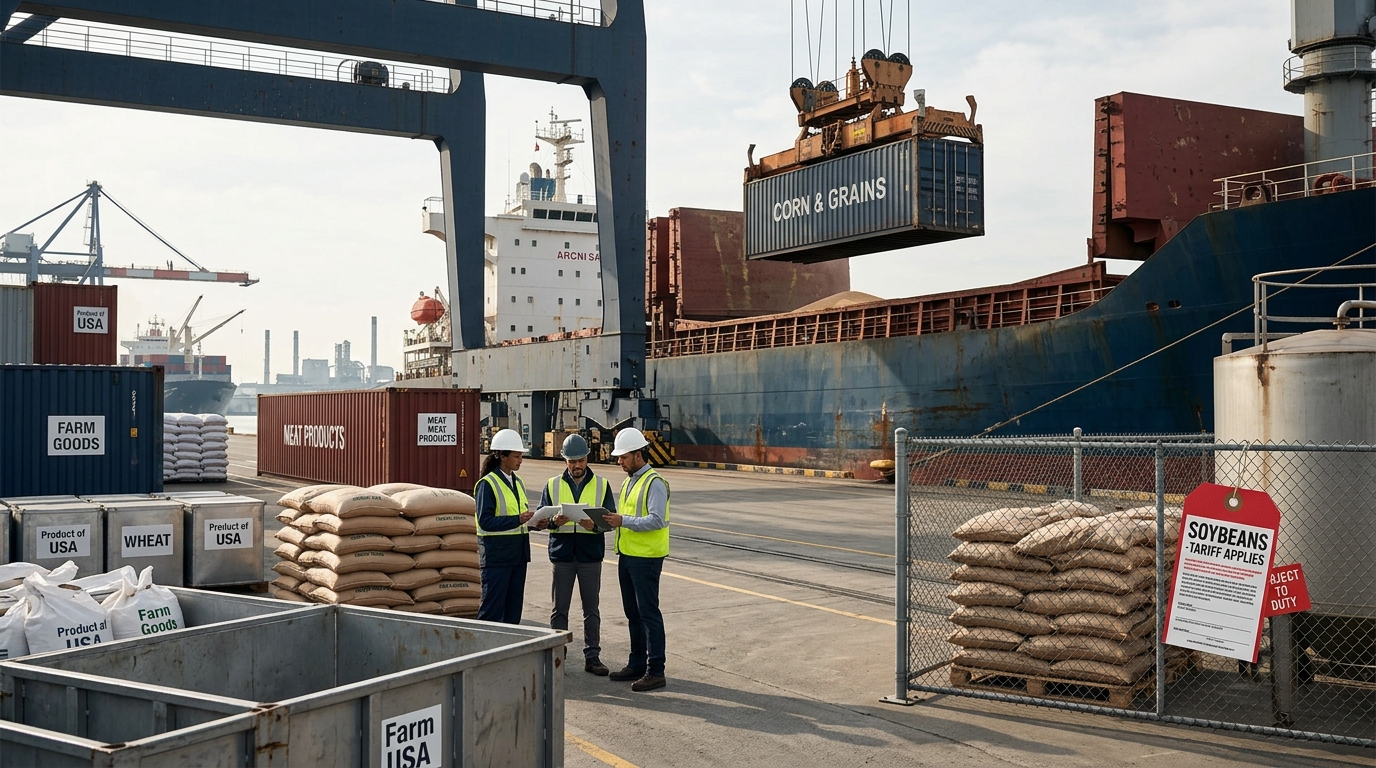
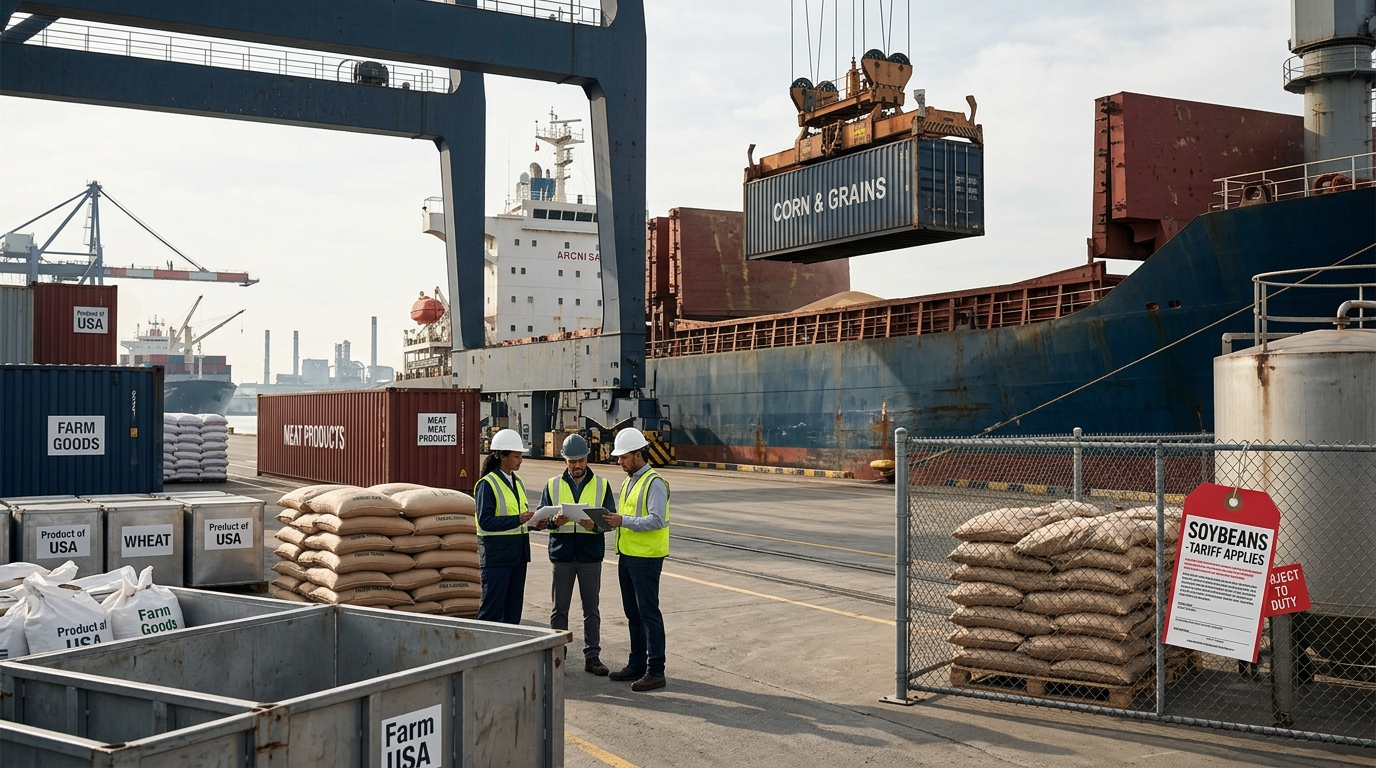
Both governments published the product lists this morning. 1,619 American lines. 77 Chinese ones. The asymmetry alone tells traders something important about where negotiating leverage actually sits.
- China’s Commerce Ministry confirmed more than 90% of covered products will fall to most-favoured-nation rates under the $30bn reciprocal arrangement.
- Corn, wheat, sorghum, soyoil, soymeal, meat, and dairy all made China’s cut list. Whole US soybeans did not.
- US soybeans still carry an extra 10% tariff, a rate traders say is too high for private Chinese crushers to absorb commercially.
- The truce expires January 10, 2027. Every position in this space carries a hard calendar risk.
- ADM trades at roughly $81, near its 52-week high of $85.37. Bunge (BG) at $109 carries a 30.1% consensus analyst target upside, but “Fair Value” estimates vary meaningfully by model and vendor.
- Corteva (CTVA) had baked in ~$80M in tariff headwinds for 2026; any relief on crop-protection inputs is incremental positive that guidance has not fully credited.
The Scoreboard That Matters
Read the 1,619-versus-77 count not as a diplomatic curiosity but as a capital-flow signal. China’s 77 entries cover fireworks, household goods, sporting equipment, and toys, consumer categories, not agricultural inputs. America’s 1,619 entries tilting heavily toward farm commodities confirms where Beijing chose to concentrate its goodwill. The question is whether the specific omissions cancel the headline gains for publicly traded US agriculture names.
For grain merchandisers and oilseed processors, the soybean carve-out is the number that matters. Soybeans are the single largest US agricultural export line to China. Their exclusion means the dominant revenue driver for ADM’s Ag Services and Oilseeds segment and Bunge’s Soybean Processing and Refining unit still faces a structural cost barrier for private Chinese buyers.
Who Actually Gets Relief
Soyoil and soymeal are on the list. That is not nothing. Bunge posted Q2 2026 Total EBIT of $1.06 billion, up $522M year over year, driven precisely by strength in Soybean and Softseed Processing and Refining. If derivative product flows improve, Bunge’s processing margins benefit even without whole-bean tariff relief. The company’s full-year 2026 adjusted EPS guidance of $9.25 to $9.75 was updated on July 29, 2026; any volume acceleration is upside to that range.
ADM’s FY2026 guidance already assumed China resumes a normalized buying pattern for North American soybeans. The soybean exclusion today creates risk that this assumption proves optimistic. Its Q2 net earnings of $908M came in stronger than consensus. The Barclays target sits at $90; Morgan Stanley recently upgraded to Equal Weight at $79. At $81, the stock appears to have priced in the positive trade resolution scenario without full credit to the soybean risk that remains.
Corteva (CTVA) is a different story. Its China exposure runs through crop-protection inputs sourced from China rather than agricultural exports to China. Any tariff relief on those input lines is a margin tailwind for a company already guiding $4.0B to $4.2B in operating EBITDA for 2026, with ~$80M in tariff headwinds embedded in that estimate. Even partial relief is accretive to a business that posted strong earnings and cash flow in 2025.
Technical Framework
ADM has been consolidating below its $85 52-week high. A sustained close above $83 with volume expansion would suggest the market is pricing full tariff normalization. Failure to hold $79, the Morgan Stanley upgrade level, brings the $75 region back into focus. BG’s structure is different: it has already outperformed on processing results, meaning today’s news is more binary. A break below $105 would indicate traders are discounting the soybean exclusion as a structural drag rather than a temporary negotiating tactic.
Scenario Modeling
Bull Case
Soybeans are added to a supplementary list before January 10, 2027. Private Chinese crushers re-engage at scale. ADM tests $90; BG consensus analyst targets around $141 come back into range. Corteva’s tariff headwind shrinks toward zero and the seed and crop-protection separation proceeds with clean financials.
Base Case
Soybeans remain excluded through the January 10, 2027 expiry. State-owned Chinese buyers continue purchasing at committed volumes, but private crusher demand stays suppressed. ADM trades sideways in the $78 to $83 range. BG captures processing upside from soyoil and soymeal flows but cannot fully close the gap to consensus analyst targets. Corteva benefits modestly from input-cost relief.
Bear Case
Truce expires without extension. The additional 10% soybean tariff becomes entrenched. South American suppliers capture share permanently. ADM breaks below $75; BG retraces toward the high-$90s if the market adopts a more conservative intrinsic value view. The January 10 cliff is not a soft deadline, it is the position’s stop.
Active Trader Framework
The derivative products on the list, soyoil, soymeal, are the near-term catalyst for BG and ADM processing margins. Watch those commodity spreads in the coming sessions as the first signal of actual flow change. For CTVA, the relevant monitor is whether today’s list includes Chinese-sourced crop-protection inputs; that determines how much of the ~$80M tariff headwind gets released. Position sizing must reflect the January 10, 2027 binary: this framework has a defined expiry, and vol around that date will be elevated. Preparation over prediction means mapping your levels now, not when the calendar forces the decision.