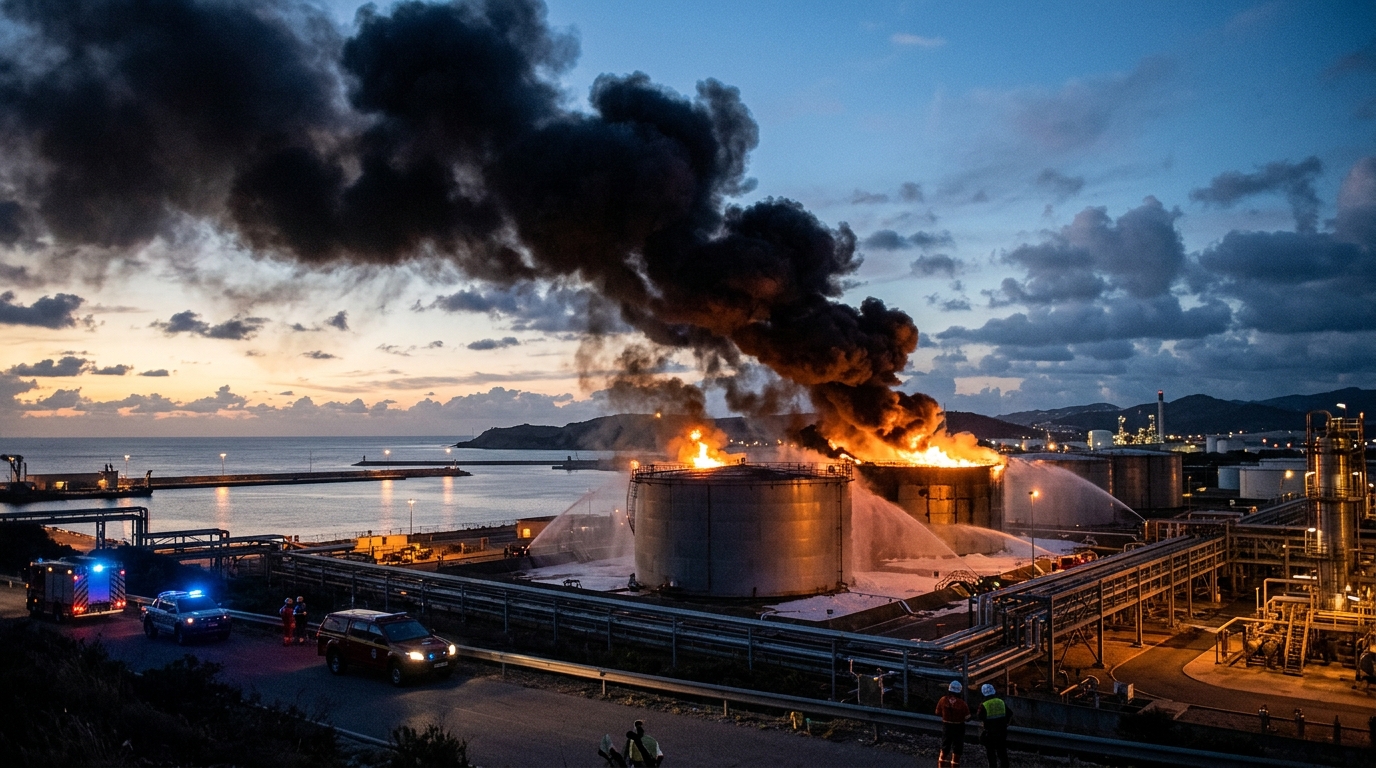
Satellite imagery confirmed it before the European open: crude storage infrastructure at Yanbu’s Al-Mu’ajiz terminal was visibly burning after strikes attributed in regional reporting to Houthi missiles and drones. By 2:51 a.m. ET, Brent November had moved to $107.10, up 1.73% on the session. WTI added 1.58%, reaching $94.06. It was the second straight up day for both benchmarks.
The timing is what makes this structurally different from earlier Houthi strikes. Saudi Arabia had only just restored East-West pipeline export flows, with overseas shipments via the line resuming and volumes reaching about 3.5 million barrels per day by September 28, as reported by Bloomberg. The pipeline, which bypasses the Strait of Hormuz to the Red Sea port of Yanbu, was still ramping after drone strikes earlier in September forced a shutdown. Based on late-September estimates cited in that Bloomberg reporting, full capacity restoration could still take six to eight weeks. That recovery timetable now has a new risk premium attached to it.
Why Yanbu Is the Swing Variable
Hormuz gets the headlines. Yanbu is where the physical barrel actually clears. Since the U.S.-Israeli war on Iran disrupted Gulf flows, Riyadh had rerouted roughly 4 million barrels per day, about 4% of global supply, through the East-West pipeline to Yanbu’s Red Sea loading berths. France’s president said on September 24 that France would deploy troops and air defense assets to help protect Yanbu. Pakistan and Türkiye have held military chiefs’ talks under the Makkah Joint Defence Agreement framework in late September. None of that deterred the latest strike.
The crude curve is reflecting the urgency. Brent’s backwardation, already established through the summer, typically steepens when a physical loading hub is compromised. By the end of July, global observed oil inventories had fallen by about 410 million barrels from end-February levels, a draw that oil-market reporting tied to sustained supply disruption and constrained shipping. Prompt tightness was priced before the fires. Today’s move widens that premium further.
Three Expressions of the Trade
The crude curve itself. A supply disruption at the export terminus, rather than at the wellhead, compresses physical availability immediately. Roll yield on long front-month positions improves when backwardation steepens. Traders positioned in November Brent versus March 2027 are watching whether the spread widens from current levels, which would confirm physical tightness rather than a sentiment move.
Tanker equities. Route disruption is not uniformly bearish for crude carriers. Longer haul voyages around the Cape of Good Hope, substituting for blocked Red Sea transit, consume more vessel-days per cargo and tighten effective VLCC supply. DHT Holdings secured a three-year time charter for the DHT Panther at $100,000 per day commencing October 2026, and it has also disclosed a three-year time charter for DHT Jaguar at $75,000 per day starting in September 2026. In its Q2 2026 reporting, DHT posted net profit of $198.3 million with spot VLCCs earning $162,600 per day. Frontline’s annual reporting shows that, as of December 31, 2025, it had 41 VLCCs and 21 Suezmax tankers. Any sustained re-routing of Saudi barrels away from Yanbu supports that rate floor.
Refining margins. Crack spreads remain the most direct expression of the supply-shock trade in the downstream. The WTI 3-2-1 crack spread was near $59/bbl into late September pricing, after a sharp year-to-date expansion. Marathon Petroleum (MPC) reached $424.07 and Valero (VLO) $413.09 in the most recent refiner weekly. The S&P 500 Oil and Gas Refining and Marketing sub-industry group gained over 100% in 2026, though it was also trading 41% above its 150-day moving average as of mid-August, a level that historically preceded negative six-month returns. Supply disruption extends the duration of elevated margins, but the entry on refiner equities at current valuations carries significant mean-reversion risk if any geopolitical catalyst resolves.
Technical Framework
Brent November broke above the $105 consolidation zone established after the late-September pipeline restart. The $107 level is now the first test: a close above it on meaningful volume confirms the breakout structure. Pullbacks into the $104.50 to $105.50 range represent the prior support zone converted to demand. The 20-day moving average for front-month Brent sat near $100 before today’s session. Momentum is extended on shorter-term indicators, which does not negate the move but argues for staged entries rather than full commitment at the open.
Scenario Modeling
Bull case: Saudi authorities confirm material damage at Al-Mu’ajiz, pipeline throughput is curtailed again, and France’s deployment proves insufficient to prevent further strikes. Brent trades toward $112 to $115 as the market prices a sustained export shortfall. Tanker rates spike. Crack spreads re-accelerate.
Base case: Satellite imagery shows contained storage-area damage. The pipeline continues ramping and absorbs the disruption. Brent consolidates between $105 and $110 for several sessions as the market balances confirmed damage against the ongoing geopolitical risk premium. Refiner margins hold at current elevated levels without a new leg higher.
Bear case: Rapid Houthi ceasefire or credible deterrence from the French deployment removes the risk premium. Pipeline flows return toward higher utilization faster than expected. Iran-U.S. diplomatic contacts discussed publicly around the UN General Assembly sessions produce a surprise signal on easing Hormuz constraints. Brent retraces sharply toward $95 to $97. Crack spreads compress. Refiner equities, already extended, correct hard.
Active Trader Framework
This is a geopolitical event with a physical basis, not a rumor-driven spike. Confirmed satellite imagery of burning infrastructure at a named terminal carries more persistence than a headline without physical corroboration. That said, position sizing matters: the $107 level has not been held intraday, and the Brent move is already 1.73% off the prior close.
Key levels to monitor: $109.50 as a near-term Brent target in the bull case, $104.50 as the pullback zone, and $97 as the level that would signal broader risk-off reversal. For tanker names, watch daily spot rate postings from the Baltic Exchange for VLCCs on the Yanbu-Asia route. For refiners, the 3-2-1 crack spread is the lead indicator. A crack above $65/bbl would extend the refiner trade. Below $55/bbl and the mean-reversion thesis accelerates.
The market is pricing a supply-route event. Position discipline and scenario awareness, not conviction alone, determine whether today’s move is an opportunity or a trap.