
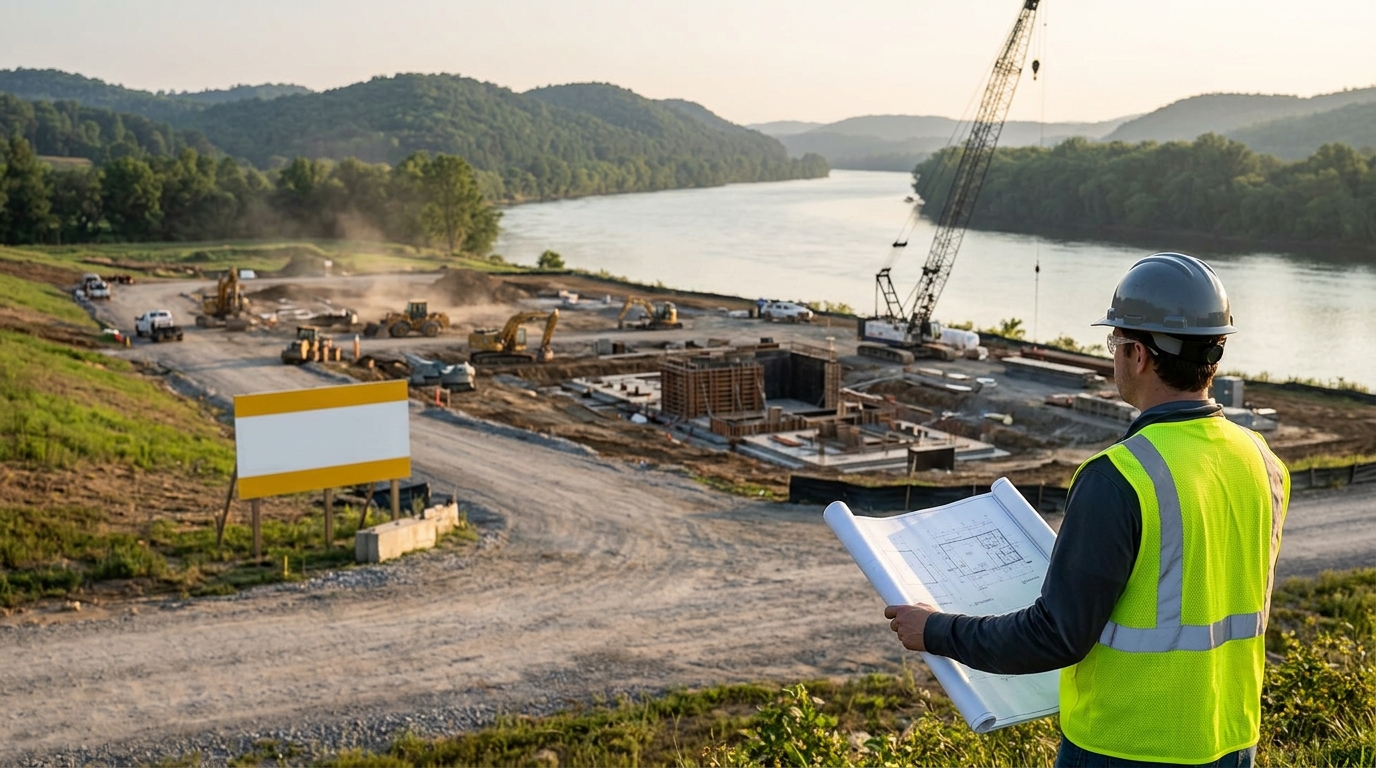
On September 29, 2026, the Nuclear Regulatory Commission did something it had never done before: it approved a construction permit for the Tennessee Valley Authority to build what the NRC described as the nation’s first commercial small modular reactor at its Clinch River site in Roane County, Tennessee, near Oak Ridge. TVA plans to build a 300-megawatt GE Vernova Hitachi BWRX-300 boiling-water reactor. That approval is real. The electrons are not.
Active traders watching the SMR-to-data-center trade need to separate the regulatory milestone from the revenue event, because those two things sit years apart on the calendar.
The Gate That Just Opened, and the Gates Still Closed
A construction permit is step one of a two-step federal process. Before loading fuel and starting operations, TVA will need a separate operating license from the NRC. That operating license application will require its own safety review, environmental clearances, and a public hearing process. The NRC completed its Clinch River safety evaluation in June 2026 before issuing the permit in September. A similar sequence awaits the operating license, meaning no power flows until the 2030s at the earliest for TVA.
The broader pipeline carries its own gating events. The NRC’s Part 53 framework for advanced reactors is now on the books, but it is still early in its practical rollout, and most near-term projects remain anchored to the existing Part 50/Part 52 playbook and project-specific licensing strategies. The U.S. ADVANCE Act, signed in July 2024, is intended to improve NRC efficiency and timeliness, but the market should still treat schedule compression as an outcome to be demonstrated, not assumed.
What Hyperscalers Have Actually Contracted
Across 13 deals tracked through May 2026, the four major U.S. hyperscalers have been reported as committing roughly 9.8 GW of nuclear capacity tied to AI data center infrastructure. Those commitments are forward-start contracts, not delivery receipts. Amazon and Talen Energy have described a “front-of-the-meter” arrangement tied to the Susquehanna nuclear plant, but the companies said the transition from the existing co-located structure is expected after transmission reconfigurations targeted for spring 2026, not as an SMR-driven, already-online June 2025 milestone.
The first SMR-adjacent, data-center-linked electrons in this cohort are more plausibly a 2030-era story than a 2026 story. Google, Kairos Power, and TVA have said Kairos’ Hermes 2 plant in Oak Ridge is intended to deliver up to 50 MW to the TVA grid that powers Google data centers in Tennessee and Alabama, with a goal to bring advanced nuclear capacity online by 2035. Hermes 2 already has NRC construction permits, but any power production still depends on completing construction and securing operating authority.
Scenario Modeling
Bull Case: Part 53 becomes a usable, repeatable pathway in real projects, and NRC review durations for operating authority compress meaningfully versus recent norms. Kairos’ Hermes 2 and TVA’s Clinch River both hit first power in the early 2030s. SMR-linked equities re-rate on demonstrated delivery.
Base Case: The first U.S. SMRs serving commercial technology loads come online around 2030, but primarily as pilot deployments. Operating-license work streams still take multiple quarters and remain vulnerable to hearings, data requests, and supply-chain realities. Hyperscaler contracts begin generating revenue in tranches through 2032 to 2035.
Bear Case: First-of-a-kind economics repeat the pattern seen in NuScale’s cancelled Carbon Free Power Project, where public cost estimates rose to roughly $9.3 billion before termination in November 2023. Cost overruns on Clinch River or other first-wave projects trigger renegotiations, pushing first commercial SMR data center power past 2035 and compressing valuations on SMR-exposed names.
What Traders Are Monitoring
The construction permit issued September 29 is the most concrete SMR regulatory action in U.S. history. It is not a power-on event. Position sizing in SMR-adjacent equities should reflect that the operating license, fuel loading authorization, and grid interconnection agreements each represent independent binary events, any one of which can slip. For the next hard catalyst, watch X-energy’s Seadrift construction permit track, where the company has described an NRC review timeline running through late 2026, with construction-permit issuance discussed as a 2027 event, rather than a guaranteed operating license decision in late 2026.