October 7, 2026
Bonus Content: Fertilizer Hit $1,124 a Ton. Smart Nitrogen Attachments Are Eating That Cost.
Dear Reader,
You check your balance.
But how closely do you follow the systems behind it?
Four federal information collections touch bank deposits, financial customer-data security, securities-market activity and institutional trade settlement.
Each has a public-comment window closing October 26, 2026.
That gives you a specific reason to look beyond your account statement.
Start with what the proceedings actually cover.
Then watch a public FDIC discussion about explaining the resolution of major financial institutions while maintaining public confidence.
It includes a remark from former Goldman Sachs president Gary Cohn that deserves to be heard in context.
We’ve brought those materials together with our bank-branch closing counter so you can examine the details yourself.
See what the public can comment on before October 26.
Bill Brocius
Author of The Vanishing Dollar and Digital Dollar Exposed
Dedollarize News
Fertilizer Hit $1,124 a Ton. Smart Nitrogen Attachments Are Eating That Cost.
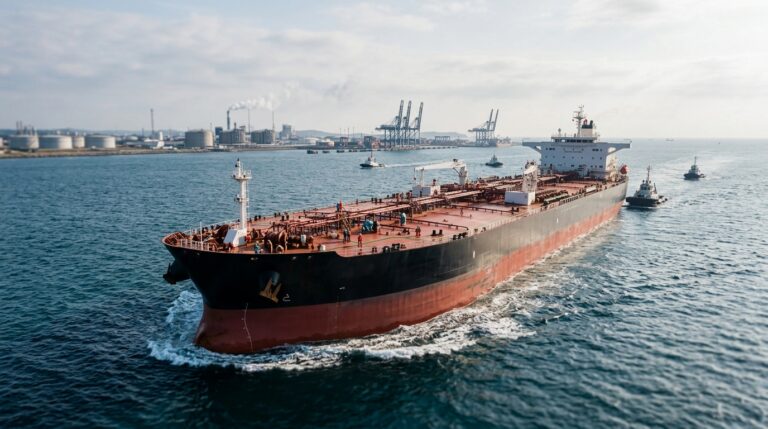
Anhydrous ammonia crossed $1,124 per ton in Illinois by mid-April 2026, up from roughly the high-$800s per ton in the weeks before conflict near the Strait of Hormuz disrupted global shipping lanes. That single choke point matters for nitrogen because major Gulf-based suppliers are effectively locked in when transit is restricted. For a 5,000-acre corn operation, where fertilizer can run roughly one-fifth of total per-acre production costs in typical years, the swing is not an abstraction: it is six figures of lost margin.
The attachment manufacturers are where traders should look next. The core trade is straightforward: when nitrogen volatility becomes structurally elevated, the return on precision application hardware compresses payback periods sharply. A 2025 precision-ag benefits report released by the Association of Equipment Manufacturers, with Kearney involved in the analysis, put the average benefit at an 8% reduction in fertilizer use across farms deploying precision technology. Applied to a 5,000-acre operation at current nitrogen prices, that eight percent is worth roughly $100,000 annually.
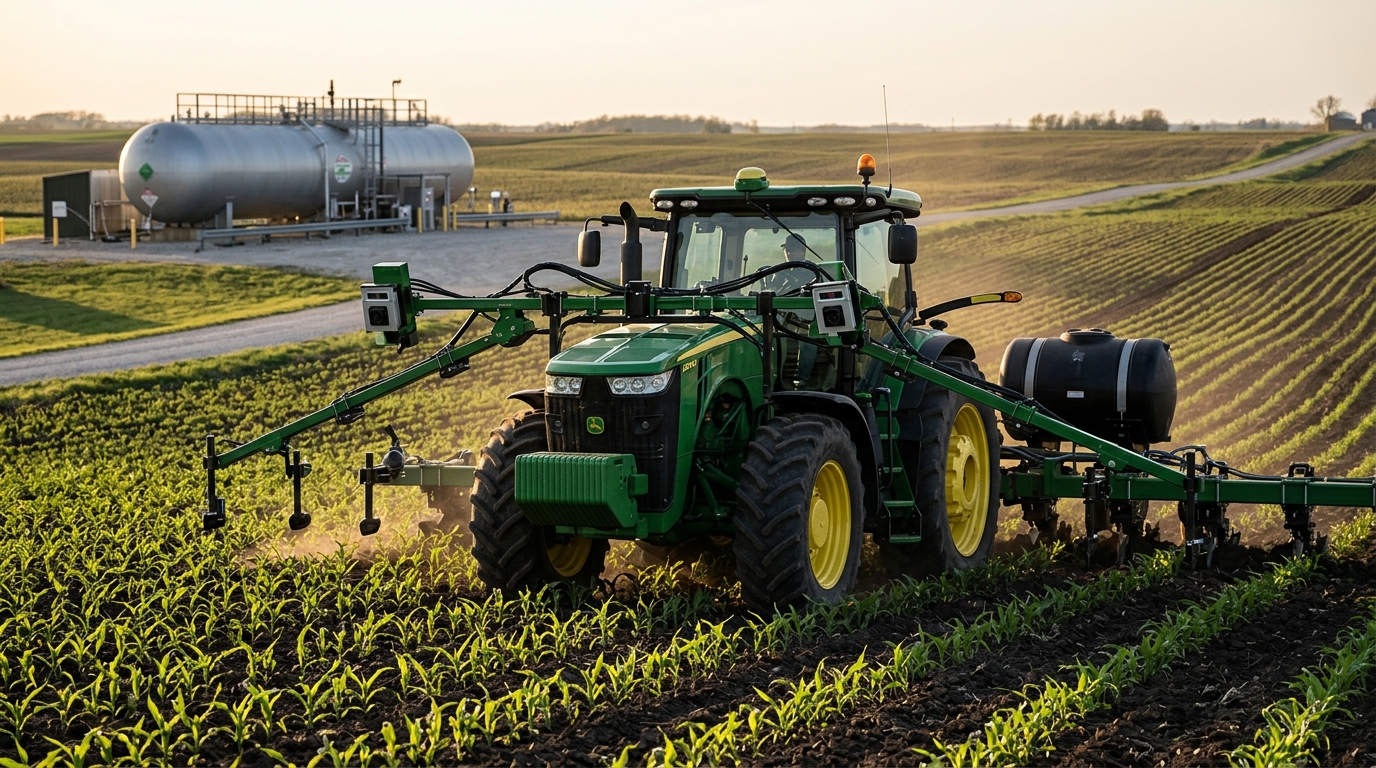
The more aggressive data comes from peer-reviewed field research. A meta-analysis published in September 2026 covering 235 paired comparisons found that optical sensor-guided variable-rate application reduced total nitrogen rates by 18%, boosted nitrogen-use efficiency by 22%, and generated a 6% profit gain without any yield penalty. Tractor-mounted canopy sensors, which measure crop light reflectance at operating speed, sit at the center of this shift. Yara’s N-Sensor adjusts fertilizer rates in real time based on biomass density rather than static prescription maps.
John Deere’s ExactShot system offers a sharper data point for the attachment economics: up to 60% savings on in-furrow nutrient input costs by delivering starter fertilizer directly onto the seed rather than applying a continuous stream in the furrow. The ExactRate liquid fertilizer system adds row-by-row control at planting speeds, integrating with Deere displays. These are upgrade paths rather than full machine replacements, which changes the capital equation for operators already carrying equipment debt.
USDA expects total U.S. fertilizer spending to rise $5.3 billion, or 15.3%, in 2026 versus 2025. The structural volatility has not resolved: industry analysts have recently described Europe’s nitrogen output as running at about three-quarters of normal capacity since early 2022, and market commentary has continued to flag limited Chinese urea exports tied to domestic supply priorities.
Sector and Stock Framework
Publicly traded precision ag exposure runs through John Deere, CNH Industrial, and AGCO, all of which embed variable-rate capability across their platforms. The attachment and sensor layer is fragmented: Yara competes alongside a cluster of manufacturers that build ISOBUS-compatible controllers. John Deere’s Operations Center and AGCO Fuse serve as the data aggregation layer where prescription maps execute. At 2025–2026 input prices, precision application systems on row-crop operations above a few thousand acres often pencil to a two- to three-year payback window.
Scenario Modeling
Bull case: Nitrogen prices hold near $945 per ton for anhydrous through spring 2027 planting. Payback periods fall below 18 months on 3,000-plus-acre operations. Dealer channel volumes for retrofit attachment packages accelerate. AGCO and Deere see margin expansion in their precision technology segments.
Base case: Nitrogen retreats modestly but stays well above pre-2022 norms. Attachment adoption grows steadily at single-digit annual rates. Farm ROI on sensor systems remains positive but not compelling enough to drive rapid channel pull-through below 2,000 acres.
Bear case: Hormuz tensions ease, Chinese exports normalize, and anhydrous drops back toward $700 per ton. The urgency premium on precision hardware fades. Attachment sales revert to trend, and the near-term catalyst for precision nitrogen stocks disappears.
Active Trader Framework
Monitor anhydrous ammonia futures where available and USDA’s Agricultural Marketing Service price reporting for the Illinois benchmark. A sustained hold above $1,000 per ton into fall 2026 is the confirmation signal that farm-level demand for attachment retrofits remains acute. Watch John Deere’s fiscal Q4 earnings for precision technology results as a proxy. Relative strength in AGCO versus the broader industrial machinery group is a secondary tell. Position sizing should account for the binary risk embedded in any Hormuz resolution: the trade in precision ag hardware has a geopolitical tail that tightens the risk framework considerably.