
October 10, 2026
Bonus Content: Old Oil Wells Are Powering AI Data Centers
Dear Friend,
Every Tesla built in the last decade.
Every Starlink dish.
Every AI satellite Elon sends up.
One small company gets paid on all of it.
Elon’s been paying them since 2012.
When NVIDIA tried to buy them, Elon fought the deal.
Now he’s filed for 1,000,000 satellites.
That could mean a 100X bigger bill.
Dylan believes this stock takes off October 24th.
See Elon’s 100X AI stock here >>
The Buck Stops Here,
Kelly Maguire
Behind the Markets
Old Oil Wells Are Powering AI Data Centers
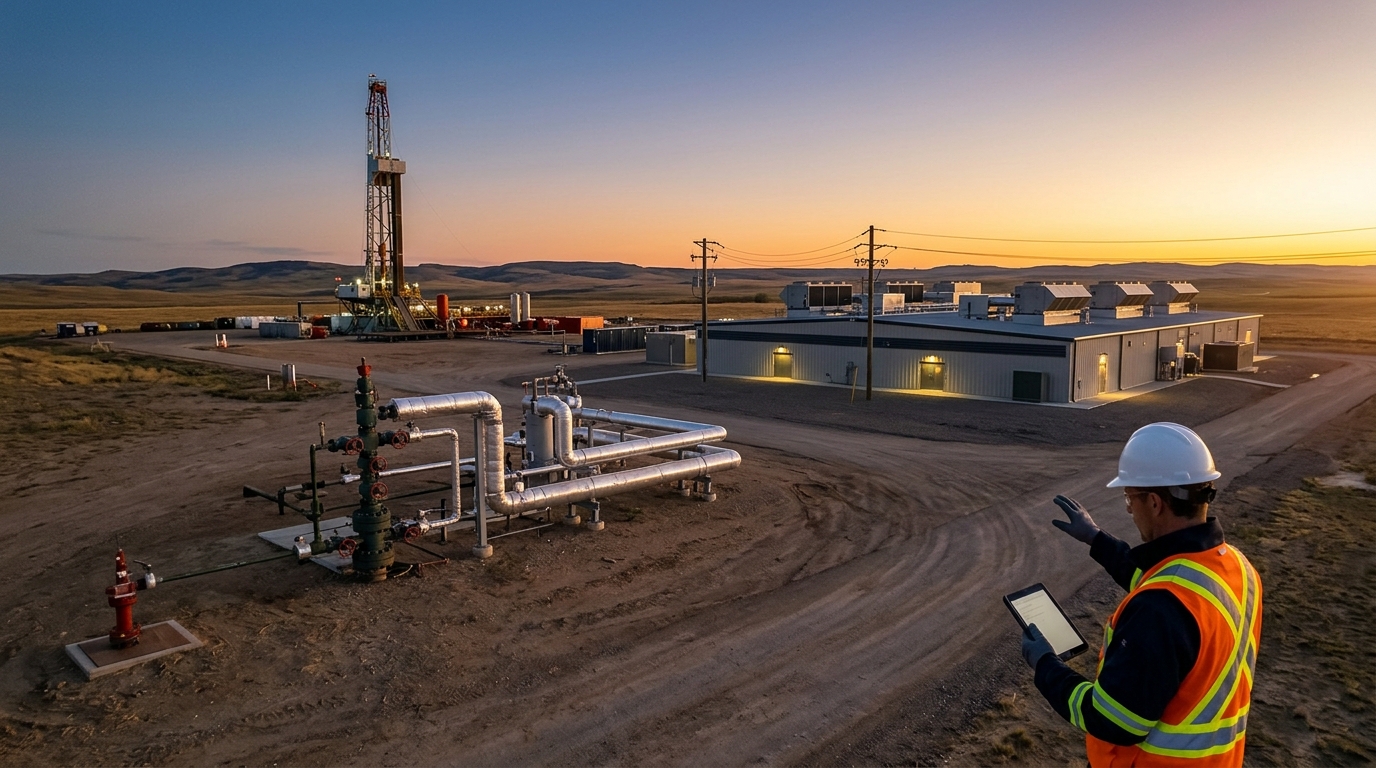
The geothermal story has always had a structural flaw: it worked only where the earth cooperated. That constraint is dissolving. The same horizontal drilling and hydraulic-stimulation techniques that unlocked the shale boom are now being applied to deep-granite reservoirs, converting legacy liabilities into 24/7 carbon-free power co-located next to the data centers burning it.
- Fervo Energy (FRVO) priced its IPO at $27/share on May 12, 2026, raising $1.89 billion, and began trading May 13, 2026 under the ticker “FRVO.”
- Cape Station Phase I, an approximately 100 MW installation, drilled its fastest well in 21 days, a roughly 70% reduction versus Fervo’s first commercial horizontal well at Project Red in 2022.
- Ormat Technologies (ORA) raised full-year 2026 revenue guidance to $1.15–1.20 billion after Q2 revenue of $258.8 million, up 10.6% year-over-year.
- Fervo disclosed a Geothermal Framework Agreement with Google for up to 3 GW of capacity through December 31, 2033. Separately, Ormat signed a portfolio PPA with NV Energy for up to 150 MW of new geothermal capacity to support Google’s Nevada operations, with projects expected online from 2028 to 2030.
- The USGS’s 2026 United States Documented Orphaned Well Database counts 130,121 unplugged orphaned oil and gas wells across 28 states.
- Meta and XGS Energy announced an agreement supporting development of 150 MW of next-generation geothermal in New Mexico.
Why This Moment Is Different
Geothermal’s commercial problem was always cost, not physics. Drilling accounts for 40% to 70% of a project’s total capital. That made each well a high-stakes bet with uncertain geology. The shale industry solved this by industrializing subsurface drilling: standardized bits, pad drilling, real-time data analytics. Fervo transferred the playbook directly. From 2022 to 2025, Fervo’s IPO filing said drilling times fell by approximately 75% and per-foot drilling costs fell by approximately 70%. The company has also said it drilled a Cape Station well to total depth in 21 days.
The abandoned-well angle can tighten the economics further, but it is still more promise than bankable baseload at hyperscale. Many unplugged orphaned wells are not suitable candidates for conversion, and many repurposing concepts depend on site-specific casing condition, temperature gradient, and permitting. Treat conversion cost ranges and LCOE deltas as project-specific rather than universal, and anchor diligence on actual developer EPC budgets and utility interconnection terms.
The Stocks That Move With This
Ormat (ORA) is a profitable, vertically integrated pure-play in public markets. In Q2 2026, its Electricity segment generated $169.3 million in revenue, up 5.8% year-over-year. The Google-focused NV Energy portfolio PPA (up to 150 MW) is expected to come online across multiple projects from 2028 to 2030. Valuation still depends on execution, commissioning timelines, and how quickly new-build capacity converts from announcement to rate base and contracted cash flow.
Fervo (FRVO) is the higher-beta read. Reuters reported the IPO implied a valuation of roughly $7.66 billion at the offer price. Trading data show the stock closed at $36.54 on its first session (May 13, 2026), about 35% above the $27 offer, but it subsequently traded well below that early peak. The company has disclosed a Geothermal Framework Agreement with Google (up to 3 GW through 2033), and a separate 396 MW PPA with Google tied to Cape Station, with an expansion option that could lift contracted capacity at the site substantially if exercised. The core question remains construction execution and whether learning-curve gains persist as drilling moves into new pads and designs.
Scenario Framework
Bull Case. Cape Station Phase I reaches commercial operation on schedule, and Phase II drilling stays on the steep part of the learning curve. Cost per installed kilowatt trends toward management’s longer-run targets as the design standardizes. Ormat converts additional data center-linked PPAs into commissioned megawatts on the 2028 to 2030 timeline. ORA’s multiple holds or expands on upward revisions. FRVO reclaims and holds its early-post-IPO highs.
Base Case. Phase I runs close to plan, but Phase II schedules and costs move in ranges typical for first-of-kind buildouts. Drilling efficiency gains continue but slow as operational complexity rises. Data center offtake demand remains strong, keeping contract pipelines active. ORA holds guidance and trades in a range. FRVO consolidates as the market waits for sustained operating cash flow proof points.
Bear Case. Subsurface variability interrupts the learning curve and stretches commissioning timelines. EGS stimulation execution proves harder than modeled in new rock types and thermal regimes. Competing firm-power options win incremental hyperscaler load. FRVO trades below its $27 IPO price. ORA de-rates on slower-than-expected megawatt additions and EBITDA revisions.
Active Trader Framework
The FRVO chart has limited history for technical levels, so position sizing matters more than entry precision. Monitor Cape Station construction updates and any DOE milestone announcements as potential catalysts. For ORA, the next earnings release is the next fundamental inflection. Watch whether management narrows or widens the $1.15–1.20 billion 2026 revenue guidance range and what language surrounds next-generation geothermal pilot progress. The timing and scope of the Google-linked NV Energy portfolio PPA is a line item that can move expectations. Neither position is low-volatility. Both carry construction, interconnection, and permitting risk that no technical level can hedge. Size accordingly, and define the risk before the trade.