
Most defense contractors dream of a backlog that covers a year or two of sales. Lockheed Martin is sitting on roughly 3.6 years’ worth at current revenue run rates. That gap between what the market prices today and what the order book implies for the next several years is the central question for anyone looking at LMT right now.
Third-quarter 2026 sales rose 11% to $20.7 billion. Net earnings climbed 14% to $1.8 billion, or $7.97 per share. EPS of $7.97 beat the analyst consensus of $7.52, while revenue of $20.7 billion exceeded the roughly $20.48 billion consensus cited by several market data services. Those are clean numbers. What makes them more than a one-day story is what is sitting behind them.
The PAC-3 Contract Changes the Scale
Backlog reached $292.0 billion, up 27% since the second quarter, including $52.5 billion associated with a multi-year award to produce PAC-3 Missile Segment Enhancement (MSE) interceptors. That is a big step-change in visibility, even before you get into what it implies for missile production capacity. To put the PAC-3 piece in context: the U.S. government award was described as a seven-year undefinitized contract action modification for up to $53.86 billion, with Lockheed framing it as enabling a major production ramp through the end of the decade.
The expansion follows Lockheed’s stated intent to surge PAC-3 MSE production and triple capacity by the end of 2030. That is not a capacity bump. It is a structural rebuild of the production base.
F-35 Adds Another Layer
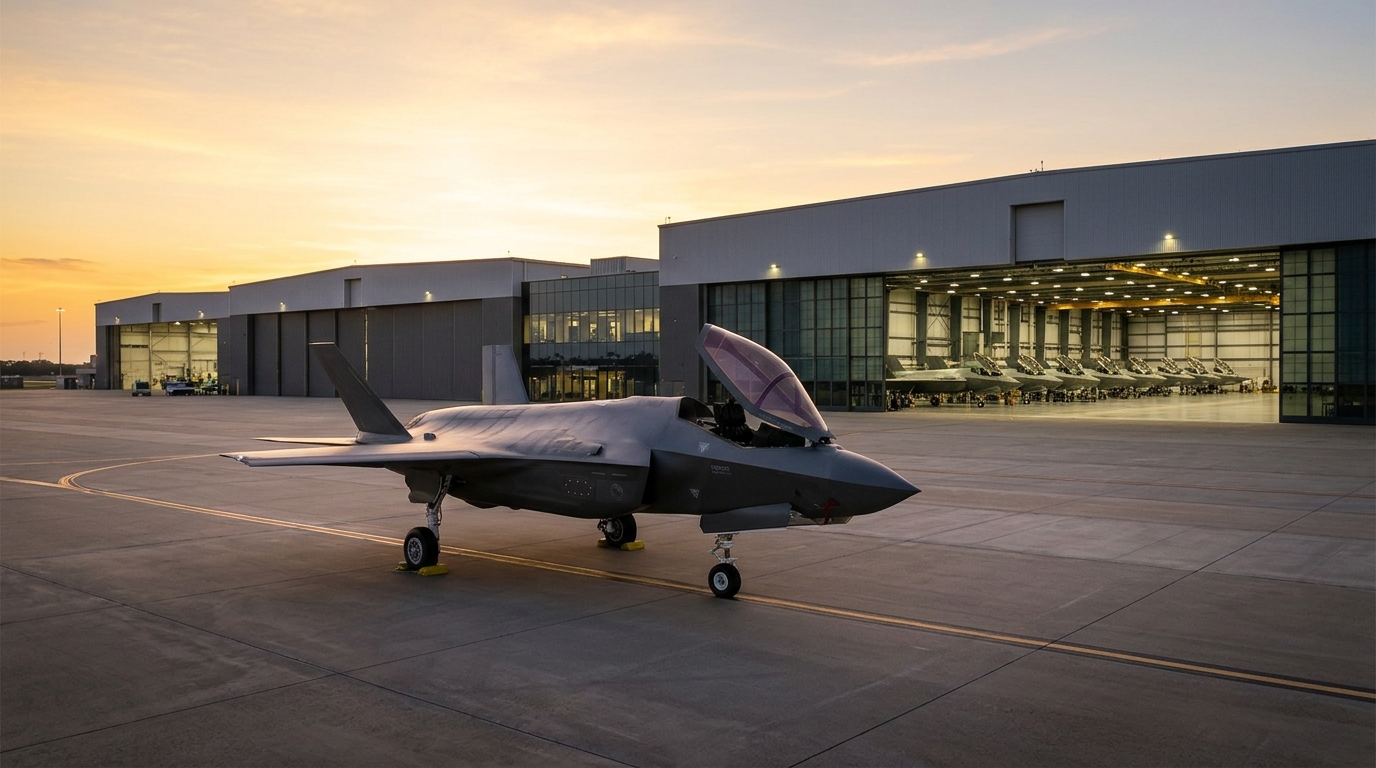
On the same day earnings dropped, a separate announcement amplified the duration argument. The Pentagon and Lockheed unveiled a framework agreement for multiyear F-35 production and sustainment covering 850 U.S. aircraft over 10 years, with associated initial spares, 10 years of modification kits and sustainment, and international customer orders across Lots 21 through 30, at a continued production rate of 156 aircraft per year. In exchange for the decade-long commitment, Lockheed will self-fund at least $7 billion in initiatives supporting the F-35 program. The total cost was not disclosed, and execution remains subject to congressional authorization and appropriations. The framework is a floor, not a signed check. But for a program that is a major driver of Aeronautics segment sales, locking in a decade of production intent is significant.
Cash and Guidance
Free cash flow reached $3.0 billion in the quarter, bringing the year-to-date total to $5.6 billion. The company raised its 2026 outlook to approximately $80 to $82 billion in sales, $30.35 to $30.75 in diluted EPS, and $7.8 to $8.0 billion in free cash flow. This is the second consecutive quarter Lockheed has raised its financial guidance. The company also said it raised its dividend for the 24th year in a row.
Bull Case and Bear Case
The bull case is straightforward: a $292 billion backlog provides revenue visibility that most industrial companies can only approximate, and PAC-3 demand is geopolitical rather than cyclical. A backlog of this size gives Lockheed substantial visibility into future performance, with much of next year’s work already under contract, providing a strong foundation regardless of how near-term budgets unfold.
The bear case centers on execution and funding risk. The F-35 framework still requires congressional action. The PAC-3 award is described by the company as an undefinitized contract action, which means final terms and pricing still need to be completed. Lockheed ended the quarter with $5.96 billion in cash and $20.5 billion in long-term debt, a leverage position that bears watching if production ramp costs run high. Segment operating margin of 10.8% is thin for the scale of capital being deployed.
What to Watch
Three things will determine whether the thesis holds: the pace of the PAC-3 production ramp and whether capacity expansion stays on schedule; congressional action on the F-35 multiyear; and free cash flow conversion as capital expenditure rises to support both programs. LMT shares gained about 7% in Thursday’s regular session after the earnings beat and raised guidance. At roughly 19 times trailing earnings, the stock is cheaper than peer RTX’s 27 times, per Morningstar data. Whether that discount closes depends on what the next several quarters of production data look like.
The backlog is a number. Turning it into earnings is the work ahead.