
October 24, 2026
Bonus Content: Alphabet, Boeing, and Amazon Report This Week. Here Is What the Numbers Must Deliver.
Today, mining represents just 1% of global equities – the lowest level in more than a century.
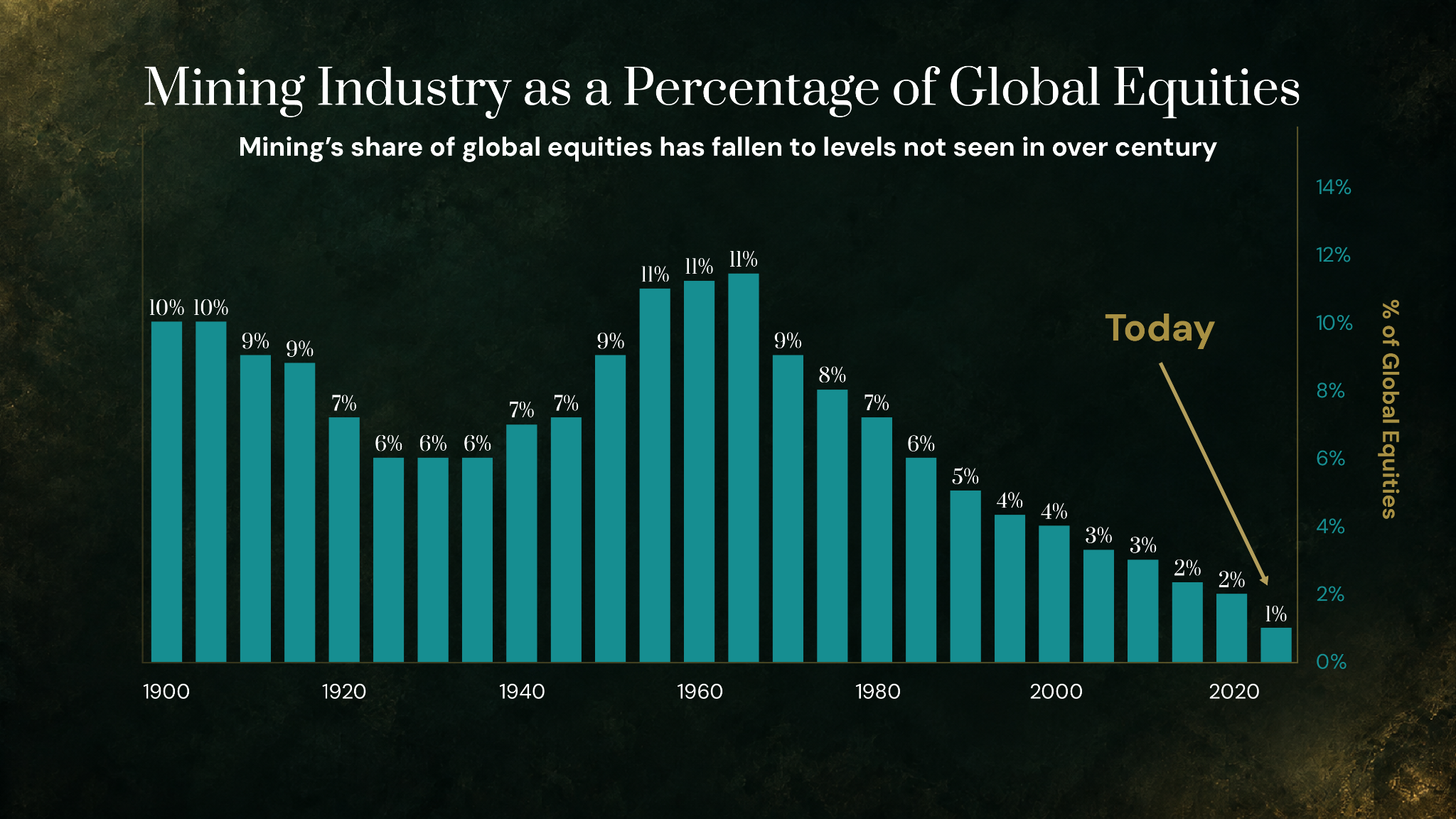
Almost nobody owns them. Now consider…
What happens if even a small amount of the enormous capital currently chasing AI/tech/growth stocks starts looking for somewhere else to go…
I call this a “Great Rotation” – when money flees growth stocks looking for undervalued hard assets.
Bottom line: The trillions of dollars currently betting on AI cannot flow into the tiny universe of gold stocks without making early investors very rich.
Now…
If you think money from growth/tech/AI isn’t going to flood into gold stocks in the coming market correction… think again.
It’s happened three times before.
I’ve spent more than 20 years studying gold and mining companies – traveling to mines around the world.
If you want to potentially profit when the AI trade finally goes off the cliff, here’s all you need to know:
Only a small percentage of an enormous pool of money in AI/tech has to rotate into gold stocks for this tiny sector to hand early investors a generational fortune.
For details on my top four miners, go here.
Regards,
Garrett Goggin, CFA, CMT
Lead Analyst and Founder, Golden Portfolio
Alphabet, Boeing, and Amazon Report This Week. Here Is What the Numbers Must Deliver.

Three companies report this week with enough combined market weight to move the broader index regardless of what happens in between. Each has a distinct pressure point, and each has a distinct level traders must watch.
Alphabet: Cloud Growth vs. a $200 Billion Spending Bill
Alphabet reports after the close on Wednesday, October 28. Consensus sits at $127.4–$127.9 billion in revenue and EPS of approximately $3.03. The revenue bar is not the problem.
The problem is capex. After Q2, Alphabet raised its full-year capital expenditure guidance to $195–$205 billion. Q2 spending alone reached $44.9 billion, more than double the prior year. First-half totals hit $80.6 billion, which means the second half must absorb close to $115–$125 billion to stay on track. Q2 operating cash flow was $39.1 billion. The math is straightforward: capex is outrunning cash generation, and Alphabet has already raised equity to cover part of the gap.
Google Cloud revenue surged 82% year over year in Q2, reaching $24.77 billion, and the backlog stands at $514 billion. That growth rate is not in dispute. What traders are pricing is whether another capex guidance increase, particularly any 2027 forecast, erases the headline beat the way it did in July, when the stock fell 7.13% during the session after reporting a strong quarter.
GOOGL closed Friday at $320.76, roughly 21% below its May high of $408.61. Options markets are pricing an approximately ±6.4% earnings-day move. Key levels: $335.72 is near-term resistance; a daily close below $315.29 opens a path toward $297.45.
Boeing: A Turnaround That Has to Show Cash
Boeing reports before the open on Tuesday, October 27. Consensus EPS is a loss of $0.21 per share on $24.28–$24.53 billion in revenue, implying year-over-year improvement on the bottom line compared with a $7.47 per-share loss in Q3 2025, which included a $4.9 billion charge on the 777X program.
The single most important figure is free cash flow. Management guided $1–$3 billion for the full year; Q3 is expected to stay positive despite a $700 million Department of Justice payment. The 737 program is running at 47 aircraft per month, and analysts forecast 125 737 deliveries for the quarter versus 121 a year ago. Boeing has missed EPS estimates in three of its last four quarters, and its Earnings ESP sits at -6.11%, signaling the street is not pricing a beat. The real read is whether delivery volumes and services margins confirm a durable cash floor, not whether GAAP EPS lands above a low bar.
Amazon: AWS Is the Only Number That Matters Thursday
Amazon confirms Q3 results after the close on Thursday, October 29. Consensus is $1.96 EPS on $202.16 billion in total revenue. Amazon guided net sales of $197–$202 billion and operating income of $22.5–$26.5 billion, versus $17.4 billion a year earlier. Analysts sit at the top of that sales range.
AWS earned $16.6 billion of Amazon’s $27.5 billion in operating income in Q2 alone. Andy Jassy stated on the July call that both AWS’s AI business and Amazon’s chips businesses had each passed run rates of more than $25 billion. The company raised 2026 capex guidance to approximately $220 billion in July, and free cash flow has already turned negative on a trailing basis at -$7.6 billion.
The tension between AWS growth and Amazon’s capex commitment has already played out once this cycle. AWS margin expansion while absorbing the largest infrastructure buildout in Amazon’s history showed how the market resolves that equation.
AWS growth has accelerated for five consecutive quarters. The Q3 question is whether that curve holds into a period with no one-time investment gains inflating the comparison. Any upward revision to the $220 billion capex number will compress the free cash flow read further and is the primary downside catalyst for the session.
Scenario Framework
Bull case: All three deliver on revenue. Alphabet holds capex guidance flat, Boeing FCF comes in above the midpoint, and AWS growth accelerates past 35%. Sector rotation from defensive names into mega-cap tech intensifies through Friday’s close.
Base case: Alphabet beats on Cloud, raises capex modestly, and trades sideways near $320–$335. Boeing hits the low end of its FCF range but posts positive cash. Amazon meets revenue guidance and AWS growth holds in the 30–33% range. Market absorbs the week without a significant directional break.
Bear case: Alphabet raises 2027 capex guidance without providing a return timeline. GOOGL breaks below $315.29. Boeing misses deliveries due to 787 engine supply disruptions, and FCF turns negative again. Amazon either misses operating income or raises capex above $220 billion, dragging both AMZN and the broader hyperscaler complex lower into Friday.
Strategy Framework
Traders entering earnings-week positions should size for the options-implied moves: roughly ±6.4% for GOOGL and wider for AMZN given the Q2 one-time distortion. In each name, the capex number and free cash flow trend carry more weight than the EPS headline. Levels are your framework, not predictions. The week’s macro context, with 707 companies reporting and the S&P 500 last marked at 7,623.68, leaves little room for positioning error.
Preparation is the advantage. Know your levels before the releases, not after.