November 8, 2026
Bonus Content: $67B in Bonds Hit the Same Day as CPI
Dear Reader,
Have you ever wished you could see what the price of Nvidia would be a week from now?
Wall Street spends millions trying to figure out the answer.
They calculate prices with super computers…
They fly teams around the world for boots on the ground research…
And hire massive teams of analysts.
A Main Street investor just couldn’t keep up.
Until now.
That’s because a new kind of AI is levelling the playing field.
A new way to use AI is letting main street forecast the price of over 2,334 stocks…
Up to 21 days in the future.
And it’s unlocked a new style of investing that beat out “buy-and-hold” five to one in historical testing.
Best of all, you don’t need to be a hedge fund or a millionaire to do it.
It operates on the same principle that lets storm watchers track hurricanes from their personal computers.
With more accurate results than the most advanced government models in the world.
Only instead of predicting hurricanes… these folks are turning AI’s predictive power to the stock market.
I want to let you test-drive this new AI today for free.
But I also want you to understand exactly how you can use AI to inform all of your own trades moving forward.
That’s why I put together this brief demo showing exactly how this AI works…
How a bizarre MIT-discovered phenomenon makes it VASTLY different from Chat-GPT and more uniquely suited to looking at stocks…
How it forecasts prices to the penny up to 21-days in the future…
And exactly how it could help you grow your account.
See where any stock could land in 21 days – run a free forecast here.
To your wealth,
Keith Kaplan
CEO, TradeSmith
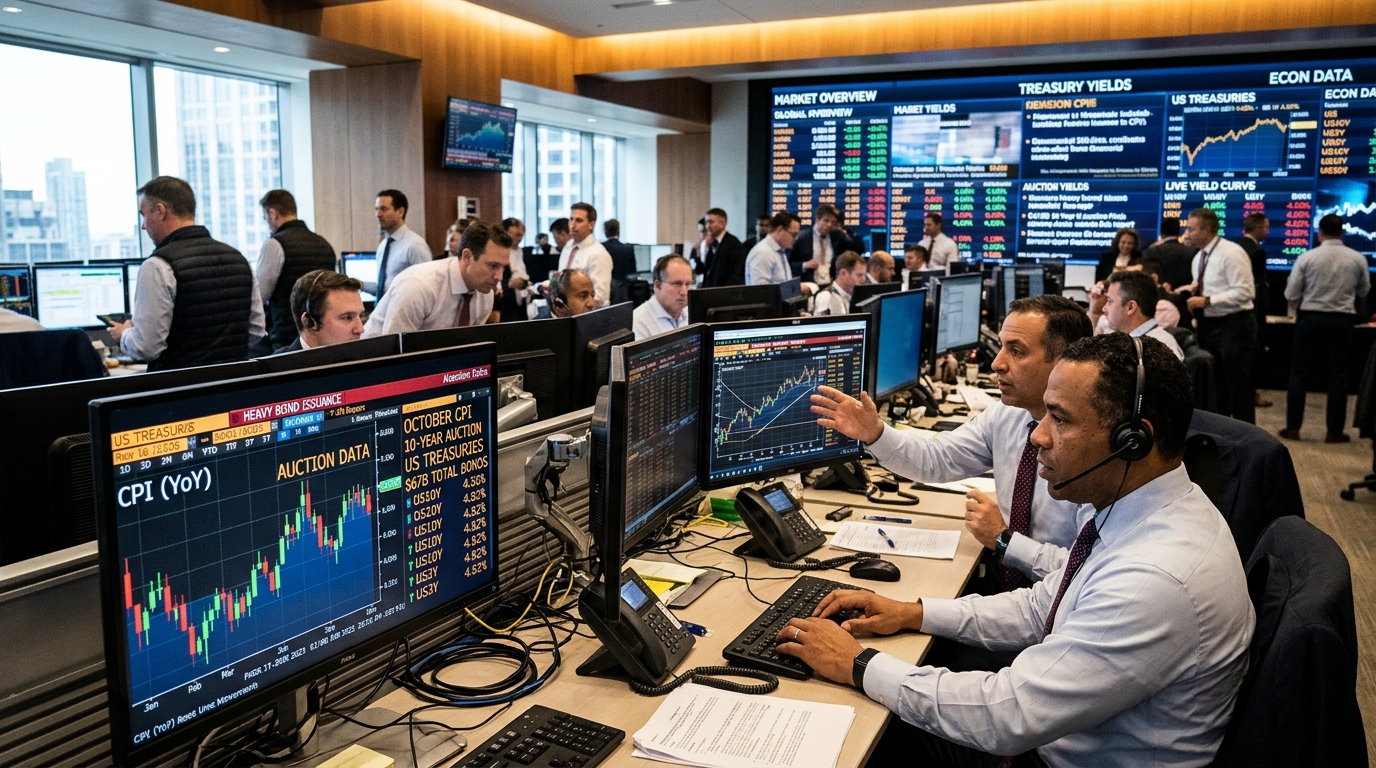
$67B in Bonds Hit the Same Day as CPI
Three sessions. Three auctions. One CPI report. No safety valve on Wednesday. That is the structure traders face this week, and the sequencing matters as much as any individual data point.
- Treasury’s November refunding totals $125 billion, raising approximately $28 billion in new cash, with all three legs settling November 16.
- The $58 billion 3-year note auctions Monday; $42 billion in 10-year notes auction Tuesday at 1:00 p.m. ET; $25 billion in 30-year bonds follow Thursday at 1:00 p.m. ET.
- The 10-year yield closed Friday at 4.86%; the 30-year at 5.26%, both down sharply from their early-October cycle highs of roughly 5.31% and 5.67%, respectively.
- October payrolls printed at 165,000, well above a roughly 60,000 to 65,000 consensus range, pushing December Fed hike odds to the mid-70% range on CME FedWatch.
- October CPI releases Tuesday at 8:30 a.m. ET, four and a half hours before the 10-year auction closes. September CPI ran at 3.7% year-over-year.
- The October 30-year bond auction cleared at 5.618%, versus 5.308% previously, setting the context for this week’s supply.
- TLT closed Friday at $81.92, still about 10.9% below its 52-week high of $90.86, reflecting the persistent duration overhang.
Market Context
The Fed held its target range at 3.75% to 4.00% on October 28, with one committee voter dissenting in favor of an immediate hike. That internal division, combined with Friday’s strong payrolls number, has rates markets treating December 9 as a live meeting. CME FedWatch put a 25-basis-point December hike in the low-to-mid-70% range after the jobs report, up from the prior week. The 10-year yield, while well off its early-October high of 5.31%, remains well above where it started the year. At 4.86%, it is not cheap enough to absorb a hot CPI surprise without consequence.
The 30-year at 5.26% is the number dealers are watching. This week’s auction prices against that backdrop, with one crucial constraint: the bond market is closed Wednesday for Veterans Day. Any CPI-driven reset on Tuesday has no release valve the following session. It carries directly into Thursday’s 30-year book.
The Sequencing Problem
Tuesday compresses two of the week’s largest risk events into a single four-hour window. CPI at 8:30 a.m. ET, 10-year auction at 1:00 p.m. ET. If October inflation runs above the 0.3% month-over-month consensus estimate that many desks are penciling in, rate-hike odds for December push higher, the 10-year yield rises, and the auction concession evaporates before the book is even opened. Primary dealers, who are obligated to absorb whatever end investors leave behind, would face a deteriorating clearing level in real time.
The October 7 reopening of the 10-year at 5.300% attracted extraordinary demand: indirect bidders took about 80.3% of the $39 billion issue, leaving dealers with about 2.5%, an unusually low share. That auction cleared at a 5.3% handle. Tuesday’s new issue clears at roughly 4.86%, more than 40 basis points lower on yield but still not far enough off recent lows to generate that same gravity-driven foreign demand. The question is whether the same overseas buyers who flooded the 10-year above 5% show up with equal enthusiasm at 4.86%.
Technical Framework
TLT’s 52-week range runs from $76.43 to $90.86. At $81.92, the ETF sits in the lower third of that range. The October low near $76 represented the yield peak around 5.67% on the 30-year. A hot CPI that pushes December hike odds deeper into the 70s would test whether the mid-$79 to $80 zone on TLT holds as support. On the upside, a soft CPI and clean 10-year auction would likely push TLT back toward the $84 to $85 range, where it traded before the September sell-off resumed.
The 10-year at 4.86% sits between its 50-day moving average, recently around 4.90% to 4.95%, and the early-October cycle high at 5.31%. A clean auction Thursday on the 30-year would reinforce the lower range. A tail would retest 5.40%+ on the long bond.
The payrolls beat that reset December hike odds is not the only labor input the Fed is weighing. Fed hawks rely on a wage dataset that carries more policy weight than the monthly jobs report.
Scenario Modeling
Bull Case: October CPI prints at or below 0.2% month-over-month. December hike odds recede toward the upper-60% area. The 10-year auction attracts strong indirect demand above 70%, dealers absorb less than 8%, and the 30-year closes Thursday at 5.15% to 5.20%. TLT retraces toward $84 to $85. Primary dealers enter the market short duration heading into next week.
Base Case: CPI at 0.3% month-over-month, in line with consensus. Hike odds hold in the low-to-mid-70% range. The 10-year clears with a modest tail of 1 to 2 basis points, bid-to-cover near 2.5x. The 30-year Thursday absorbs cleanly given two days of price discovery post-CPI. TLT ends the week in the $81 to $83 band. The curve steepens modestly as the front end reprices hike risk and the long end stabilizes on decent Thursday demand.
Bear Case: CPI surprises at 0.4%+ month-over-month. December odds approach the upper-70s to mid-80s. The 10-year auction tails by 3 to 5 basis points, with dealers forced to absorb 15%+ of the issue. The bond market closure Wednesday prevents an orderly unwind. The 30-year Thursday opens into a deteriorated backdrop, testing 5.45% to 5.55%. TLT revisits the $78 to $79 zone. The October 30-year auction cleared at 5.618%; that level becomes the reference point for the bear scenario.
Active Trader Framework
The asymmetry this week runs toward the bear case being more damaging than the bull case is beneficial. A clean CPI already has significant good news priced into the recent yield decline. A hot number, with no Wednesday session to absorb it, compresses all the adjustment into Tuesday afternoon and Thursday morning. Traders watching TLT should treat the $80 level as the structural dividing line. Volatility around 8:30 a.m. Tuesday will likely set the range for the entire refunding cycle.
The structural pressure on the long end is not new to this refunding cycle. Treasury’s tripled buyback operation failed to suppress 30-year yields even with a $6 billion intervention.
Monitor dealer takedown percentages in Tuesday’s results, posted within minutes of the 1:00 p.m. close. High dealer absorption is the tell. It signals that end investors stepped back and primary dealers are holding inventory into a closed Wednesday, which is the least favorable combination heading into Thursday’s $25 billion long-bond sale.
Conclusion
Preparation here means knowing your levels before 8:30 a.m. Tuesday, not reacting to them after the fact. The Treasury supply is known. The Veterans Day closure is known. What is unknown is whether inflation cooperates. Disciplined positioning accounts for both the data and the structural constraint of a compressed three-session window where there is no room to defer a decision to Wednesday.