
For a while now, I’ve been showing regular traders like you how to take advantage of a specific 60-minute window…
One that lets us go after 50% returns every morning – whether the market opens higher… or lower.
Here’s what I mean…
If you had spotted this 60-minute opportunity yesterday morning… all you would’ve had to do was place a quick trade before 10 am…
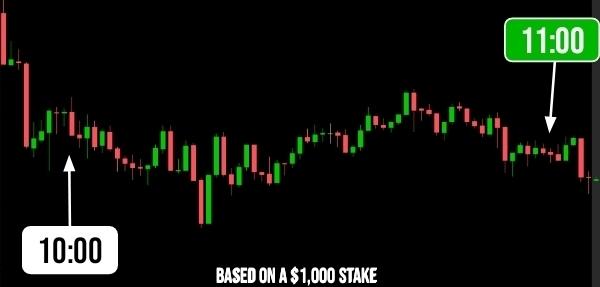
Went ahead with your morning plans and when you return a couple of minutes later, there’s a good chance you’d find $500 in extra income sitting in your account (on a 1k stake)
It wouldn’t have mattered what happened with the overall market… this 60-minute window would have been all you needed to target cash.
Today? Same story.
Place a quick trade, grab your coffee… and let the setup do the heavy lifting.
And just 60 minutes later… come back to what could be a nice $500 in extra income sitting in the brokerage account.
I designed the setup to be that straightforward.
Granted, there will be trades that won’t work out
But if you want in?
GPN’s $22.5 Billion Debt Load Is the Real Obstacle in the CD&R Buyout

Global Payments has beaten adjusted earnings estimates four consecutive quarters. Its adjusted EPS rose 10% in Q1, 12% in Q2, and 10% again in Q3 2026, with the most recent quarter landing at $3.58 per share on $3.18 billion in adjusted net revenue. None of that moved the stock in any sustained way before October 30. The reason is simple, and the CD&R situation makes it impossible to ignore.
The debt is the story. As of September 30, 2026, GPN reported $22.54 billion in total long-term debt (including the current portion) against cash and cash equivalents of $5.57 billion. That puts net debt at roughly $17.0 billion before other balance sheet items, against year-to-date operating cash flow of $0.21 billion for the nine months ended September 30, 2026. That ratio is what William Blair analysts flagged immediately: the company’s nearly $22 billion net debt load could be a material impediment to any deal, particularly in a higher-rate environment. Four consecutive EPS beats failed to expand the multiple because public investors priced the leverage, not the earnings. With roughly 6.6% short interest, that read was not fringe.
Debt loads are repricing equity multiples across sectors, not just payments. Cleveland-Cliffs faces the same dynamic — strong operational tailwinds undermined by a balance sheet that public investors will not give full credit for.
CD&R, which manages approximately $90 billion in assets, has teamed with GTCR, GPN’s largest outside shareholder at roughly 15% of shares, on a joint bid that Reuters confirmed on October 30. The implied enterprise value of around $40 billion would rank this transaction as one of the largest leveraged buyouts ever executed. That scale matters for financing: any acquirer must absorb the existing debt stack plus new acquisition financing on top of a depressed equity base. At roughly 5.67x forward earnings, GPN trades at a fraction of the payments sector’s 17.72x industry average, which is precisely the valuation dislocation that makes the asset attractive in the first place.
GPN’s Q3 results, reported November 5, added a constructive data point. Management raised its run-rate Worldpay integration expense synergy target to $650 million and reaffirmed the full-year outlook. Normalized adjusted net revenue growth accelerated sequentially to above 4%, with full-year consensus revenue pegged at $12.4 billion. The Worldpay integration is the operational thesis CD&R would be buying: a combined merchant-focused platform with scale, embedded Genius software, and expense synergy extraction still in progress.
The core positioning question for traders is not whether CD&R wants the asset. It is whether leveraged-finance markets will fund it. With existing senior notes spanning maturities from 2027 to 2052, any buyer must negotiate around a dense existing capital structure. The Wall Street consensus target sits around $108, implying modest upside from current levels even before a premium is applied. If talks stall, the stock likely retraces toward pre-announcement levels near $83 to $85. If a formal offer materializes, the premium debate centers on where enterprise value settles relative to that $40 billion figure already circulating in the market.
Leveraged-finance appetite is not just a GPN question. Record AI-related debt issuance has already pushed blue-chip borrowing costs to cycle highs, tightening the terms on which any large deal gets financed.
Traders should track three things: credit market appetite for a deal of this scale, any formal board-level disclosure from GPN’s management team, and whether GTCR’s existing position shifts. The debt load is not a dealbreaker in isolation. It is a dealbreaker if financing costs make the return math unworkable. Right now, that question is open.