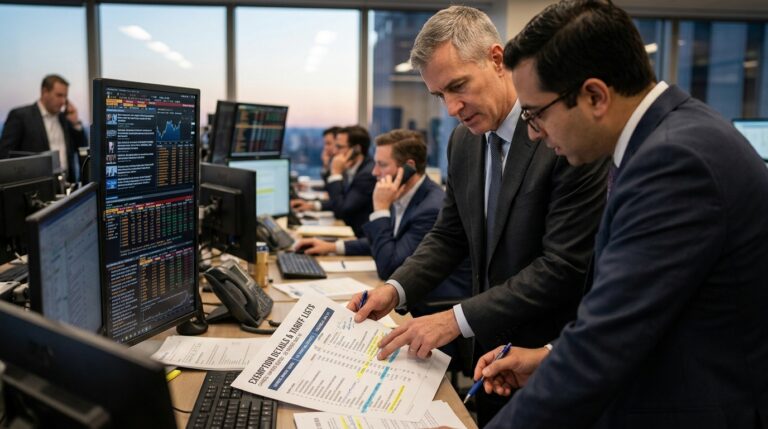

The BlackRock-Meta El Paso bond deal was announced July 28 and is being marketed at about a 7.5% yield. That number matters. For a blue-chip data-center offering backed by one of the world’s largest asset managers, it is among the highest borrowing costs of this AI debt cycle, and it tells you almost everything you need to know about where the credit market stands right now.
The story is not that demand has collapsed. It is that demand has dropped fast enough to change the terms on which the next wave of supply gets done, and that next wave is coming at precisely the wrong moment.
The Market Context
The numbers surrounding 2026 debt issuance are genuinely without precedent. Goldman Sachs strategist Amanda Lynam estimated in late July that $489 billion of AI-related debt had already been issued this year, already above Goldman’s own estimate of $322 billion for all of 2025. Morgan Stanley projects the full-year total will approach $570 billion globally, more than double last year’s figure. The five largest hyperscalers, which averaged $28 billion in annual U.S. corporate bond issuance between 2020 and 2024, issued $121 billion in all of 2025 and have already surpassed that figure barely halfway through 2026.
To understand why this is straining the market, look at what underwriters are doing to get deals done. When BlackRock sought to raise billions in debt financing for a Meta data center, the transaction’s underwriters deliberately favored so-called real-money accounts like pension and insurance funds, institutions that buy to hold and whose steady hands wouldn’t sink the bond’s secondary-market performance the way fast-money accounts can. That is not normal deal execution. That is triage.
Banks are also growing quieter about upcoming transactions, omitting jumbo tech deals from their weekly bond sale forecasts to avoid telegraphing supply that might spook buyers before a deal prices. The playbook has changed because the market has changed.
The Research
The cover ratio collapse is the cleanest signal. The coverage ratio for hyperscaler bond issuance fell from nearly 5x in February 2026 to below 2x in July, according to Apollo Global’s chief economist Torsten Slok. By contrast, the ratio for investment-grade bonds overall slipped by only about half a point over the same stretch. Hyperscaler paper is losing relative appeal even as the volume grows.
Part of the explanation is structural. Hyperscaler capital expenditures in 2026 are on pace to consume close to 100% of operating cash flows, compared with a 10-year average of 40%, according to UBS figures. Epoch AI’s analysis of the five largest hyperscalers puts aggregate cash capex growth at roughly 70% per year against operating cash flow growing 23% per year, with those lines crossing around the third quarter of this year. Incremental debt as a share of capex rose from 9% in fiscal year 2024 to 32% in the twelve months before June 2026, taking aggregate total debt for the group to approximately $700 billion. Goldman Sachs reports that hyperscaler leverage ratios have doubled from 0.9x to 1.8x in roughly six months. The bond market is being asked to fill a gap that free cash flow can no longer cover.
Companies have tried to manage the supply shock through signaling. When Meta sold $25 billion of high-grade bonds in April, it indicated it would not return to the bond market until at least the fourth quarter. That message helped support demand. Oracle raised $25 billion in February and told investors it did not expect to issue additional bonds during calendar year 2026. But that kind of forward guidance only works until the capex needs exceed what the promises can contain. Oracle, whose five-year credit default swap reached a multi-year high of 75 basis points this year, is already a cautionary example.
One banker privately told Bloomberg that some $50 billion to $60 billion in debt from hyperscalers will hit the market following the Labor Day holiday in early September. That figure could be even higher, but some clients requested an issuance pause specifically to allow investors to accommodate new supply before the next wave. That pause is the calm before a very crowded window.
The Hidden Insight
The more consequential development is not in the public bond market. It is in the structures being used to route financing off public balance sheets entirely.
The BlackRock-Meta El Paso campus is a 1-gigawatt facility with JPMorgan and Morgan Stanley arranging about $12.5 billion in debt. BlackRock’s infrastructure and private-credit units own 80% of the project. Meta owns 20% and leases the compute back. The debt sits with a project entity tied to Project Sopaipilla Holdings, not with Meta. Meta books the cost largely as rent rather than capital spending. Meta’s Hyperion campus in Louisiana used the same template with Blue Owl holding 80% and Meta 20%, and that entity raised about $27.3 billion of project-level debt via a private securities offering, one of the largest such data-center financings on record.
Estimates for private credit and off-balance-sheet AI data-center financing vary widely. The OECD has said private credit is expected to supply roughly $800 billion to the AI expansion over the next several years, largely through asset-based finance structures. Separate reporting has put off-balance-sheet lease exposure across major U.S. tech firms well into the trillions. The public bond market sees only a portion of the total AI debt stack. The rest sits in structures where price discovery is limited, disclosure is thinner, and the identity of the ultimate risk-holder is genuinely unclear.
This matters for everyone in fixed income, not just those buying hyperscaler paper. Bank of America research has highlighted how much of the recent supply is being raised across multiple currencies, as companies sell bonds denominated in euros and other markets. As hyperscalers tap euro and yen markets directly, hedging dynamics shift with ripple effects across rate and currency markets that extend well beyond the tech sector. Passive investors in broad investment-grade indexes will absorb this concentration by default. Active managers face a decision that is becoming harder to avoid: how much hyperscaler credit exposure belongs in a portfolio at current spreads?
Investment Opportunities
The clearest beneficiary from the AI debt indigestion is not a borrower. It is the infrastructure through which that borrowing gets done.
BlackRock stands apart. Its Global Infrastructure Management and private-credit platform are the ownership vehicles behind the El Paso deal, and the fee engine does not require the campus to be a home run. BlackRock needs to keep managing capital that flows into deals like it, and the asset base keeps growing. The structure of the El Paso transaction, where the bonds sit in a project entity while BlackRock collects ownership fees and management income, is the firm’s core private infrastructure model applied at AI scale.
Apollo Global Management and Blue Owl Capital are direct beneficiaries of the private credit channeling trend. Blue Owl held 80% of the Hyperion project and funded a portion of its commitment through project-level debt sold in a private securities offering. Apollo’s Slok flagged the cover ratio deterioration early, which is also evidence of the firm’s front-row view of how deals are getting structured and where capital is flowing.
Within the bond market itself, Penn Mutual Asset Management’s research published in mid-July drew a useful distinction: high-yield data-center credit has faced more spread pressure as investors grew more cautious on execution-intensive AI infrastructure, while the largest, investment-grade hyperscaler issuers have generally retained workable access to capital. That divergence is a genuine signal. The largest, most creditworthy hyperscalers retain access to capital at workable rates. Smaller data-center operators in the high-yield tier, including names like Core Scientific, TeraWulf, and Applied Digital, face a different credit environment entirely, and the spread gap between them and the IG tier is widening.
For equity investors, the capex-to-cash-flow crossover has concrete consequences. Group free cash flow for the five largest hyperscalers dropped 23.7% in 2025 from 2024, and three of the five recorded lower free cash flow than the prior year. Stocks of the five hyperscalers are down 9.3% as a group in 2026. That underperformance is not market irrationality. It is the bond market’s correct read of where cash is going.
Risks and Counterarguments
The bear case on AI debt has a ceiling. Hyperscaler leverage ratios, even after the recent surge, remain far below the investment-grade average. Goldman estimates a post-issuance leverage of 0.4 to 0.7 times versus the IG average of near 3x. Deals remain oversubscribed in absolute terms. The argument that this is a credit crisis is not supported by the data.
The Oracle lawsuit adds a different kind of risk, however, and it deserves attention as a precedent. Bondholders led by the Ohio Carpenters’ Pension Plan sued Oracle alleging the company failed to disclose plans to raise a significant amount of additional debt not long after completing an $18 billion bond offering in September 2025. The complaint, filed in New York state court, argues that offering documents were materially misleading. If that case advances, it changes the disclosure calculus for every hyperscaler planning to return to the market in September. Even a threat of litigation forces underwriters to think differently about how much they tell buyers, and at what point.
The deeper risk is the one Epoch AI’s analysis makes explicit: if aggregate AI infrastructure investment tracks toward $1.5 trillion annually by 2030 with roughly 90% externally financed, then the entire pace of the buildout becomes dependent on debt market conditions rather than the underlying technology’s commercial viability. A credit contraction stops the buildout. The bond market does not need to break. It only needs to tighten enough to make the next $50 to $60 billion in September supply more expensive than the last round, and then the one after that more expensive still.
Research Conclusion
The AI bond market is not in crisis. It is in the late phase of an absorption problem, where the pace of supply has definitively outrun the growth of buyer appetite. The BlackRock-Meta El Paso deal at about 7.5% is the current price of that imbalance. The September supply window will set the next price.
Watch three things. First, the cover ratio on the first major hyperscaler deal to price after Labor Day. If the February-to-July decline from 5x to below 2x continues, underwriters face a genuine concession problem and spreads move wider across the IG tech complex. Second, the pace of private credit and off-balance-sheet deal formation. If the roughly $800 billion private-credit financing expectation grows faster than the public market can digest, the location of the real risk in the AI debt stack becomes increasingly hard to identify. Third, the Oracle litigation. Any adverse ruling or large settlement changes how every CFO writes the next offering document, adding friction to a process that already requires careful management of investor expectations. The credit market is telling you something the equity market has not fully priced: the cost of building AI infrastructure is going up, and the bill is still being negotiated.