Dear Reader,
Democrats have won both the House and the Senate.
That could make things a lot harder for President Trump.
Obviously, now comes the debate over what he can get done in the remainder of his term, and what it means for your money.
But before you make any changes to your investments, there’s something else worth thinking about.
What if the next big financial problem starts OUTSIDE Washington?
As you probably already know, companies are spending huge sums on AI data centers… counting on future revenue to justify the current expenditure.
But what happens if that revenue falls short?
The losses could hit not just AI stocks but also banks and retirement funds. And Washington could face pressure for another bailout.
Our new briefing explains all our concerns and also the steps you can take to prepare.
You’ll also find out how to get our reports on buying gold and silver in a crisis.
As Washington adjusts to the election results, take a moment to check how prepared your money is for what comes next.
Eliza Lasky
Weiss Advocate
First Solar’s 58% Gross Margin Hides a Single-Point Policy Risk
First Solar just reported its strongest margins in company history. The stock is down roughly 10% over the past two weeks. That gap is the trade.
The Margin Story
Q3 2026 gross margin expanded to about 58%, up roughly 20 percentage points from the prior-year quarter, with adjusted EBITDA reaching $744 million on an adjusted margin of approximately 60%. Net income came in at $571 million, or $5.30 per diluted share, against $4.24 in the same quarter last year. On EPS, First Solar beat the consensus estimate of $4.67 by $0.63.
The revenue line is the complication. Quarterly revenue fell about 23% year-over-year to $1.23 billion, below analysts’ expectations of $1.29 billion. Management trimmed full-year volume guidance to 16.0 GW to 17.0 GW and net sales guidance to $4.6 billion to $4.9 billion. Gross profit guidance stayed unchanged, which tells you something: the company is selling less but keeping nearly every dollar of margin.
Where the Margin Actually Comes From
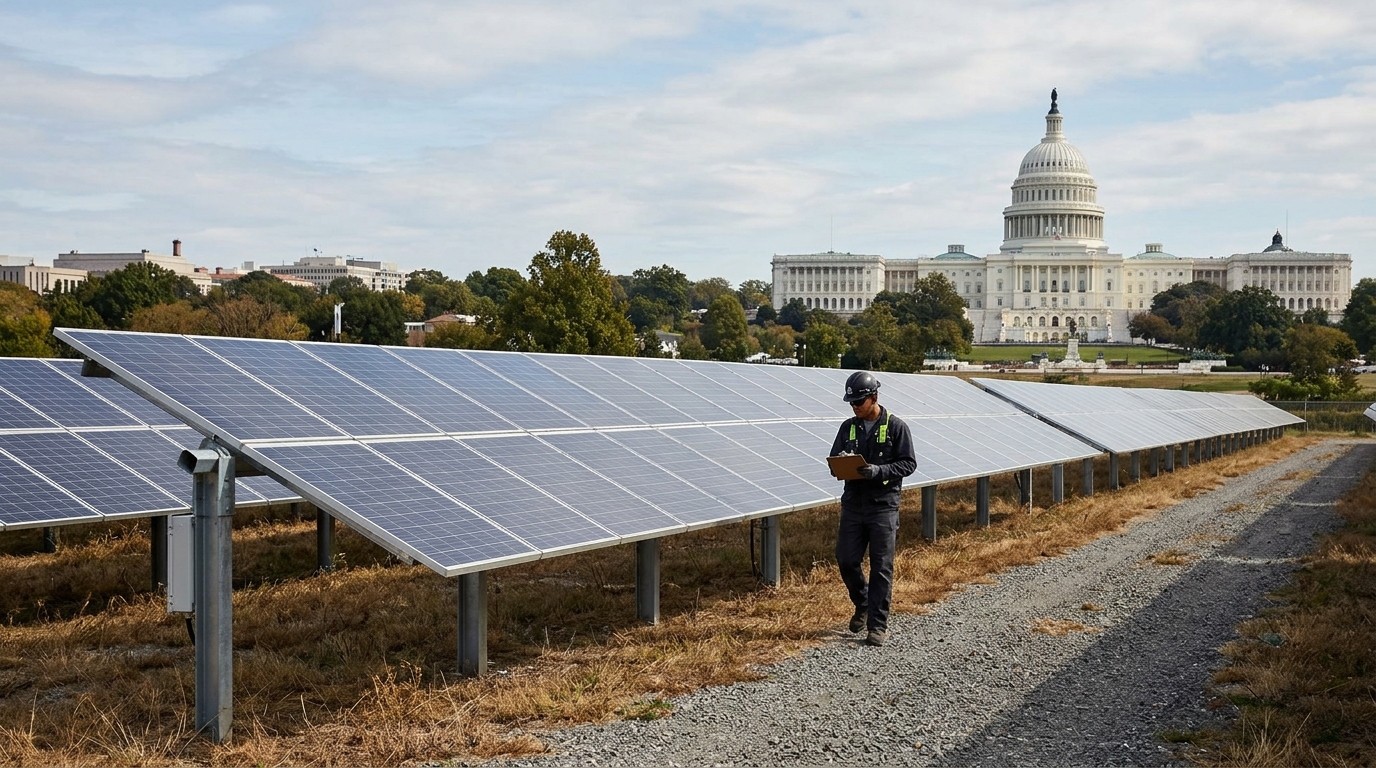
This is the number analysts are wrestling with. Updated 2026 guidance assumes $2.07 billion to $2.19 billion of Section 45X manufacturing tax credits. Strip those out and core module gross margin drops to roughly 7%, as management discussed on the Q1 2026 call. That is not a theoretical risk. It is the base of the earnings model, and a 2026 plan built on Section 45X credits keeps the stock trading on Washington news as much as on its own numbers.
Policy milestones and regulatory approvals can move clean-energy stocks sharply before a single watt of new power flows. The gap between a regulatory green light and actual revenue is a recurring trap for investors pricing in clean-energy policy wins too early.
The structural offset is Section 232. CEO Mark Widmar said Section 232 represents “a structural change in how the United States approaches solar manufacturing.” The company recently commenced operations at its fifth U.S. manufacturing facility and is completing a sixth in South Carolina to onshore final production processes for modules initiated by its international fleet. Based on the company’s filings, the Section 45X credit is roughly $0.17 per watt for U.S.-made modules.
Where Analysts Stand
Piper Sandler cut its price target from $251 to $222 but held an overweight rating; MarketBeat reports a consensus average target of $256.38 with a moderate buy rating across the Street. Morgan Stanley lowered its target from $326 to $307 but kept an overweight rating. The 50-day moving average is around $186 versus about $214 for the 200-day.
Three Scenarios
Bull case: Section 45X credits survive intact through the next budget cycle, and Section 232 tariffs on imported modules hold. Earnings are expected to grow roughly 38% next year, from $17.61 to $24.30 per share. At 11x forward earnings, that puts fair value above $260.
Base case: Guidance holds at the low end. Revenue lands near $4.6 billion with gross profit preserved. The stock consolidates between its 50-day near $186 and the 200-day near $214, with catalysts tied to any Section 45X legislative update or Q4 bookings data.
Bear case: A cut to Section 45X credits or an adverse policy shift would reduce earnings directly, since a large share of projected profitability runs through the tax credit line rather than the module business itself. On a 7% ex-credit margin and current revenue, the stock re-rates sharply lower.
Tactical Framework
For Q4, management guided to module sales of 4.3 GW to 5.3 GW, including 3.4 GW to 4.3 GW from U.S. manufacturing operations. That domestic mix figure matters: more U.S.-produced volume means more 45X credit capture and higher per-module margin. Watch Q4 bookings for signs of pricing power at newly raised levels. Bearish analysts are focused on slower bookings and shorter contract durations as a risk to First Solar’s long-term growth pipeline. Volume re-acceleration would invalidate that concern faster than any policy update. Size positions with the understanding that any Congressional action on the IRA triggers outsized moves in both directions. The 200-day moving average near $214 is the technical level that separates a consolidation from a trend break.