One Asset Gained 2,300%
The Last Time This Setup Happened
Here’s What It Was
Dear Reader,
From 1970 to 1980, one specific asset gained more than 2,300%.
That’s not a typo. A $10,000 investment became $230,000 in a decade.
And here’s why we’re bringing it up right now.
The exact same conditions that produced that gain in the 1970s are forming again today.
Stagflation. The toxic combination of high inflation AND a stalled economy. The 1970s version trapped the U.S. economy in a vise for nearly a decade. Stocks went sideways for 10 years. Bonds got crushed. Cash lost half its value.
Now look at where we are:
Inflation expectations spiked to 4.8%. JP Morgan and Moody’s are warning of recession by 2026. Oil is surging on Middle East tensions. And the Fed is trapped – cut rates and inflation worsens, hike rates and recession arrives faster.
The setup is identical.
Now we know what you’re thinking. “That was 50 years ago. It can’t happen again.”
The smartest money in the world disagrees.
Central banks are loading up on the same asset that gained 2,300% in the 1970s – at the fastest pace in 50 years. JP Morgan is forecasting it could hit $8,000 before this cycle ends.
You’re going to make a decision today whether you realize it or not.
Position before stagflation locks in. Or watch from the sidelines while the same trade plays out again.
Because once the trap closes, getting out gets expensive.
Anthropic Is Pricing Its IPO This Week. The Loss-to-Revenue Ratio Is the Number That Matters.
Anthropic is expected to price its IPO on November 18 and begin trading on the Nasdaq under ticker ANT on November 19. The roadshow launched November 10 with an official price range of $70 to $78 per share, implying a fully diluted valuation of roughly $1.4 trillion at the top end. Bankers are already signaling they expect to price above that range, with the Financial Times reporting the target may climb to $1.5 trillion or more on robust order flow.
The bull case is real. Revenue grew about 1,300% year-on-year in the first six months of 2026, reaching $16.3 billion. Across the first nine months, the company generated $33.2 billion in revenue, reaching an annualized run rate of roughly $67.2 billion based on the first nine months through September 30, 2026. Net revenue retention came in at about 900%, with an implied gross margin of roughly 85%. Consumption-based revenue made up $13.1 billion, or 80% of total first-half revenue, which anchors the growth to paying enterprise customers, not speculative usage.
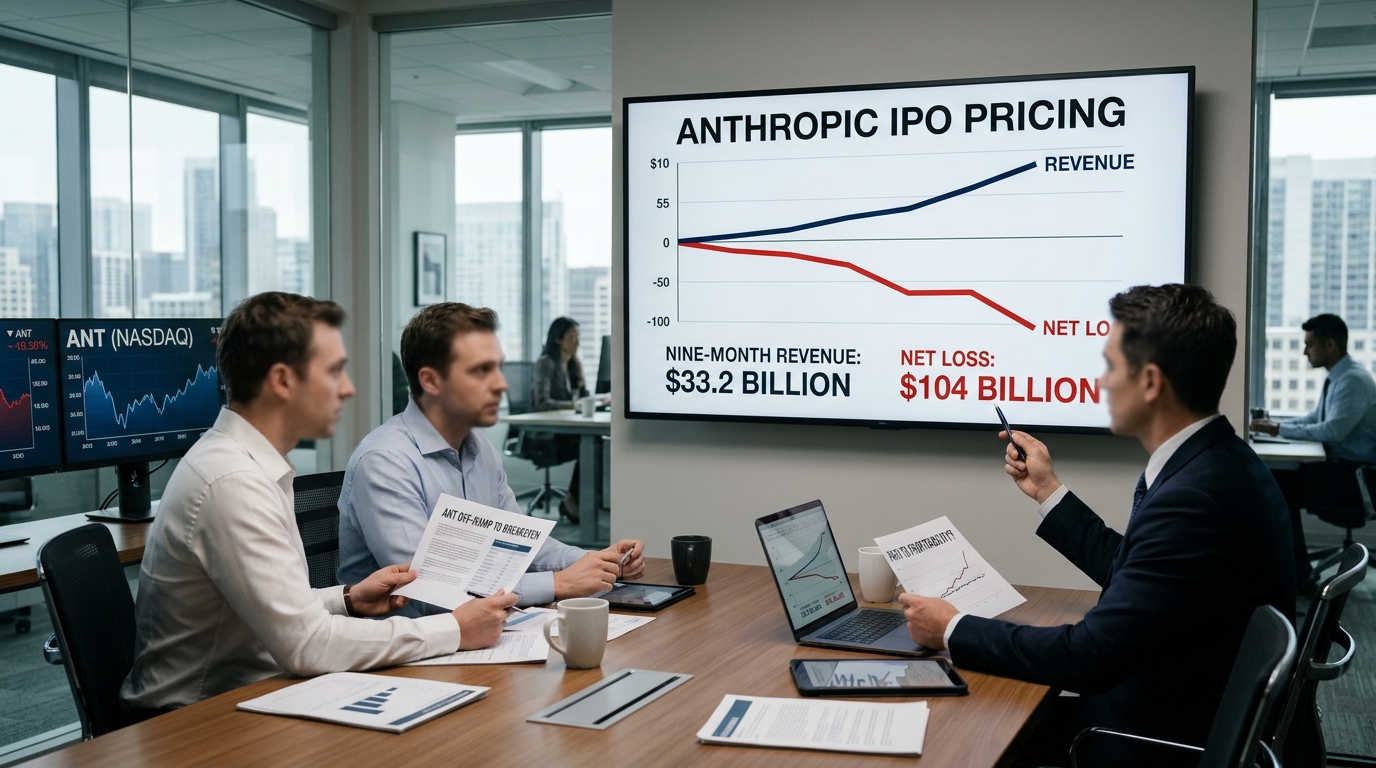
The bear case is also real, and it starts with a single line in the S-1. The amended filing, submitted November 2, shows a nine-month 2026 net loss of $104.0 billion, including a $94.3 billion non-cash fair-value charge, on $33.2 billion of revenue. Strip out the accounting adjustment and the operating picture clarifies: Q3 revenue of about $17.0 billion, up 46.7% from Q2, accompanied a $567 million operating loss, following a $974 million operating profit in Q2. The swing from profit to loss in a single quarter, at scale, is the data point institutional buyers are sitting with.
Public market buyers demanded a standard 20% to 25% IPO valuation cushion and refused to price Anthropic at a massive premium over rival OpenAI’s expectations. At $1.4 trillion, the implied multiple sits at approximately 20.8 times revenue annualized from the first nine months of 2026.
The capital structure adds another layer. Anthropic will raise $26 billion via a separate private placement with cornerstone investors including Alphabet’s Google, Nvidia, and AMD, alongside Broadcom, Micron, Microsoft, and TSMC, bringing total proceeds to up to roughly $90.4 billion. That is not a standard IPO capital raise. It is a structured refinancing of a compute-dependent business that burns capital at a rate its revenue has not yet caught.
The compute-dependency problem is not unique to Anthropic. OpenAI’s S-1 revealed the same structural tension between revenue scale and losses that dwarf both.
The IPO was fully covered with orders from prospective investors for all available shares when the deal launched, which matters. Full coverage at launch does not equal sustained demand after the first trade. Post-IPO price discovery on a $1.4 trillion AI name, with no public comps and a Q3 operating loss on the books, will be its own event.
Traders watching ANT need three levels in their framework before Thursday: the $78 IPO ceiling where covered demand was built, the $70 floor where institutional protection sits, and the first post-lock-up window where insider supply enters a market that has had no time to form a consensus on what the business is worth.
The lock-up question connects to a broader shift in how AI compute is financed. Institutional capital is now being structured around GPU assets as collateral, changing the cost basis for every compute-dependent AI lab.