
Hindsight is 20/20.
And in hindsight, these sorts of inflection points are always obvious.
Imagine, for example, if I’d told you in the mid-1850s that crude oil would be the foundation of the next century’s global economy.
Or that I told you in 1958 that Jack Kilby’s and Robert Noyce’s microchip would unleash the information age.
Or that Bill Joy’s 1981 graduate study program at Cal Berkeley would lead to the creation of the World Wide Web.
If you had known these things ahead of time and grasped how they would change the world… would you have had an edge as an investor?
Obviously.
Because the right idea, understood at the right time, by the right investor is what makes some people very rich.
Case in point: decades ago, a company called Schlumberger saw the insatiable demand for oil and pioneered tech to map underground reservoirs.
As the post-WWII energy boom hit its stride, Schlumberger’s stock exploded 50-fold.
Same with Intel…
If you understood the magnitude of what Robert Noyce created with the microchip, you didn’t need to be a Silicon Valley venture capitalist to get rich.
You could have simply bought shares of his company, Intel, and watched it surge from just $0.50 in the mid-1980s to $75 by the year 2000.
Same with Sun Microsystems…
In 1994, following the commercialization of the internet, Bill Joy’s company moved from $0.65 per share to over $125 per share in just six years – a 19,000% gain.
These enormous, historical gains didn’t require pre-IPO investing, early-stage funding, or any type of high-risk capital allocation.
All it took was a deep understanding of how a new technology, or a fusion of technologies, would impact certain companies and, of course, knowing what to buy.
Think back to the late 1990s, when the dawn of the net collided with the telecom boom.
A convergence that sent the companies building the infrastructure, like Cisco, up roughly 100,000%.
Or look back to January 2007… when microchips fused with 3G cellular networks to give birth to the smartphone, propelling Apple’s stock up 9,500%.
But mark my words: those events could be reduced to footnotes in history compared to what’s forming right now.
You see, the rate of disruption and transformation we’re seeing today has no precedent.
Right now, beneath the surface of the market, a number of immense forces are fusing together to create a potentially generational investment opportunity.
What I call an Ignition Point.
And even in the early stages of this event, we’re seeing certain stocks connected to the story rise sharply in a very short window of time.
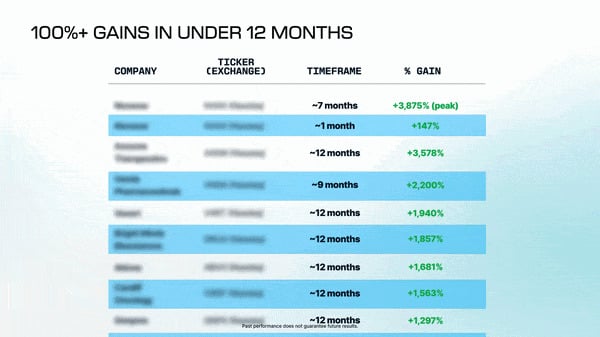
Yet almost everyone is blind to it.
Everyone is too distracted by Nvidia, SpaceX, the IPOs of Anthropic and OpenAI, and the rest of the late-stage AI circus.
They’re missing the fact that the real wealth is being generated in a completely abandoned corner of the stock market.
I just released a video detailing exactly what is happening, and how to best capitalize on it regardless of your investing experience.
In it, I hand you a complete roadmap for playing this opportunity… I even give you the name and ticker symbol of the #1 stock sitting at the center of this Ignition Point.
Watch it here now while it’s still online.
Good investing,
Porter Stansberry
Marvell Has 58% to Recover. Its Revenue Guide Says It Can.

The trillion-dollar club added another member this year. Nvidia, Meta, Broadcom, TSMC, Micron, SK Hynix, and SpaceX have all either reached or significantly reinforced their trillion-dollar valuations on the back of the AI infrastructure boom. The roster is growing fast. The question that actually matters for active traders is not who already crossed the line. It is who crosses next, and how far away they are from the threshold right now.
The most specific answer came on June 2. Nvidia CEO Jensen Huang called Marvell Technology the “next trillion-dollar company,” sending its shares up 32.5% in a single session, according to Reuters. Huang argued that Marvell’s networking and connectivity chips are essential to data centers where computing tasks are spread across thousands of connected chips that need to share data quickly. The catalyst was real. The fundamental case was not new. What changed was whose voice said it.
Since then the stock has reversed hard. Marvell shares finished November 5 at $133.55, around 58% below its record close on June 4. Investors fled AI stocks on fears that tech companies are overspending on infrastructure, and shares declined further at the very end of October after Bloomberg reported that Marvell was in advanced talks to acquire optical component maker Lumentum. The market cap sits near $150 billion, a long way from $1 trillion.
The revenue trajectory, though, has not softened. Marvell’s revenue growth accelerated from 28% year over year in fiscal 2027’s first quarter to 37% in the second, with third-quarter revenue guided to $3.15 billion plus or minus 5%, which would imply roughly 52% growth at the midpoint. Management’s October 6 investor day made the longer-range case explicit. Reuters reported that Marvell raised its fiscal 2028 revenue outlook to about $20 billion. Management also laid out a long-term model targeting fiscal 2031 revenue of $70 billion to $90 billion, with $80 billion at the midpoint, nearly ten times fiscal 2026 sales.
Three Scenarios for the Path to $1 Trillion
Bull Case. Marvell executes the roughly $20 billion revenue guide for fiscal 2028. If the market re-rates the stock to 50x forward earnings, as it did at the June peak, $1 trillion becomes mathematically reachable by late 2028. The Lumentum deal closes cleanly and adds optical networking scale that hyperscalers require. MRVL reclaims $200 and builds from there.
Base Case. AI infrastructure spending moderates but does not collapse. Data center revenue, which jumped 46% from a year earlier in fiscal Q2, sustains mid-to-high 30% growth. MRVL trades at 25x to 30x forward earnings on $12 billion in fiscal 2027 revenue. Market cap recovers to the $300 billion to $400 billion range, well short of $1 trillion but sharply above today’s level. The trillion-dollar milestone shifts to fiscal 2029 or 2030.
Marvell is not the only AI networking name trading at a steep discount to its own guidance. Broadcom faced the same price-versus-guidance disconnect while guiding for 200% AI chip growth, and how that resolved shapes the valuation framework for the whole sector.
Bear Case. Lumentum integration consumes capital and management attention. Hyperscaler capex guidance disappoints in early 2027. MRVL fails to hold the $120 support zone, and multiple compression keeps the stock below $150 through year-end. The June rally is fully retraced.
Trading Framework
The 58% drawdown creates asymmetry, but that asymmetry only pays if the revenue acceleration holds into the Q3 report, expected late November or early December based on Marvell’s fiscal calendar. Watch the $120 level as hard support and $160 as the first meaningful resistance from the October consolidation range. Volume through $160 on earnings week would be the confirmation signal worth monitoring. Position sizing must account for event risk around the Lumentum deal close. This is a high-beta AI infrastructure name, not a defensive trade.
The trillion-dollar question has a specific, data-driven answer right now: Marvell is the named candidate, trading at an 85% discount to the threshold, with accelerating revenue and a credible multi-year growth plan. Preparation means knowing those levels cold before the next quarterly report arrives.