
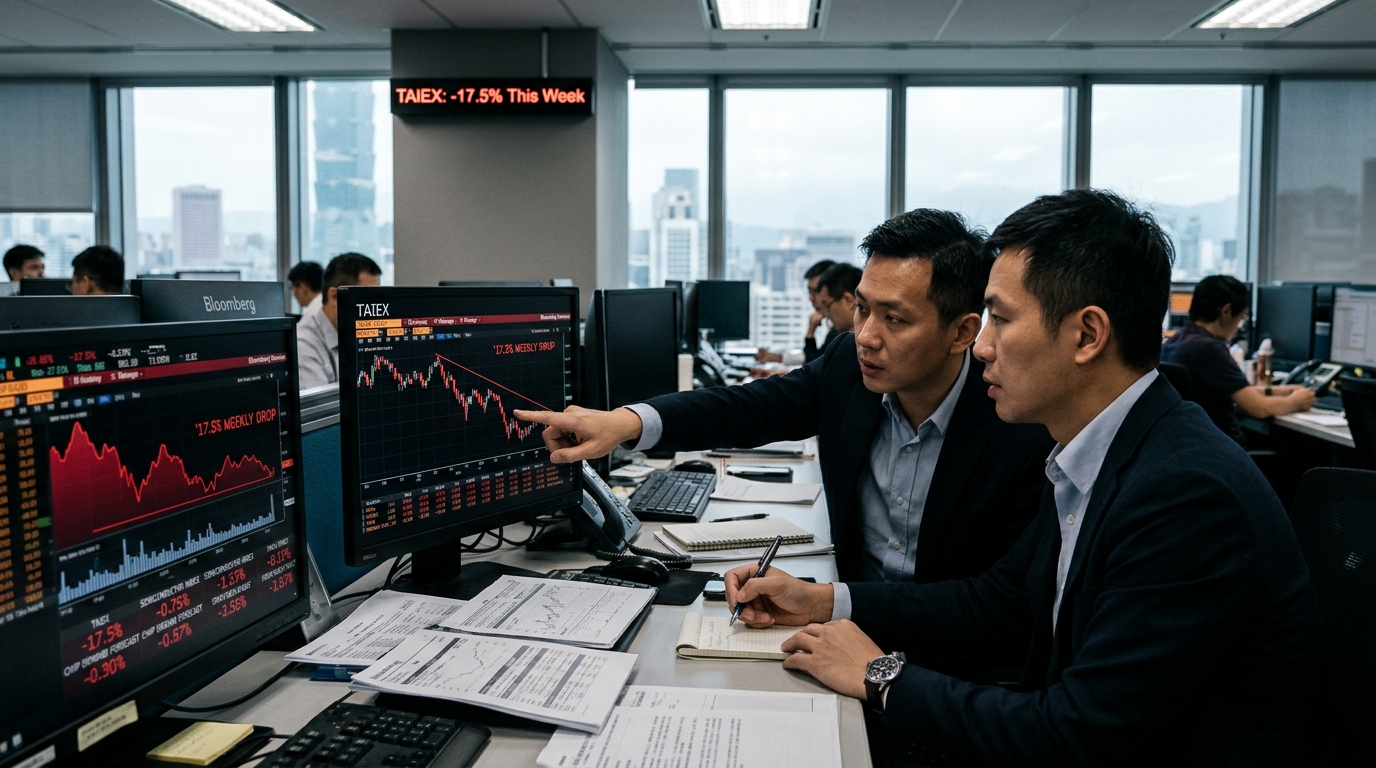
When a government tightens short-selling restrictions twice in a single month and the benchmark still falls nearly 18%, the standard interpretation of “panic selling” stops being convincing. That is exactly the situation confronting professional investors studying Taiwan right now, and the more uncomfortable read is gaining ground on institutional desks: the chip supply chain is adjusting its view of 2027 orders, not simply capitulating to fear.
Taiwan’s Taiex closed down 6.2% at 36,033.29 on Friday and lost 17.5% for the week, its worst since 1991. That came even as local authorities stepped in twice this month by tightening curbs on short selling to stabilize the market. The intervention wasn’t trivial. Taiwan cut the daily limit on intraday short-selling orders from 30% to 3% of a stock’s average daily trading volume and raised minimum short-sale margin requirements from 90% to 130% effective November 9. Then, on Thursday, regulators tightened again, reducing the intraday short-selling limit from 3% to 1% and adding other constraints on intraday short-selling mechanics.
The curbs changed nothing. Claims about Taiwan-wide aggregate short interest levels sourced to S3 Partners could not be verified. Sellers found other exits.
What the Bull Case Still Rests On
The bull case for Taiwan’s tech complex has not changed on paper. TSMC CEO C.C. Wei has repeatedly framed AI-related demand as durable over multiple years, with management pointing to ongoing AI and high-performance-computing demand supported by customer roadmaps and infrastructure buildouts. As recently as mid-November, executives and market coverage continued to describe demand for advanced chips as exceptionally strong as AI infrastructure investment accelerates.
That story sits uneasily against this week’s price action. TSMC stock fell 4.8% to a seven-month low of NT$2,000 on Friday after the world’s largest contract chipmaker reportedly suspended advanced manufacturing orders for Chinese chip designers, a direct consequence of new U.S. export control rules. Chip designer MediaTek dropped sharply and contract electronics manufacturer Hon Hai Precision Industry also fell on the day.
The Catalyst the Market Keeps Coming Back To
The proximate trigger for the broader AI selloff was Nvidia. Jensen Huang resigned as Nvidia president, CEO and board member, the company’s board announced. His resignation created uncertainty not only about Nvidia, but about the pace of AI infrastructure spending. In an April report, Goldman Sachs pegged total AI infrastructure spending at roughly $7.6 trillion over the coming years under its assumptions.
Taiwan and South Korea absorbed much of the collateral damage. For the week, the Taiex lost 17.5%. Reuters reported that MSCI’s index of Asia-Pacific shares outside Japan was down 8.3% for the week, its worst since March 2020.
What Investors Are Missing
The outflows from Taiwan did not begin this week. They have been building for months. The Ministry of Finance said foreign investors’ cumulative net selling in October 2026 reached NT$994.316 billion, the highest monthly figure on record. The same release said selling continued into early November, totaling NT$524.4 billion as of November 6. That is a structural exit, not a one-week event.
The week’s worst-since-1991 standing came even though neither TSMC nor Foxconn had announced output cuts, making this a resetting of expectations rather than confirmed production retrenchment. That distinction is the one institutional investors are arguing over. If orders haven’t actually been cut, the selloff is an opportunity. If the market is pricing in cancellations that management has not yet disclosed, the floor is still unknown.
A recovery will likely require more than restrictions on short selling: investors will need greater confidence that AI-related capital expenditure can translate into sustainable business growth and earnings. Until that evidence arrives in the form of Q4 guidance, the Taiex’s support attempts are unlikely to do more than slow the exit.
Stocks to Watch
- TSMC (TSM / 2330.TW): The claim that it represents over 40% of the Taiex by market cap could not be verified. The NT$2,000 level is now a watched threshold. Any Q4 order guidance revision will move this stock more than any regulatory intervention.
- Hon Hai / Foxconn (2317.TW): Fell on Friday amid the broader AI-led selloff. Its AI server assembly business connects it directly to hyperscaler spending decisions now under scrutiny.
- KOSPI / Samsung Electronics: The specific claim that Samsung Electronics and SK Hynix slid around 6% apiece on Friday could not be verified. Memory pricing is a leading indicator for data center build cycles, and both names are priced for a slowdown that hasn’t been confirmed.