May 21, 2026
Write Down This Ticker Today…
Featured: Walmart Beat on Revenue. Then the Stock Dropped 8%.
Editor’s Note: Larry Benedict – the hedge fund legend who beat the S&P 500 by 18 times in 2025 and made his clients $95 million during the 2008 crisis – says Trump’s installation of a new Federal Reserve chair is triggering the most significant shift in U.S. markets in nearly 20 years. He has already identified the one ticker he believes will be at the center of the money flows – and he’s revealing it completely free. Read more below…
Dear Reader,
Grab a pen and write down this ticker: TLT.
It could be the single most valuable ticker you hear about all year.
Beginning May 2026, billions of dollars could pass through it.
But before you rush out and buy it… WAIT.
There is a very specific way you must play this ticker if you want to make real money from it.
Do it wrong, and you’ll only capture a fraction of what’s possible.
Do it right, and you could double your money in a matter of days.
I know, because I’ve done exactly that before.
My name is Larry Benedict, and I’ve been trading TLT for years.
In that time, I’ve watched a 4% move in this ticker turn into a 117% gain for my readers who followed my recommendation – in just a matter of days.
And it’s all because of the very specific way I trade it.
Discover how to access exactly how I trade this ticker – and why right now is the best setup I’ve seen in years – by watching this exclusive, free briefing.
Click here to learn how to access my complete TLT playbook.
Regards,
Larry Benedict
Founder, The Opportunistic Trader
P.S. The current setup on TLT is more attractive than I have seen in years – but it won’t last forever – so if you want to learn how to position for what could be some of your best gains of 2026, click here.
FEATURED
Walmart Beat on Revenue. Then the Stock Dropped 8%.
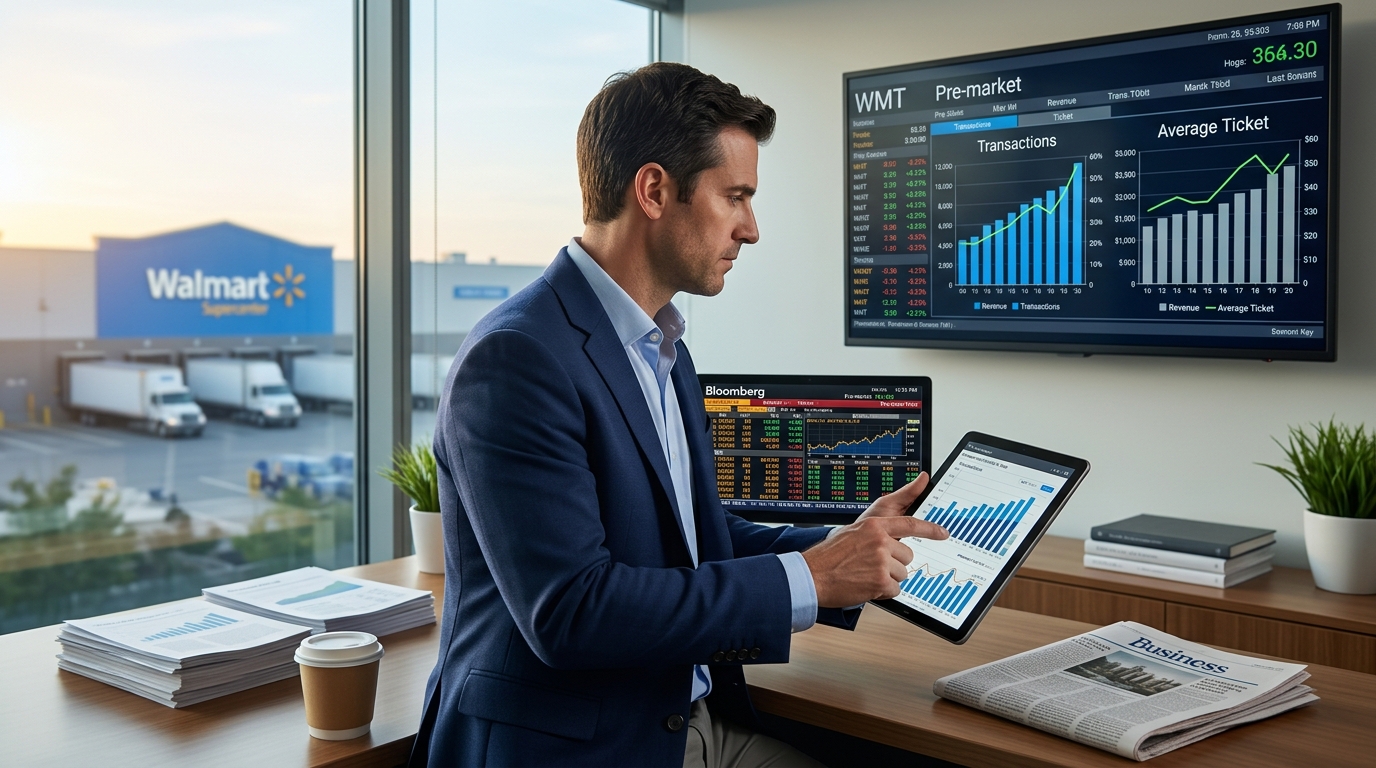
The print is done. Walmart reported Q1 FY2027 this morning and the headline numbers were genuinely strong — and then the stock dropped roughly 8% by the close anyway. That gap between the results and the reaction is where the actual story lives.
Revenue came in at $177.8 billion, a 7.3% year-over-year increase that cleared the $174.98 billion consensus by nearly $3 billion. Adjusted EPS landed at $0.66, right in line with estimates. Net income hit $5.33 billion — up 18.8% from a year ago. On paper, this is a clean beat.
Where the Sell-Off Came From
The problem wasn’t Q1. It was the forward look. Q2 adjusted EPS guidance came in at $0.72–$0.74, short of the $0.75 the street was penciling in. Full-year EPS guidance was held at $2.75–$2.85 — a range that trails the $2.97 analyst consensus. When a stock is priced for perfection and guidance comes in light even by a few cents, the reaction tends to be disproportionate. That’s what happened today.
The margin pressure has a specific source. Operating income took a 250 basis point hit from elevated fuel costs in distribution and fulfillment. Management flagged that the tailwind from higher tax refunds earlier in the year — which had cushioned consumers against rising pump prices — is likely to fade into Q2, leaving households more exposed. That’s not a Walmart-specific problem. It’s a consumer-condition problem wearing a Walmart uniform.
The Numbers That Actually Held Up
Comparable U.S. store sales rose 4.1% excluding fuel — above the 3.85% consensus. Global e-commerce volume expanded 26%. The advertising segment posted 37% growth. Walmart Connect in the U.S. grew 44% excluding VIZIO. Traffic at Walmart U.S. was up 3%, Sam’s Club up 6%. These aren’t soft numbers. The flywheel is working.
Slight tangent worth noting: on tariffs, management essentially signaled they’re leaning into price investment rather than aggressive pass-through. They’re pursuing tariff refunds but acknowledged the maximum eligible recovery represents less than half of 1% of U.S. annual sales — so that’s not moving the needle. The playbook is to absorb where possible and protect the price gap. For the broader retail complex, that’s the dovish read the sector needed.
Full-year constant currency sales guidance held at 3.5–4.5%, and management noted Q1’s 5.7% constant currency growth puts them tracking toward the upper end of that range. The framework to grow operating income faster than sales remains intact.
What the market decided today: the top line is fine, the earnings power trajectory is murkier than the valuation implies. With EV/EBITDA near 25x — roughly double where it sat in 2024 — there isn’t much room for guidance to disappoint even slightly. Today was a re-rating moment, not a fundamental breakdown. Those are very different things, and how you frame that distinction probably determines your next move.