July 3, 2026
Tesla Delivered 480,126 Cars. The Stock Dropped 7% Anyway.
The delivery beat was never really the question. July 22 is.
Here’s the thing about Tesla right now: the car business is working again, and almost nobody cares.
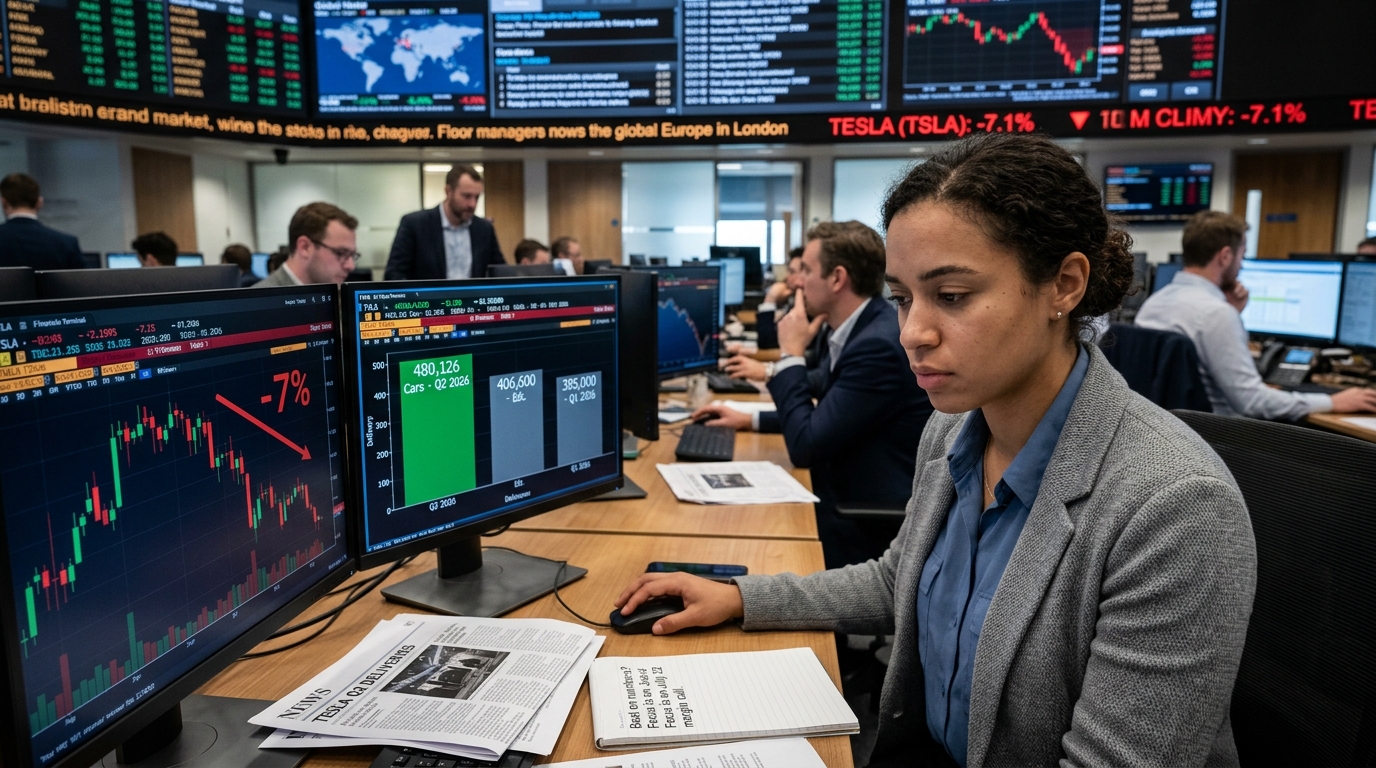
480,126 vehicles delivered in Q2 2026. Up 25% year over year. Up 34% from Q1. Wall Street’s StreetAccount consensus was roughly 406,600 — so the beat wasn’t close. Morgan Stanley called it the strongest year-over-year auto growth rate since Q3 of 2023. And yet TSLA dropped 7.49% on July 2, closing at $393.45, its worst single-day decline in nearly a year.
It has now fallen on each of the past three quarterly delivery reports.
What’s Actually Going On
The stock had already surged heading into the report. Shares climbed over 8% on a new FSD v14 Lite software rollout just three trading sessions before the delivery number hit. The market front-ran the data, the data landed, and sellers showed up right on schedule. Classic buy-the-rumor reaction.
But there’s a deeper issue, and it matters a lot more than short-term positioning.
Tesla’s trailing P/E sits north of 380x depending on the source. On a forward basis, the stock is pricing in roughly 200x earnings estimates. At that kind of multiple, vehicle deliveries are essentially irrelevant. What the market is actually pricing is the Robotaxi, Optimus, and Full Self-Driving story. And none of those showed up in Thursday’s report in any material way.
What’s Inside Elon Musk’s Mystery Crates?
Right now, 4,000 of these are rolling out of a high-security compound in Lathrop, California to critical locations all across America…
They have nothing to do with cars or space. And nothing to do with AI, robots or crypto…
Almost nobody knows what’s inside them. But Adam O’Dell does…
And he believes they will go down as Elon’s greatest ever invention…
Which is why he says that anyone who understands what’s going on here, and positions themselves before July 22, could walk away wealthier than they ever thought possible.
Truist analyst William Stein kept a Hold rating while raising his target from $400 to $430, but flagged the core issue directly: AI projects, and FSD in particular, matter far more to Tesla’s long-term cash flow than vehicle delivery counts. That’s the crux of it.
The Numbers Worth Noting
- Q2 deliveries: 480,126 vehicles vs. ~406,600 expected (StreetAccount) — an 18% beat per Morgan Stanley
- Production: 451,758 vehicles — Tesla shipped more than it built, drawing down the 50,000-unit inventory overhang from Q1
- Model 3 and Model Y: 467,762 units, roughly 97% of total deliveries
- Energy storage: 13.5 GWh deployed, up over 50% from Q1’s 8.8 GWh (analysts had expected 13.3-13.8 GWh)
- FSD subscriptions as of Q1 2026: 1.28 million, up 51% year over year
- Q1 automotive gross margin ex-regulatory credits: 19.2% — the strongest of any quarter in 2025
Demand held up better than many expected internationally. Europe has been a meaningful tailwind — battery-electric cars captured 20% of the EU market through May, up from 15.3% a year earlier. The U.S. picture is rougher. Cox Automotive projects Tesla’s domestic Q2 sales fell roughly 20% year over year, largely a result of the $7,500 federal EV tax credit expiring at the end of Q3 2025 under the One Big Beautiful Bill Act. Higher gas prices tied to the Iran conflict may have also pulled some international buyers forward.
Worth flagging separately: according to SpaceX’s IPO filing, xAI — now part of SpaceX following a merger — purchased $269 million worth of Tesla Megapacks in April 2026 alone. SpaceX is using those batteries to reduce electricity costs at xAI’s data centers in Memphis and Southaven, Mississippi. Combined with prior purchases, SpaceX and xAI have now spent nearly $1 billion on Tesla products and services since 2024. Tesla did not disclose in its Q2 delivery report whether related-party transactions contributed to the energy storage number. That detail, if material, would typically surface in the July 22 financial filing.
2,500X Smaller Than SpaceX
While everyone piles into the biggest IPO in history…
The man who saw what the Facebook IPO REALLY created is looking somewhere else entirely.
At companies a fraction of SpaceX’s size…
The kind he says get swept up in what he calls the “Aftershock.”
Click here now to see what he’s found.
P.S. History shows past aftershocks minted gains of 1,200%… 17,000%… even 299,000% over the decades. Details here.
What’s Missing From the Story
The Q1 gross margin of 21.1% — the strongest in several years — came with an asterisk. Tesla’s own 10-Q noted the improvement was helped by one-time benefits related to warranty and tariffs. Automotive gross margin excluding regulatory credits came in at 19.2%. Whether that figure can hold in Q2, after Tesla had to work through a 50,000-unit inventory build using delivery incentives across China and Europe, is exactly the kind of question institutional money is waiting to answer before adding exposure here.
Last year, SpaceX spent $131 million purchasing Tesla Cybertrucks, representing a large portion of the 20,237 Cybertrucks Tesla sold in all of 2025 according to Kelley Blue Book. Related-party demand has been a real variable in Tesla’s reported numbers. It doesn’t invalidate the delivery beat — even stripping out favorable one-time factors, this was a strong quarter — but it does raise the bar for clean margin confirmation on July 22.
Three Scenarios Into July 22
Bull case: Q2 automotive gross margin ex-regulatory credits holds at or above 19% without one-time support. Robotaxi expansion continues toward the roughly 1,000 vehicles targeted by year-end. Cybercab production confirmation arrives. FSD subscriber growth accelerates beyond the 1.28 million Q1 figure. The stock finds a reason to re-rate toward prior highs near $450-$500.
Base case: Margins soften slightly from Q1’s 19.2% ex-credits as delivery incentives weigh on ASPs. Robotaxi revenue remains immaterial to total results. Optimus ramp is on track but not yet showing up in numbers. Stock consolidates in the $380-$430 range pending further data.
Bear case: Gross margin compresses meaningfully. Free cash flow turns negative again — management already guided that capex will exceed $25 billion in 2026, up from an earlier $20 billion estimate, and warned of negative free cash flow for the remainder of the year. Cybercab production disappoints. Optimus timeline slips. At north of 380x trailing earnings, there is virtually no margin for error on execution. A single quarter of deteriorating economics could pressure the stock toward the $340-$360 range seen in April.
No. 1 Stock to Buy for THIS MONDAY
Heads up: Tim Bohen’s new algorithm just uncovered a dirt-cheap stock that could DOUBLE or MORE this coming Monday. This powerful algo has already identified Monday moves of 149%, 190%, and even a whopping 536%…
Click here to see how to get positioned ahead of this Monday’s setup!
What to Watch
The July 22 earnings call is the only thing that matters right now. Watch automotive gross margin excluding regulatory credits — can it hold above 19% without one-time items? Watch Cybercab production volumes and any concrete Optimus timeline update. Watch FSD paid subscriber additions and average revenue per subscriber. Revenue and delivery beats are already priced in. The market wants to see whether this spending cycle is actually producing returns.
The bull case and the bear case are both coherent at this valuation. That’s what makes July 22 worth watching carefully.
For informational and educational purposes only. Not investment advice. Trading involves risk, including loss of principal.