July 16, 2026
SpaceX Just Fell Back to Its IPO Price. The Real Trade Starts Now.
SPCX hit a post-IPO low this week — 22 trading days after the largest IPO in history. Here is the framework traders need before the lockup clock expires.
Below is an important message from one of our highly valued sponsors. Please read it carefully as they have some special information to share with you.
Dear Reader,
It’s official…
SpaceX is going public…
And they’re saying it could be anywhere from $800 billion…
To $1.5 TRILLION!
To date, the biggest IPO ever was Saudi Aramco… at a mere $25.6 billion.
That means…
SpaceX’s IPO could be 58X BIGGER than the largest IPO in history.
Wall Street insiders are salivating at this massive stock move.
But here’s the thing…
You do NOT have to be left out of this once-in-a-lifetime opportunity.
In fact, you can get action on this SpaceX IPO right now – before it goes public, in a regular brokerage account …
And you can get into this play for less than $100.
Click here for the full story.
It sounds nuts…
But this is your chance to beat Wall Street to the punch…
And get a piece of the action on the BIGGEST IPO in history…
Before the news even hits the market.
Do NOT miss this opportunity.
Click here to learn how to claim your stake NOW.
Best,
Matt Insley
Publisher, Paradigm Press
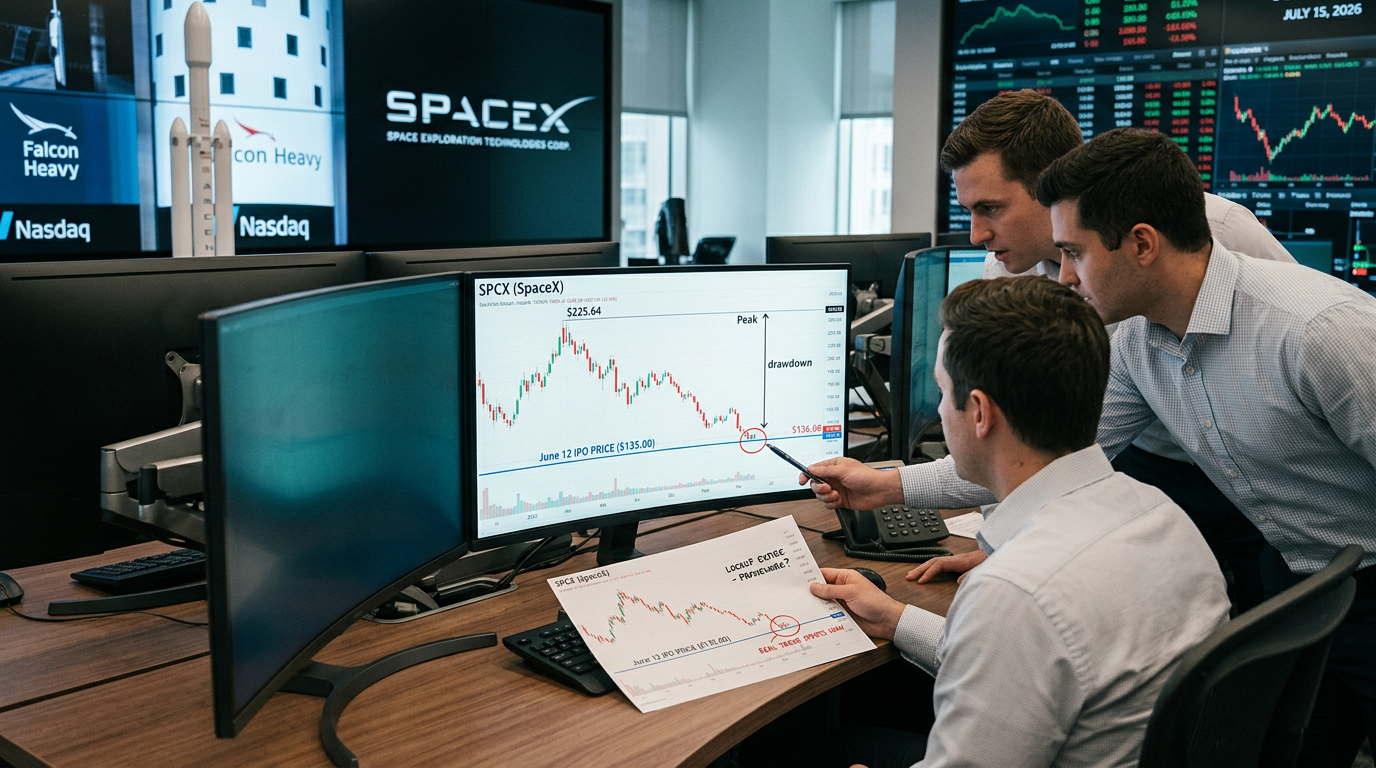
July 15, 2026. Twenty-two trading days after the biggest IPO in history, SpaceX (Nasdaq: SPCX) touched $136.08 on July 13 — just above the $135 price at which shares were sold to the public on June 12. The stock that briefly hit $225.64 after its debut, briefly pushing its market cap to roughly $2.6 trillion, has now erased the entire post-IPO run. That’s a ~39.7% drawdown from peak to trough in just over a month.
This is not a broken company. This is a broken float structure colliding with a market that initially had no anchor for the valuation.
What the Numbers Actually Say
Start with the fundamentals, because the debate here is not really about SpaceX’s technology. It’s about timeline and probability.
For Q1 2026, SpaceX generated about $4.69 billion in consolidated revenue, and posted a consolidated loss from operations of about $657 million. The company carries an accumulated deficit of $41.311 billion. SpaceX completed its all-stock xAI merger on February 2, 2026, which it has described as a move aimed at enabling space-based data center ambitions.
The profitable piece of the business is Starlink, which generated about $11.4 billion in 2025 revenue and about $4.4 billion in operating profit. As of March 31, 2026, SpaceX reported roughly 10.3 million Starlink subscribers across 164 countries, territories, and other markets. That’s a real, growing, cash-generative business. But average revenue per subscriber has declined by roughly a quarter since 2024, and that trend will show up in margin modeling.
SpaceX reported 2025 revenue of $18.67 billion alongside a net loss of $4.94 billion. At current prices, you’re still paying a very high multiple of trailing sales.
Analyst targets range from Morningstar’s $62 bear case to Raymond James’s $800 price target, implying a spread of $738 per share. That is not analytical incompetence — it’s a structural valuation problem when you have three businesses (launch, connectivity, AI) at completely different stages of demonstrability, stapled under one ticker.
The Float Problem Is What Matters Right Now
Here’s where active traders need to pay attention. SpaceX raised $75 billion in its IPO, selling 555,555,555 Class A shares. Those IPO shares represent only about 4%–5% of total shares outstanding, meaning the other ~95% is locked. That’s the most extreme float constraint on any stock of this size in modern market history, and it’s why the stock moved violently in its first days on thin supply.
Now supply is about to arrive — in stages.
The first major unlock comes tied to SpaceX’s Q2 2026 earnings (date not yet confirmed publicly). On or after the second full trading day following that earnings release, 20% of the “Early Release Eligible Shares” become eligible to sell. An additional 10% tranche unlocks if SPCX closes at least 30% above its $135 IPO price (the $175.50 threshold) on at least 5 of the 10 trading days heading into and including that earnings date. That threshold has not been met recently, so that bonus tranche remains conditional.
After the Q2 earnings unlock, 7% tranches follow at approximately 70, 90, 105, 120, and 135 days from the June 12 listing date. A larger 28% release is tied to Q3 2026 earnings, and the standard 180-day mark lands on December 9, 2026 (counting 180 calendar days from June 12, 2026). Elon Musk and certain other major holders are subject to a separate ~366-day lockup that runs into June 2027.
One analyst noted that insiders could theoretically sell a large share of locked stock by early September, dramatically increasing the current float. Whether insiders actually sell is the variable. The Facebook 2012 playbook — where insiders mostly held through the initial lockup expiry, which the market read as confidence — is the historical reference point worth studying.
The Starship Variable
Starship Flight 13 is scheduled for Thursday, July 16 from Starbase, Texas. This flight is notable because it is expected to deploy 20 Starlink V3 satellites for the first time. The FAA cleared SpaceX to fly Starship again after the company identified a probable cause of a booster-stage failure during a May test flight. This is a real-world engineering milestone, not marketing — and the market reaction will likely be swift in either direction.
SpaceX’s Falcon rockets have built a long track record and a high mission success rate. What matters for orbital AI data centers — the highest-multiple business in the thesis — is whether in-orbit refueling of Starship can be demonstrated. SpaceX has disclosed that this capability has not yet been attempted. The company has said it expects to begin deploying orbital compute satellites as early as 2028.
Technical Structure and Key Levels
SPCX’s post-IPO range spans $135.00 to $225.64. The post-IPO low was set July 13 at $136.08. Current price is approximately $136–138. The IPO price of $135 is now the most visible technical floor — a price-memory level backed by millions of public-offering participants who own shares at exactly that number. A break and close below $135 on meaningful volume would be a structurally significant event.
On the upside, the first meaningful resistance cluster sits near $160–165 — the range where the stock traded early after listing and where early institutional buyers may have established positions. The $175.50 level carries mechanical significance given the lockup trigger math. Volume structure has been compressed by the thin float. When the lockup tranches hit, the daily volume dynamics will shift materially — reducing the volatility premium that currently inflates short-term price swings but also reducing the potential for short-squeeze-driven runs.
Three Scenarios Worth Modeling
Bull Case — Starship Flight 13 succeeds with clean satellite deployment. Q2 earnings in August show Starlink subscriber growth and ARPU stabilization. Insiders hold through the first unlock, which the market reads as confidence signal. SPCX reclaims $165–$180 on volume. The Q3 earnings-linked 28% float expansion is absorbed by institutional buying pressure tied to Nasdaq-100 index inclusion.
Base Case — Stock stabilizes near IPO price ahead of August earnings. Q2 results show continued Starlink revenue growth but elevated AI spending. First unlock proceeds without significant insider selling. SPCX trades in a $130–$165 range through September as successive 7% tranches introduce moderate overhead supply pressure. The real earnings story doesn’t arrive until the company confirms its Q2 earnings date.
Bear Case — Starship Flight 13 encounters a technical setback. Q2 earnings show widening losses with no clear AI revenue path. Insider selling materializes across the first two unlocks, float expands materially, and with improved price discovery, the stock retests toward $100–$115 as the multiple compresses. Morningstar’s $62 DCF target becomes a reference point.
Active Trader Framework
The near-term positioning question is less about long-term SpaceX conviction and more about float supply mechanics. The Q2 earnings-linked lockup unlock is the most consequential single event in the next 60 days — not because insiders are definitely selling, but because the market will price in the uncertainty before it knows the answer.
Traders monitoring SPCX should track three things: (1) whether Starship Flight 13 succeeds and how the market reacts on July 16, (2) the Q2 earnings date announcement — once confirmed, the unlock window starts its countdown — and (3) whether SPCX can reclaim and hold above $150 ahead of that earnings release, which would shift the technical narrative from breakdown to stabilization.
Position sizing relative to this stock’s beta profile is a first-order risk management consideration. A stock with extreme market sensitivity behaves like a leveraged instrument during broad market swings. Sizing it as you would a conventional large-cap will mismatch your risk exposure significantly.
The supply calendar creates a known framework. The engineering calendar — Flight 13, Q2 earnings, the unlock — defines the event window. What happens inside that window is where the position management discipline gets tested.
For informational and educational purposes only. Not investment advice. Trading involves risk, including loss of principal.