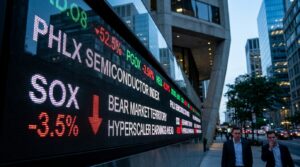
While chips were getting demolished and the Nasdaq was sinking Friday morning, one stock quietly hit a 52-week high on the heaviest earnings beat of the quarter.
Travelers.
The market was not expecting this.
The Numbers Are Hard to Ignore
Travelers (TRV) reported Q2 2026 results before the bell this morning. The consensus was $5.33 per share. The company delivered $10.04. That is an 86% beat on a metric where the analyst range spanned from $4.17 to $7.37 — meaning even the most optimistic analysts did not get there.
Revenue came in at $12.15 billion against expectations of $11.03 billion. Combined ratio hit 83.6%, down sharply from 90.3% a year ago and nearly 1,200 basis points better than the analyst estimate of 95.1%. That is not a small miss. That is a structural re-rating event.
Catastrophe losses fell to $518 million pre-tax from $927 million in the year-ago quarter. Net investment income grew 14% year over year to $883 million after tax. Pre-tax underwriting income was $1.7 billion. The company returned $1.58 billion to shareholders in a single quarter, including $1.31 billion through buybacks.
CEO Alan Schnitzer said on the call that Travelers produced its eighth consecutive quarter of after-tax underlying underwriting income above $1 billion. Core return on equity came in at 24.9%. That is a durable business printing real money, not a one-quarter fluke.
The Contrast With Progressive Is the Story
Here is where it gets interesting. The day before this report, Progressive (PGR) got obliterated — down roughly 9% after its June monthly data showed slowing premium growth and pricing pressure. The broader P&C sector traded off with it. TRV opened today in a completely different direction.
The divergence matters. It tells you something about how the market is thinking about the insurance cycle. Progressive has historically been a growth-at-speed story — aggressive pricing, rapid market share expansion, lean loss ratios. When the auto insurance market softens, that model faces headwinds. Travelers runs a fundamentally different playbook.
Schnitzer said it plainly on the call: competing on price is “a fool’s errand.” The company is not chasing volume. It is optimizing for margin. The Q2 results are the proof.
Why the Rotation Into Defensives Matters Right Now
The PHLX Semiconductor Index is on track for its worst week since the April 2025 tariff meltdown — down approximately 20% from its recent high. The Nasdaq is down. Chinese AI startup Moonshot just dropped a model that sent chip stocks into another leg lower today. The rotation out of high-multiple tech and into economically sensitive sectors that actually earn money is not subtle anymore.
Insurance is not a hot trade. It is not on the cover of anything. But when the SOX is in a bear market and the Dow is losing 300 points on chips, a stock that just beat estimates by 86% and hit a new all-time high draws attention for the right reasons.
The sector dynamics are worth understanding. P&C insurance is a hard market when pricing discipline holds and catastrophe losses normalize. Travelers has been navigating that cycle better than most.
What the Technicals Say
TRV opened at $365 this morning against a prior close of $337.82 — a gap of roughly 8% at the open. Volume is elevated. The stock is now trading above every major moving average. The prior 52-week high was the resistance level; that level broke cleanly on this morning’s gap up.
The options market had not fully priced this outcome. The wide analyst estimate range heading into the report ($4.17 to $7.37) signaled genuine uncertainty. The actual result at $10.04 sat above even the most aggressive estimate. That kind of surprise is what generates sustained price discovery, not a one-day pop and fade.
Key levels to watch going forward: the $365-$370 zone is where new buyers are stepping in. The gap from $337 to $365 represents a technical air pocket — if the stock revisits that range, it will be a meaningful test of whether the bid is durable. On the upside, there is no technical overhead given the 52-week high breakout.
Three Scenarios for the Second Half
Bull Case: Catastrophe activity remains below 2025 levels through Q3 hurricane season. Investment income continues growing at double-digit rates as the portfolio rolls at higher yields. The combined ratio stays below 90. TRV re-rates toward $400 as the market prices in the durability of the underwriting engine.
Base Case: A moderate hurricane season introduces some catastrophe noise in Q3. The underlying combined ratio holds in the 84-86% range. The stock consolidates the morning’s gains and trades sideways in a $355-$380 band as investors wait for Q3 data.
Bear Case: A major catastrophe event — a severe hurricane hitting a populated coastal area, or an abnormal wildfire season — drives a spike in catastrophe losses. The reported combined ratio moves above 100% in Q3, as it did in Q1 2025 when large wildfire losses hit. The stock gives back a portion of today’s gains and re-tests the low $330s.
Active Trader Framework
The immediate read-through is that the P&C sector is bifurcating. Travelers is proving that underwriting discipline and pricing power generate returns that are relatively uncorrelated to the AI trade and the chip cycle. Progressive faces different dynamics — it is a more auto-centric book, more exposed to loss cost inflation, and its monthly reporting cadence means bad news hits fast.
For traders watching the broader sector: Chubb (CB) reports July 22. That date becomes the next data point for anyone trying to understand whether the TRV print is company-specific or sector-wide. If Chubb confirms a similar pattern of lower catastrophe losses and strong underlying margins, the insurance sector re-rating trade has legs beyond a single name.
Risk management considerations: position sizing matters in insurance names because catastrophe events can move stocks 10-15% in a single session. That combined ratio print above 100% in Q1 2025 — caused by wildfire losses — is a reminder that even the best-run insurers have quarters that hurt. The question is always whether the core underwriting engine is intact. Today’s Q2 data says it is.
The broader market context is worth sitting with. The chip selloff, the Moonshot model release, the Middle East tension driving oil above $80 — all of it is creating a flight to sectors that generate real earnings without depending on hyperscaler capex. That is not a permanent state. But while the rotation is running, insurance names with strong Q2 results are exactly the kind of stock that gets bought.
What to Watch Next
The next catalysts for the insurance trade are sequential. Chubb reports July 22. If that confirms the trend, the sector becomes a conversation. The Q3 hurricane season tracks through September — that is the primary risk to the bull case. And the Fed’s next move on rates matters: higher-for-longer is structurally positive for insurance investment portfolios, which are overwhelmingly fixed income.
The part people tend to miss is that Travelers is not just an underwriter. After-tax net investment income grew 14% year over year in Q2. That is a durable cash flow stream that does not depend on the AI capex cycle, the chip market, or the Nasdaq.
Today was a reminder that the most interesting trade in a volatile market is not always the loudest one.