August 23, 2026
Broadcom’s $16B Moment Is 10 Days Away
Featured: Broadcom’s $16B Moment Is 10 Days Away
Reader,
If my math is correct, what I’m about to reveal here could generate as many as 410 new millionaires a day.
It’s a brand-new project I call “The Presidio Initiative.”
And the window to get in early is open right now.
I will explain everything in a short video…
I’ll even tell you a way to invest in this right now with a 100% FREE recommendation revealed in the video.
Yours in smart speculation,
Bryan Bottarelli, Co-Founder
Monument Traders Alliance
P.S. Billionaires are already backing this mega-project. Including Elon Musk. According to one respected futurist (and New York Times bestselling author): “Twenty-trillion-dollar checks (are) waiting to be cashed.” But nobody is talking about this quite like what I will show you…
The GPU war gets all the headlines. The custom silicon war is where Broadcom (NASDAQ: AVGO) is quietly making its most consequential moves.
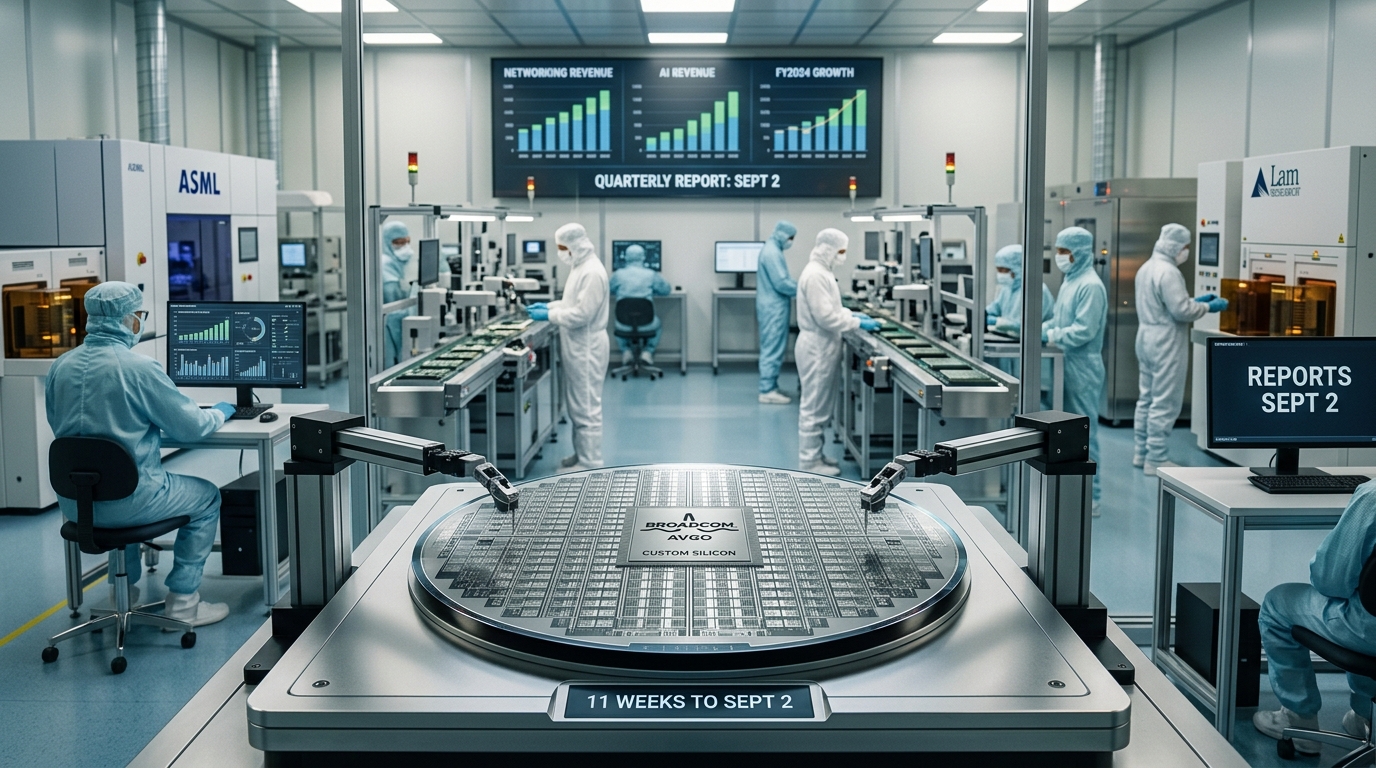
While investors spend August debating general-purpose GPU allocation and inference token economics, Broadcom is running a fundamentally different business model. It designs purpose-built accelerators, called XPUs, for the world’s largest AI spenders and collects on both the compute layer and the network fabric that connects it. September 2 is when the market finds out whether that model is delivering on its most ambitious promise yet.
Market Temperature
The macro backdrop heading into September is complicated but not hostile. The Federal Reserve held rates at 3.50% to 3.75% at its July 28-29 meeting, though the vote was 9-3, with three regional presidents dissenting in favor of a hike. That level of internal division has not been seen since September 2016. Jackson Hole runs August 27-29 this week, and Chair Kevin Warsh’s first keynote as Fed chair on Friday morning is drawing close attention from bond traders weighing the odds for the September 15-16 meeting.
Inflation has cooled from May’s 4.2% CPI reading, with July coming in at 3.4% year-over-year. The Fed’s 2% target remains elusive, and three of its own officials voted for an immediate hike last month. That policy tension is the context in which hyperscalers are still committing to record-level capital expenditure.
For hardware-intensive AI companies, this creates a specific tension. Capital expenditure from hyperscalers is accelerating. Alphabet raised its 2026 capex guide to $195 to $205 billion from $180 to $190 billion on July 22. Microsoft, Amazon, and Meta are running parallel buildouts. That spending must flow somewhere. A meaningful share flows to Broadcom.
Healthcare and financial stocks have led recent rotation, giving some air cover to AI infrastructure names that sold off through July. Broadcom fell roughly 12.6% in a single session after its June 3 Q2 report, even after beating revenue and EPS estimates. The market wanted a higher $100 billion target. It did not get one. The stock has since partially recovered but still sits near $368, roughly 26% below its all-time high of $495 reached on June 3.
Company Introduction
Broadcom is two businesses operating under one ticker. The first is a custom semiconductor company that designs XPUs, Ethernet switches, and co-packaged optics for hyperscale AI clusters. The second is an enterprise software company anchored by VMware, which runs the private cloud infrastructure of most of the Fortune 500.
CEO Hock Tan calls it a two-engine model. What makes it strategically unusual is that both engines reinforce each other. VMware Cloud Foundation generates the recurring software cash flow that funds the XPU roadmap without straining the balance sheet. The XPU wins deepen relationships with the same hyperscalers buying VMware subscriptions. The attachment rate compounds in both directions.
This is not a story about riding one wave. It is a story about building infrastructure that hyperscalers cannot easily walk away from.
Data-Driven Deep Dive
The numbers do not require editorial embellishment. In Q2 fiscal 2026, Broadcom reported revenue of $22.2 billion, up 48% year-over-year, with GAAP net income rising 88% to $9.3 billion. Adjusted EBITDA reached $15.2 billion, representing a 69% margin, above guidance and up 52% from a year earlier. Cash from operations was $10.5 billion for the quarter alone.
The AI semiconductor line is the one analysts are watching most closely. In Q1 fiscal 2026, AI revenue hit $8.4 billion, up 106% year-over-year. In Q2, it reached $10.8 billion, a 143% increase. For Q3, management guided AI semiconductor revenue to $16 billion, which would represent over 200% growth from the year-ago period. That is the number September 2 must deliver.
- Q3 FY2026 revenue guidance: approximately $29.4 billion, up roughly 84% year-over-year
- Q3 AI chip revenue target: $16 billion, representing over 200% year-over-year growth
- Fiscal 2027 AI revenue target: in excess of $100 billion
- Q2 AI bookings: over $30 billion, extending revenue visibility into 2028
- VMware Infrastructure Software: management guided Q3 infrastructure software revenue to approximately $8.9 billion
- Free cash flow, Q2: approximately $10.3 billion
- Consensus analyst rating: Strong Buy, average 12-month price target above $526 per 49 analysts
The customer roster is deep and has expanded materially in 2026. Broadcom co-designs custom AI accelerators and networking with Google, whose TPU program is a long-running partnership. On June 24, OpenAI and Broadcom jointly unveiled Jalapeño, OpenAI’s first custom-built AI inference chip, co-developed with Broadcom as the first in a planned multi-generation compute platform. Anthropic is tied to the same ecosystem: in June, Broadcom and Apollo and Blackstone established a $35 billion AI XPU financing platform to help Anthropic build AI data centers using Broadcom custom chips. Reports from August also indicate Broadcom is in discussions to raise over $60 billion in additional debt financing to support chip procurement for Anthropic, OpenAI, and other AI customers.
One Date – November 27 – Could Reset the American Economy for Good
A $10 TRILLION shift is moving through Washington, D.C. Forensic accountant Joel Litman believes those who understand it before November 27 have a rare opportunity to avoid disaster and get positioned early.
The networking layer deserves equal attention. Broadcom’s Ethernet switching business, anchored by the Tomahawk 6 switch shipping in production volume at 102.4 terabits per second, and its Jericho fabric products, accounted for about 40% of Q2 AI semiconductor revenue. This means Broadcom captures revenue from both GPU and XPU clusters. It is paid regardless of which accelerator wins the compute war.
The VMware side of the business is further along than most investors acknowledge. Since the acquisition, VMware by Broadcom has moved to subscription licensing and ended the sale of perpetual licenses. In Broadcom’s fiscal Q4 2025 commentary, management cited an infrastructure software operating margin of 78%. Analysts continue to debate how quickly subscription conversion and customer churn settle into a steady state, but the recurring revenue base is already funding the AI hardware roadmap at scale.
Strategic Insight
The framing that matters is not GPU versus XPU. It is generalist versus bespoke. General-purpose GPUs are optimized for flexibility. Custom XPUs are optimized for a specific workload at a specific power budget for a specific customer. As AI training and inference workloads mature and become more predictable, the economic case for bespoke silicon strengthens.
Broadcom has reported that AI revenue across all of fiscal 2024 was $12.2 billion. It is now on track to surpass that figure in a single quarter.
The $100 billion fiscal 2027 target is not a marketing number. Management has said it has line of sight to achieve AI chip revenue in excess of $100 billion in fiscal 2027, supported by multi-year customer demand visibility extending into 2028. The combination of compute silicon and networking infrastructure creates what may be the most defensible attachment rate in enterprise technology: every new XPU cluster a customer deploys also requires networking to connect it.
The June selloff was a sentiment event, not a fundamental one. Tan held the $100 billion target rather than raising it, and the market punished the stock despite a Q2 beat. That disconnect is worth examining. The Q3 AI revenue guide of $16 billion came in below some analyst estimates of $17.2 billion, even though $16 billion still represents over 200% year-over-year growth. Broadcom has described an AI order book of roughly $73 billion to be delivered over the next 18 months. That level of near-term visibility is rare in the semiconductor industry.
Risks
Customer concentration is the sharpest risk on the list. A significant portion of Broadcom’s AI semiconductor revenue flows from a small number of hyperscalers. If Google, Meta, or OpenAI reduces AI capex, or shifts strategy, the revenue impact would be immediate and visible. The June selloff, triggered by investor anxiety about a single guidance line, shows how sensitive the stock can be to even the perception of a slowdown.
Supply chain constraints represent a second layer of risk. Broadcom has flagged foundry capacity at advanced nodes as a potential bottleneck for custom accelerator production. Advanced packaging and co-packaged optics are similarly constrained across the industry. Revenue visibility is high, but delivery execution is not immune to manufacturing delays. On July 25, Broadcom signed a memorandum of understanding with Samsung worth more than $200 billion running through 2030, covering high-bandwidth memory and 2-nanometer chip manufacturing, partly to address this risk. It is an MOU, not a firm order, and Samsung described the figure as an estimate.
The VMware transition carries its own friction. Broadcom has concentrated its focus on the top 2,000 global accounts, and aggressive subscription pricing has prompted some customers to evaluate alternatives. Churn in the enterprise base would weaken the recurring revenue profile that funds the AI hardware roadmap.
Geopolitical risk is persistent. Shifting export controls could complicate future deliveries and demand patterns, particularly for legacy semiconductor lines and customers with international deployment footprints.
Big Picture
The AI infrastructure buildout is entering a more selective phase. Hyperscalers are no longer buying compute indiscriminately. They are optimizing for power efficiency, total cost of ownership, and workload specificity. That is precisely the environment where custom silicon wins.
Alphabet, Amazon, Microsoft, and Meta are collectively tracking toward roughly $725 billion in combined 2026 capital expenditure, up approximately 77% from 2025. The routing of that spend is becoming increasingly deliberate. Broadcom is embedded in commitments from several of the largest spenders. The remaining question is not whether demand is real. It is whether Broadcom can manufacture and deliver at the pace its own backlog demands.
The VMware software engine adds a dimension that purely hardware-focused AI plays cannot match. As the subscription model matures, the software segment’s recurring cash flow could accelerate, giving management additional capital to deploy into the next generation of XPU co-design agreements. Infrastructure software operating margins of 78% are not common in enterprise technology.
Forty-nine analysts covering AVGO hold a Strong Buy consensus rating, with an average 12-month price target above $526, implying roughly 43% upside from current levels near $368. Valuation multiples shift quickly with price and forward estimates, and the stock is down 26% from its June 3 all-time high. The gap between what the fundamentals imply and what the stock currently reflects has widened.
Scenario Modeling
Bull Case: Broadcom reports Q3 AI revenue at or above the $16 billion guide, total revenue meets or exceeds the $29.4 billion consensus, and management provides upward color on the fiscal 2027 $100 billion target. Hyperscaler capex commitments for 2027 hold or escalate. The stock reopens the path toward the $400 to $420 range and potentially back toward its June highs near $495. Conditions required: clean delivery on AI guide, no VMware revenue miss, no macro shock from Jackson Hole or the September 15-16 FOMC meeting.
Base Case: Broadcom meets the $16 billion AI revenue guide, delivers total revenue near $29.4 billion, and reaffirms the fiscal 2027 $100 billion target without raising it. The stock stabilizes in the $360 to $395 range. This is the most probable outcome given the visibility Broadcom has provided into its backlog and the multi-year contracts already in place.
Bear Case: AI revenue falls short of the $16 billion guide, VMware infrastructure software again misses estimates as it did in Q2, and management language on fiscal 2027 turns cautious. Any signal that a large hyperscaler is pulling back on XPU commitments would compound the damage. The stock could retest levels in the $320 to $340 range, consistent with the lower end of its recent trading band.
Active Trader Strategy Framework
With September 2 ten days out, the volatility window is open. Implied volatility in AVGO options typically expands in the week before earnings and compresses sharply after the report, regardless of direction.
Key levels to monitor: The $368 area is current price and recent support. A break below $340 would represent a retest of post-June lows and shift short-term momentum negative. On the upside, $395 to $400 is the first meaningful resistance from the July consolidation range. The 50-day moving average and VWAP from the post-earnings flush are both worth tracking as the report date approaches.
Position sizing is the primary risk management lever here. Earnings reports at this valuation with this level of expectation create binary outcomes. The June session, where the stock dropped over 12% on a technical beat, is a reference point every trader should have in view. Sizing accordingly, rather than betting on a directional outcome, is the framework that survives both scenarios.
For traders already holding AVGO, the question is not whether to own it through earnings. It is how much of that position to carry versus the downside implied by a miss scenario. Volatility expectations, position sizing, and key levels are the decision inputs. Directional conviction alone is not a risk management framework.
Final Thought
Broadcom has earned its reputation as the quieter beneficiary of the AI capital expenditure wave. It does not manufacture the most talked-about chip. It designs the chip your cloud provider cannot build without it, and then sells that provider the software to run everything else. The Jalapeño chip with OpenAI, the $35 billion XPU financing platform for Anthropic, the Samsung manufacturing MOU: each of these is a new data point that did not exist three months ago. The customer list is not standing still.
September 2 is the moment of reckoning. The $16 billion Q3 AI revenue target, an 84% year-over-year surge in total revenue, and the $100 billion fiscal 2027 ambition will either be validated or complicated in a single earnings session. The June selloff showed that the market expects precision at this valuation. That is a risk worth sizing carefully.
Investors who have been waiting for a cleaner entry since June’s post-earnings flush may be watching the window close. The backlog is growing. The customer list is expanding. The VMware flywheel is accelerating. And the September 2 report could be the data point that finally closes the gap between what Broadcom’s fundamentals say and what its stock price near $368 currently reflects.
AVGO is worth a close look, not as a momentum trade, but as a structurally differentiated AI infrastructure franchise reporting its most consequential quarter in company history.
For informational and educational purposes only. Not investment advice. Trading involves risk, including loss of principal.