October 15, 2026
The bacterial self-healing concrete boom has an invisible input supplier, and it reports earnings in 14 days.
Most traders watching Linde plc (LIN) have been focused on its record electronics backlog and AI-driven semiconductor gas demand. That is a real story. But a quieter structural tailwind is building in construction materials, and the numbers are large enough to reframe how you think about LIN’s manufacturing segment going into the October 29 earnings release.
Former CIA Analyst: “These Are Elon’s Next Three Moves”
The man who called the SpaceX IPO almost to the exact day says Elon is about to spend his $2.1 trillion war chest on three publicly traded companies.
The Market Nobody Is Pricing
Biomanufactured self-healing concrete is crossing from laboratory curiosity to commercial infrastructure product. The mechanism is precise: dormant bacterial spores embedded in concrete activate when water enters a crack, precipitate calcium carbonate through microbial-induced calcite precipitation, and seal the fracture autonomously. Lab trials report up to 95% crack closure and 90% strength recovery. Basilisk Self-Healing Concrete, commercialized from TU Delft research, seals cracks up to 1 millimeter and can cut shrinkage reinforcement needs by up to 40%.
The market behind this is accelerating. One widely cited market estimate (The Business Research Company, via Research and Markets) puts the global self-healing concrete market at $122.94 billion in 2026, growing at a 31.7% compound annual rate toward roughly $362 billion by 2030. Concrete and cement remain a decarbonization pressure point. Cement production is widely estimated at about 8% of global CO2 emissions, giving regulators an incentive to accelerate specification of lower-lifecycle-emissions materials.
Where Linde Enters the Chain
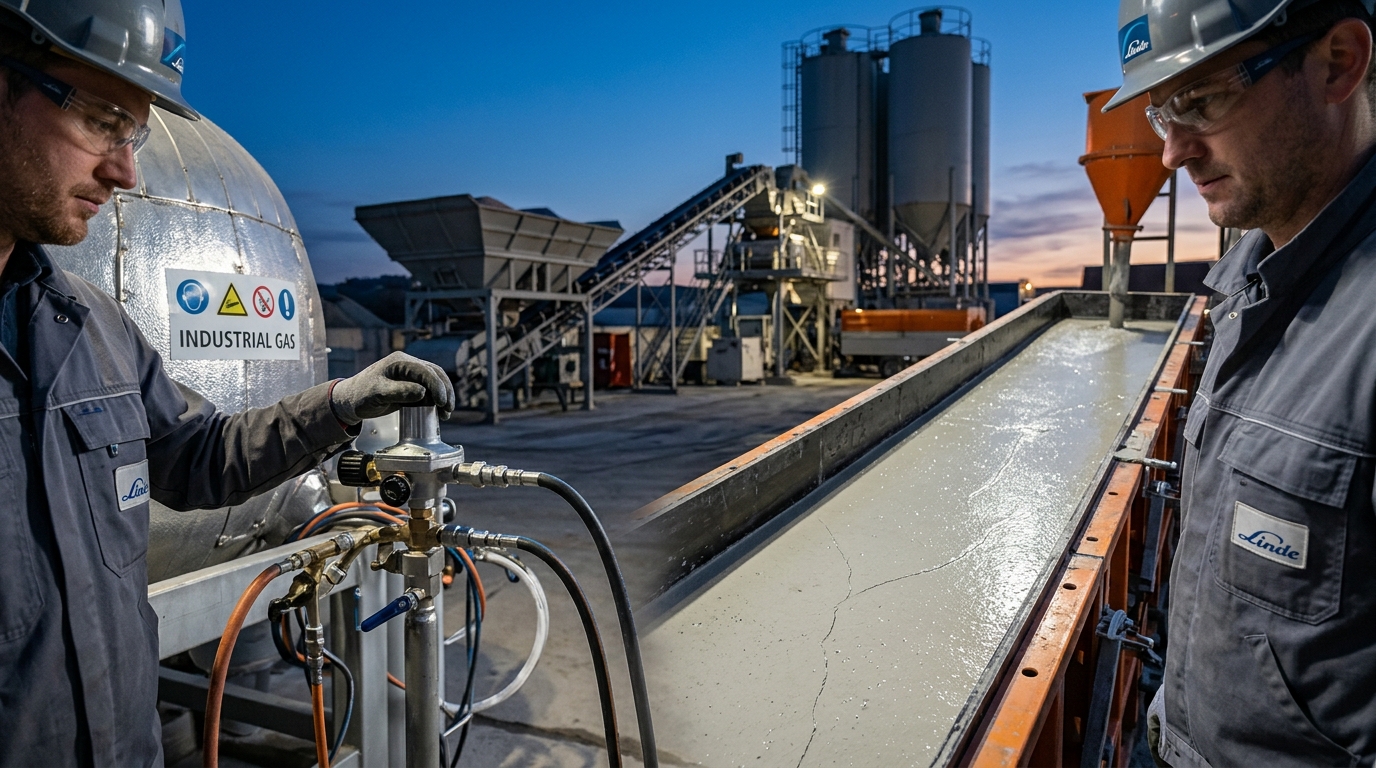
Bioreactor cultivation of bacterial strains is the chokepoint that markets have not priced into LIN. Growing organisms like Sporosarcina pasteurii at commercial scale requires precise, continuous delivery of oxygen, nitrogen, carbon dioxide, and air. These are not commodity inputs at this stage; they require controlled pressure, temperature, and flow throughout the process cycle. Linde is a global industrial gas supplier whose core products include exactly the atmospheric and process gases biomanufacturing requires. Publicly available disclosures support that Linde has operated more than 550 air separation units, while older Linde materials describe having more than 100 CO2 plants globally.
Linde already demonstrated its position at the construction materials intersection when it partnered with Heidelberg Materials to jointly build, own and operate a carbon capture and liquefaction facility at Heidelberg Materials’ Lengfurt plant in Germany. The project is designed to capture, liquefy and purify around 70,000 tons of CO2 per year, with most of the resulting liquid CO2 marketed by Linde for industrial end markets. That joint venture structure is a relevant template for a scaling advanced-materials manufacturer that needs reliable, high-purity gas supply and on-site integration.
Wall Street Is Quietly Stepping Back From the Dollar
Analysts are calling it the ‘Sell America’ trade. Goldman Sachs analysts describe gold as a hedge against currency debasement, and when confidence in the dollar softens, money has historically flowed into gold. If decades of your savings sit in dollar-based accounts, this shift matters. America’s Gold Company’s FREE guide shows how physical metals may help diversify your savings.
See what the smart money sees. Get your FREE Precious Metals Retirement Guide today.
The Numbers Around the Catalyst
LIN closed October 13 at $492.11, sitting 10.3% below its 52-week high of $548.20. Q2 2026 sales were $9.3 billion, up 9% year over year, with adjusted EPS of $4.50 beating consensus by a cent. Linde reported a record sale-of-gas backlog of large projects under construction of $8.1 billion at June 30, 2026. Q3 results land October 29, with analysts expecting $4.52 EPS on $9.16 billion in revenue, representing 7.4% earnings growth. Linde has beaten consensus EPS in each of its last eight quarters.
The consensus analyst price target sits at $544.30, roughly 10.6% above current levels. Barclays initiated coverage with an Overweight and a $577 target on October 13. UBS holds Buy at $574. Deutsche Bank has the stock rated Buy, but the specific $575 target cited here was not independently verified and is omitted. The market is pricing LIN primarily as a semiconductor and clean hydrogen play. The biomanufacturing construction angle has not entered the Street’s sector rotation conversation yet.
Scenario Framework
Bull case: Q3 results confirm electronics momentum continues and management flags new manufacturing-segment contract activity. LIN moves toward $544 consensus target. Bio-concrete adoption accelerates post-2027, expanding the manufacturing segment pipeline.
Base case: Q3 meets estimates; Lincare margin drag persists but is contained. LIN trades in the $490 to $520 range through year-end as backlog-to-revenue conversion remains the primary focus. Bio-concrete remains a watch item rather than a near-term revenue driver for Linde specifically.
Not the Same Old List of Top Stocks
Lately every top stock list has started looking the same.
And while there’s nothing wrong with Nvidia, Tesla or SpaceX…
We believe there are many other top-quality opportunities out there for investors who dig into the details.
That’s why our MarketBeat analysts took a deep dive into the numbers and came up with an all-new list of the 5 Best Stocks to Buy Now.
Bear case: Operating margin deteriorates further from the 29.5% Q2 level. Full-year guidance narrows to the lower end of the $17.70 to $17.90 range. LIN retests the $450 to $460 support zone if the Lincare review drags into 2027 without resolution.
Trading Framework
The October 29 release is the near-term decision gate. Positions built ahead of earnings carry event risk on both sides. Watch the manufacturing segment volume line in the Q3 release: any commentary on biomanufacturing or advanced materials partnerships would be a first-time catalyst. LIN’s beta of 0.71 makes it one of the lower-volatility ways to hold exposure to specialty gas secular growth. The 14-day window before earnings is the relevant timeframe for sizing decisions. Margin stabilization, not backlog growth, will determine the post-earnings direction.
The self-healing concrete market is scaling. The gas infrastructure required to cultivate the bacteria is already built. The company that owns that infrastructure reports in two weeks.