
September 3, 2026
Waller broke from the hike camp. September 11 CPI decides everything.
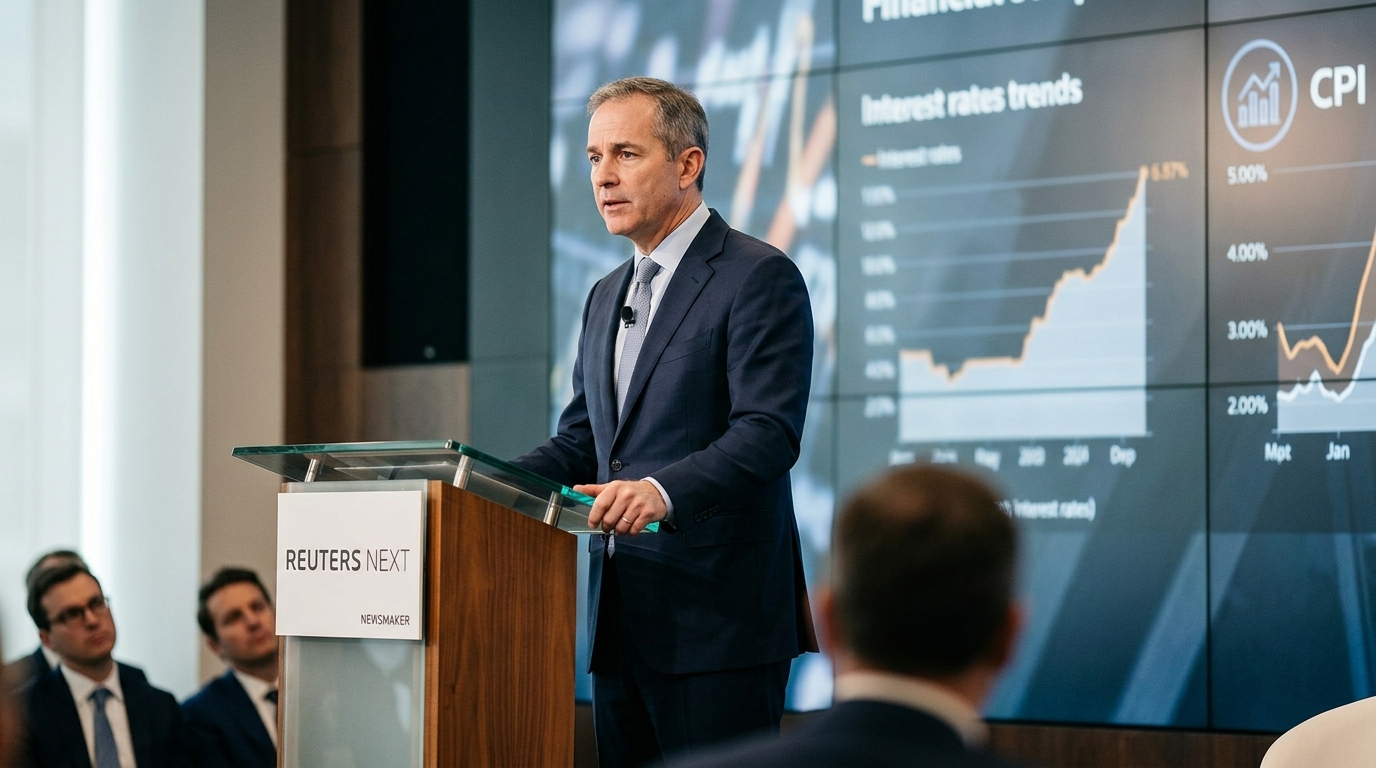
The most consequential 90 minutes in rates markets this week did not come from Chair Warsh. They came from Governor Christopher Waller, who stepped to the podium at a Reuters NEXT Newsmaker event this morning and handed traders something they had not had since Jackson Hole: a credible counter-signal.
3 Triggers Set to Ignite America’s Biggest Tech Boom in 20 Years
Three triggers are converging right now.
The same kind that once turned $5,000 into $135,000 on Qualcomm in 12 months…
And $127,500 on Amazon in two years…
Wall Street already knows.
They quietly piled billions into this corner of the market while the headlines screamed recession.
This 25-year Wall Street veteran says most Americans will miss it completely.
See why FREE…
>>Reveal the 3 Triggers – See Which Tech Stocks Could Move Next<<
Market Context
Coming into today, the rate-hike machine looked entrenched. After Warsh’s August 28 Jackson Hole speech, market-based odds for a September hike jumped sharply, with multiple outlets citing CME FedWatch moving from roughly the mid-30% range to the high-50% range. By Wednesday, the 10-year Treasury had touched 4.818%, a yield not reached since November 2023. And earlier this week, widely cited FedWatch readings had the September meeting leaning toward a hike, in the mid-60% range, before today’s shift.
That move did not happen in a vacuum. Treasury’s doubled buyback program was still days away from launching, leaving duration exposed at exactly the moment the market needed a buyer. how the 10-year broke 4.75% with eight days of no Fed cover explains the structural gap that made this week’s yield spike so difficult to contain.
Then Waller spoke. “If there is continued progress toward our 2% goal, then I am willing to support holding the policy rate at its current level,” he said in prepared remarks posted by the Federal Reserve. Treasuries rallied, trimming yields across maturities by a few basis points, led by the two-year, which is more sensitive to near-term Fed rate changes. The 2-year yield, which topped 4.40% earlier this week for the first time since January 2025, fell as much as seven basis points to around 4.30%. The dollar also weakened on the day, with broad-based softness reported across G10 in the hours after the remarks.
The ISM Services data complicated the picture. Reuters reported that the ISM Services PMI rose to 55.4 in August from 54.1, beating estimates around 54.3 and marking the 26th straight month of services sector expansion, the strongest reading in months. The Business Activity Index jumped 2.6 percentage points to 61.7%, while the New Orders Index registered 60.9%, 3.7 points above July’s reading. Strong services demand keeps the Fed’s inflation problem structurally alive, even as Waller argues the numbers look worse than they are.
What Waller Actually Said
On inflation, Waller leaned heavily on the Fed’s preferred PCE framework and on composition. In his prepared remarks, he said underlying trends are “better than the core numbers suggest.” For context, July CPI inflation was 3.4% year-over-year on the headline measure, with core CPI at 2.5%. He also noted that a shorter-run inflation rate measured by the Fed’s preferred gauge has eased meaningfully since early 2026, and he flagged a pending Commerce Department methodology change he expects could lower 12-month PCE inflation by “a few tenths of a percentage point,” with nonmarket services playing an outsized role in recent core PCE dynamics.
World’s Largest Investors Are Moving Their Money (Not Into AI)
While the media distracts you with stories about the next big AI IPO… The world’s largest investors are moving their money into one asset – at the fastest pace in a generation. This asset has crushed the S&P 500’s return over the past 12 months… More than TRIPLED the S&P 500’s return in 2025… and has outperformed the S&P 500 over the past 25 years by more than 1,100 percentage points. According to one Wall Street veteran, with over 40 years of professional investing experience… the biggest gains could be still ahead. That’s why he’s urging you to make one money move now.
The caveat was unambiguous. “But if inflation comes in hot, I would consider a rate hike,” he said, adding it may not take much acceleration in inflation to nudge him toward supporting tighter policy. This is not a hold commitment. It is a conditional one, pinned entirely to a single data release.
The CPI Binary and How Assets Respond
August CPI is scheduled for Friday, September 11, at 8:30 AM ET. Waller explicitly identified that report as the decisive input for his vote, saying his policy decision will be “heavily influenced” by what August inflation shows. With major banks broadly clustered around a benign core path (often centered near a 0.2% monthly core print), the September 11 release will function as the market’s rate verdict before the Fed even convenes.
The asset reaction map is reasonably clear. A cool number (core month-over-month at or below 0.2%) validates Waller’s disinflation argument, pulls the 2-year back toward 4.15-4.20%, compresses TLT’s duration drag, and removes the ceiling that has kept SPY range-bound. A hot number (core above 0.3%) flips Waller back to the hike camp, likely resurrects the 4.40% level on the 2-year, and re-pressures equities whose valuation case depends on rates not going higher. One strategist framed the threshold bluntly in recent market commentary: a 10-year at 5% risks a meaningful market correction, with S&P 500 forward price-to-earnings compressing toward 18x.
Scenario Modeling
Bull Case: August core CPI prints at 0.2% or below on September 11. Waller votes hold. The two other governors needed for a majority follow. The 10-year settles near 4.60%, TLT recovers duration losses from the past three weeks, and SPY breaks above near-term resistance as rate-sensitive sectors (utilities, REITs, growth tech) lead.
Wall Street Is Quietly Stepping Back From the Dollar
Analysts are calling it the ‘Sell America’ trade. Goldman Sachs analysts describe gold as a hedge against currency debasement, and when confidence in the dollar softens, money has historically flowed into gold. If decades of your savings sit in dollar-based accounts, this shift matters. America’s Gold Company’s FREE guide shows how physical metals may help diversify your savings.
See what the smart money sees. Get your FREE Precious Metals Retirement Guide today.
Base Case: Core CPI comes in at 0.25-0.28%, ambiguous enough that Waller holds but the FOMC debate remains heated into the September 16 decision. The 2-year oscillates between 4.25% and 4.38% through next week. Equities grind with elevated intraday volatility. TLT stays range-bound.
Bear Case: Core CPI at 0.3% or above. Waller’s conditional framework collapses, hike odds surge back toward the highs seen earlier this week, the 2-year retests 4.40%, and the dollar re-strengthens above the pre-Waller level. The FOMC meets September 15-16. After an extended stretch of unchanged policy, a hold into renewed inflation momentum becomes politically and analytically difficult for Warsh to defend.
Active Trader Framework
The asymmetry into September 11 is pronounced. Rates volatility (MOVE Index) has been elevated all week. Traders holding rate-sensitive duration longs in TLT face binary risk; sizing down or hedging through options spreads before the CPI release is a framework many institutional desks will be running. For SPY, the 2-year yield level is the cleanest real-time indicator: watch whether it holds the 4.30% area Waller’s remarks established, or whether tomorrow’s August payroll report pushes it back above 4.35% before the CPI data even arrives. As Waller put it, the incoming figures on employment, wages, and price pressures will likely determine whether the balance tips toward a hike or a hold, as markets weigh the dual mandate risks in real time.
Payrolls are not just a sentiment check — they are one of the last hard data points the FOMC will have in hand before the September 15-16 meeting, sitting alongside CPI as a co-equal input into Waller’s conditional framework. why this week’s ADP and payrolls reports decide the September Fed hike details the specific labor thresholds that could tip the balance before the CPI release even arrives.
Conclusion
Waller handed traders a conditional pause, not a policy pivot. One data point decides everything. Preparation here means knowing your levels before 8:30 AM on September 11, not reacting to them after. The governors have done the analysis in public. The rest is arithmetic.