
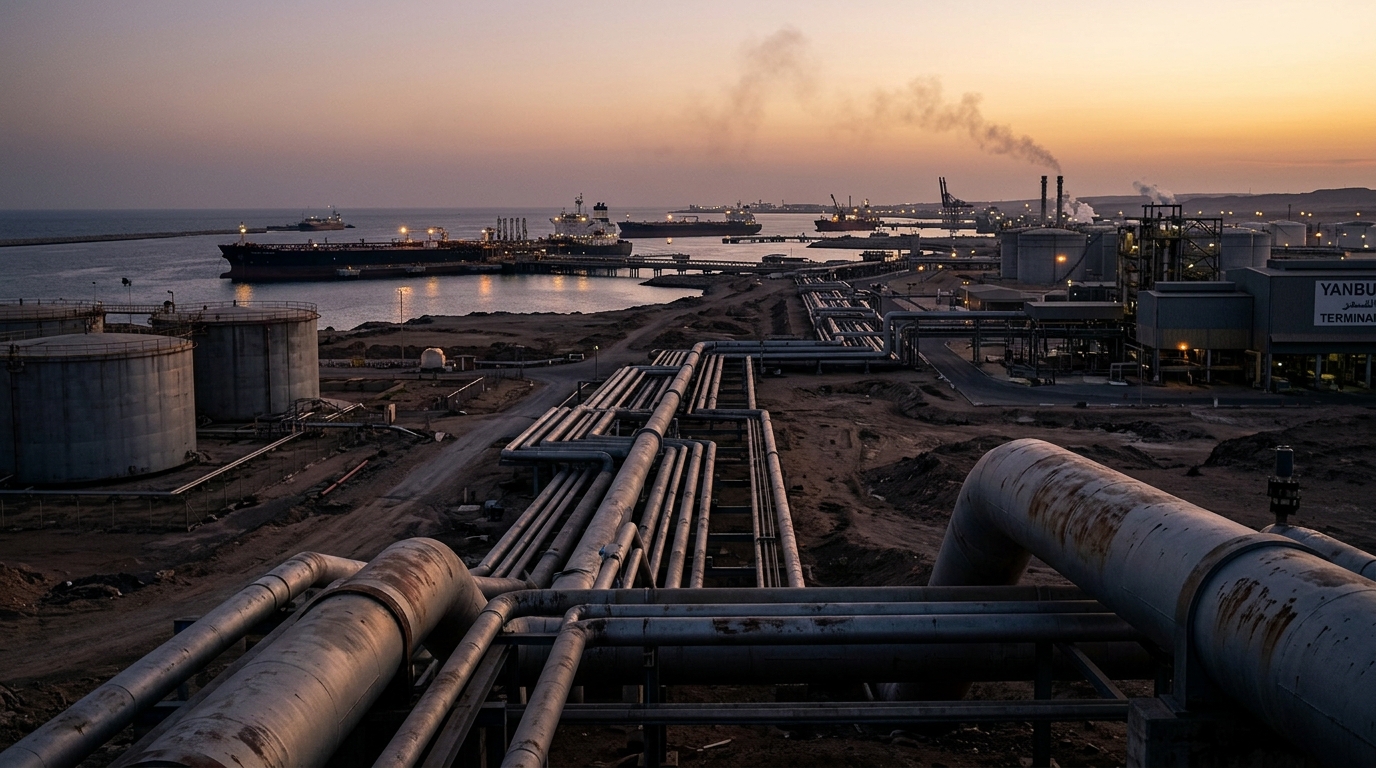
Two events landed overnight that, taken together, remove the last functioning buffer between global crude markets and a genuine supply gap. Drone attacks forced Saudi Arabia to shut its East-West Pipeline on Friday. The world’s biggest exporter had been using that pipeline to reroute around 4 million barrels per day to the port of Yanbu on the Red Sea. With it out of service, Yanbu now has stocks to maintain exports for just five to seven days, according to three industry sources familiar with Saudi exports. Sources who spoke to Reuters gave varying repair estimates, with one saying the damage could take as long as five to six weeks to fix.
The diplomatic off-ramp closed simultaneously. Gulf diplomats and Iranian officials were set to meet Monday in Salalah to discuss reopening the Strait of Hormuz to regular tanker traffic, but the meeting was postponed, according to Oman’s foreign minister. Bahrain had ruled out attending, and no country in the region had confirmed its participation. Days before the talks were due to open, drone strikes hit the East-West Pipeline, the roughly 7-million-barrel-a-day artery that lets Riyadh bypass Hormuz entirely. The line was shut down, removing at a stroke the one major alternative Gulf producers have relied on whenever the strait grows too dangerous to use.
The Six-Day Clock
Saudi Arabia will run out of oil stocks for exports if it does not restart the pipeline to the Red Sea within days, threatening a loss of up to 4% of global supply. Saudi Arabia also holds some stocks at Egypt’s ports of Ain Sukhna on the Red Sea and Sidi Kerir on the Mediterranean, but those are a secondary buffer, not a replacement. The arithmetic is simple: every day that passes without a repair timeline from Riyadh narrows the window. A further decline in Saudi flows will worsen the global supply crunch, which has already pushed fuel prices sharply higher and kept pressure on global yields.
WTI crude rose to $102.52 on September 14, up 2.47% from the previous session. Brent had settled near $104.61 on September 11 before the pipeline news broke over the weekend. Today’s open gap is the market pricing a scenario most models had not stress-tested: Hormuz constrained and the Yanbu bypass offline simultaneously.
Sector Breakdown: Who Tightens First
The grade that tightens fastest is Arab Light, the benchmark barrel flowing through the East-West Pipeline to Red Sea customers. Asian refiners dependent on that Red Sea loading window face the sharpest near-term squeeze. U.S. Gulf Coast refiners are more insulated by access to Western Hemisphere barrels, which is precisely why Valero (VLO) and Marathon Petroleum (MPC) carry structural advantage here. Marathon, Valero, and Phillips 66 generated $12.6 billion in combined profits in the second quarter of 2026, their highest combined result since 2022, driven by crack spreads that have not normalized. The WTI 3-2-1 crack spread hit about $59 per barrel in early September, nearly tripling since January, as global refining shortages and war disruptions kept fuel prices elevated.
A prolonged Yanbu outage does not automatically compress those margins. If Arab Light disappears from the spot market, Asian buyers compete harder for West African and U.S. crude, widening the transatlantic spread and potentially benefiting Gulf Coast refiners further. Valero is especially well-positioned to capitalize on tight European fuel markets, as an arbitrage window has reopened for jet fuel exports to the continent.
For tanker operators, the calculus runs the opposite direction: fewer Saudi loadings reduce voyage volumes in the short term, but rerouting and longer hauls structurally tighten vessel supply. Benchmark VLCC freight rates recently hit record highs as Middle East shipping disruptions increased voyage risk and pushed charter costs higher. Frontline (FRO) declared a Q2 dividend of $2.61 per share, reflecting strong financial performance. That payout capacity evaporates if loading volumes collapse, but rate spikes on alternative routes could offset it.
The Fed Collision
Following last week’s hotter-than-expected monthly core CPI reading, the probability of a Fed rate hike at this week’s meeting rose into the mid-80% range. The 10-year Treasury yield was hovering near 5% late last week, and today’s crude gap adds direct inflationary pressure to a Fed that Chair Kevin Warsh has already framed around credibility. A Brent spike toward $115 would force the FOMC to choose between hiking into a supply shock and pausing into an inflation overshoot. Neither outcome is clean for equities or duration.
Scenario Modeling
Bull Case for Energy: The pipeline repair takes five to six weeks. Arab Light disappears from the spot market for at least 30 days. Brent tests $120. Crack spreads widen further, lifting VLO and MPC. VLCC rates spike on rerouting demand, pushing FRO above analyst targets. Integrated majors Exxon (XOM) and Chevron (CVX) benefit from upstream price realizations, though their downstream segments face feedstock cost pressure.
Base Case: Riyadh provides a partial repair timeline within 72 hours, reducing acute panic but not removing the premium. Brent consolidates in the $105 to $112 range. The Fed hikes 25 basis points Wednesday and signals a data-dependent pause. Energy equities hold gains; refiner margins compress modestly as crude input costs rise faster than product prices. OXY, with its Permian production base, outperforms on production-side leverage.
Bear Case for Risk Assets: No repair timeline emerges within the week. Yanbu stocks are drawn down past the halfway point by Wednesday. Iran signals no rescheduling of Hormuz talks. The Fed hikes and the 10-year pushes through 5.10%. Risk-off pressure hits equities broadly, including energy names that had priced an optimistic diplomatic resolution. The double-tightening, monetary and physical supply, becomes the dominant regime.
Active Trader Framework
The immediate structural question is whether crude holds today’s gap or fills it before end of week. A gap-fill back toward $100 WTI would require either a credible Riyadh repair statement or a surprise diplomatic development. Absent that, traders monitoring Brent should watch $110 as the first meaningful resistance level. For refiners, the key variable is whether crack spreads expand with crude or lag; historically, when supply disruptions are grade-specific rather than broad, product markets respond faster than input costs, temporarily widening margins. For FRO and tanker names, position sizing should account for the volatility of rate resets: a Yanbu outage of three weeks or more is a sharply different revenue environment than one resolved in ten days. Risk management frameworks should be sized to the repair timeline uncertainty, not to current prices alone.
Preparation this week means tracking three things: Riyadh’s official communications on pipeline damage, any rescheduling signal from Oman on Hormuz talks, and the Fed statement Wednesday for any language acknowledging supply-shock inflation. Each of those three data points has the potential to move the entire complex by multiple percentage points within hours. Disciplined traders do not need to predict which arrives first. They need levels and plans for all three.