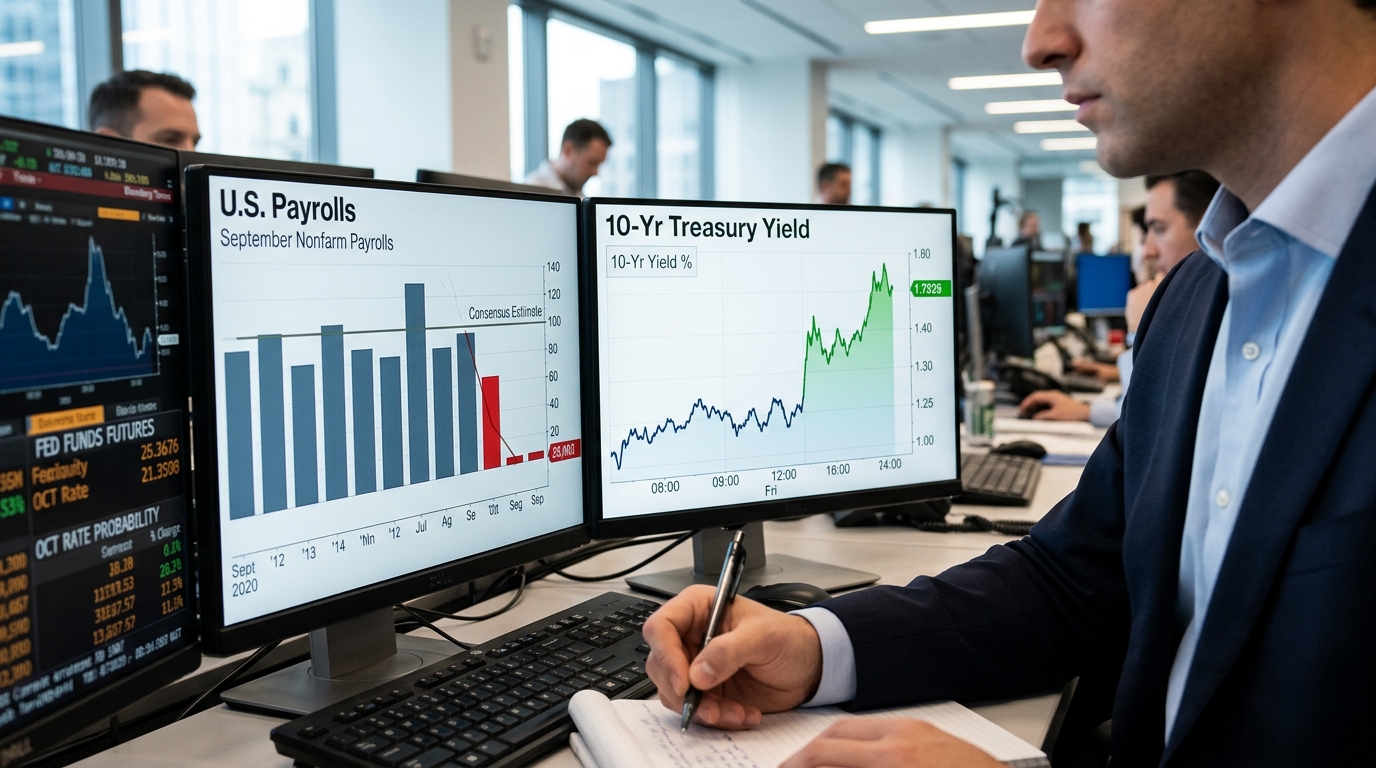
The Bureau of Labor Statistics reported Friday that September nonfarm payrolls rose just 29,000, less than a third of the roughly 90,000 economists expected. The unemployment rate rose to 4.2% from 4.1%, and the government cut July and August by a combined 60,000 jobs. Taken together, the three-month picture is far worse than any single headline suggests.
A week before the report, futures priced in roughly a 70% chance of a Fed rate hike at the October meeting. After Friday’s data, CME FedWatch put October at 21.59%. Investors are still pricing in that the Fed will hike in December. October is effectively dead. December is not.
The Long-End Tells the Real Story
Here is the tell every rate-sensitive trader needs to sit with: the 10-year Treasury closed October 2 at 5.277%, up 4 basis points on the day. The 30-year finished at 5.63%. Yields fell sharply at the open on the weak payrolls data, touching an intraday low of 5.157% on the 10-year, then reversed and closed near session highs. That is not the behavior of a bond market that believes the hiking cycle is over. It is the behavior of a market pricing structural fiscal risk regardless of what the Fed does in October.
Earlier this week, the 10-year hit an intraday high of 5.344%, its highest level going back to 2002. Elevated Treasury yields have raised concerns about the U.S. government’s balance sheet, with gross federal debt now above $40 trillion. When the long end refuses to rally on a catastrophic payrolls miss, the duration problem is not Fed policy. It is supply.
Fed Officials: Patient, Not Done
Fed Vice Chair Philip Jefferson and New York Fed President John Williams said in separate speeches this week that they believe the central bank has time to assess the economy before considering another rate increase. Analysts at Evercore ISI called the joint message from Jefferson and Williams “authoritative” in an environment where Fed Chair Kevin Warsh is not providing forward guidance on rates.
Inflation, which Fed officials project at 3.7% for 2026 on their preferred measure, sets where rates end up. Still-to-come data, particularly the CPI reading due just before the October 27-28 policy meeting, could yet shift the calculus. Warsh has consistently refused to telegraph direction, but the September minutes drop October 7. That is the next inflection point for positioning.
Sector Rotation: Who Prices It In First
On Friday, the S&P 500 gained 0.7% and the Nasdaq surged 1.2%. Nvidia reached a new all-time intraday high of $237.88, pushing its market cap to about $5.7 trillion. The AI complex, insulated by structural demand, absorbed the yield environment better than anything else on the board. That divergence is the positioning signal.
Most of the declines in rate-sensitive sectors have centered on utilities, real estate, and financial services. Growth stocks, whose valuations rest on earnings expected years in the future, may be more sensitive to rising yields, because a larger portion of their expected earnings lies further out in time. At 5.277% on the 10-year, discount rates have shifted meaningfully. Any further upside in long yields pressures real estate investment trusts and regional bank net interest margins simultaneously.
Scenario Modeling: October 28 and Beyond
Bull Case: The October 14 CPI reading comes in at or below consensus. The 10-year retreats toward 5.00%, TLT recovers from multi-year lows, and rate-sensitive sectors mount a relief trade into the FOMC meeting. October hike odds stay below 20% and the market prices a single December move.
Base Case: The Fed skips October and pulls the hike trigger in December. The 10-year holds the 5.20%–5.35% range as fiscal supply outweighs the cyclical slowdown in payrolls. Equities consolidate with tech leadership intact but rate-sensitive sectors underperform through year-end.
Bear Case: CPI re-accelerates on energy. Warsh abandons patience rhetoric and signals an October hike remains live. TLT, already at multi-year lows, sees further selling pressure as the 10-year challenges 5.40% and the S&P 500 tests the September lows near 7,500.
Active Trader Framework
TLT sits at elevated implied volatility while SPY, QQQ, and IWM still carry relatively cheap volatility. That spread matters for positioning: bond volatility is expensive, equity hedges remain accessible. Traders watching yield levels should treat 5.35% on the 10-year as the near-term resistance that reopens the October hike conversation and 5.00% as the support that confirms the December-only path.
The October 7 Fed minutes and October 14 CPI are the two catalysts that resolve this ambiguity. Position sizing into either event should reflect that the long end has repeatedly surprised to the upside this cycle, regardless of what the front end implies. Preparation over prediction. Levels over opinions.