Editor’s Note: We’re delighted to bring you the latest stock pick from our colleague, Wall Street legend Marc Chaikin. You may recognize Chaikin’s name from frequent appearances on CNBC, Bloomberg or Fox Business. His client list has included billionaires such as Paul Tudor Jones, Steve Cohen, and George Soros. His Power Gauge system flashed bullish on Nvidia right before it rose 50,001%. And it just flashed bullish on another off-the-radar AI stock poised to trigger a $248 trillion “White Swan” event as soon as October 20. See below for Marc’s research and free recommendation.
Dear Reader,
I’ve uncovered the single best AI stock in the world.
And it could explode in value on or before October 20.
That’s the date I anticipate a major announcement.
It relates to a brand-new technology this company just launched.
A technology so powerful…
It could speed up AI breakthroughs 360 times over.
Breakthroughs in medicine, energy, quantum computing and AI itself…
Breakthroughs that were five years away…
Could come in just FIVE DAYS once this technology launches.
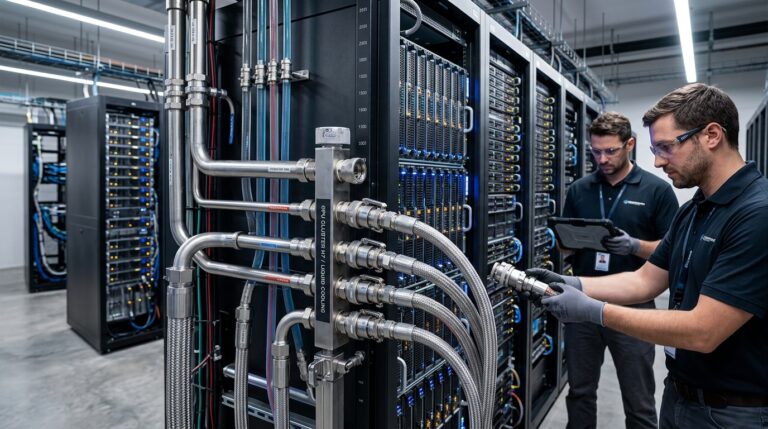
I’m talking about something I call AI “micro clusters.”
These are clusters of AI compute that will soon replace the massive data centers blotting the American landscape right now.
Micro cluster technology uses 99% less energy than data centers.
It takes up 99% less real estate.
Yet it’s more than 1 trillion times more powerful than today’s data centers.
Micro clusters are about to trigger this $248 trillion AI “White Swan” event.
Those who understand what’s coming could get very rich.
Those who ignore what’s coming could see their AI portfolios wiped out.
The good news?
One company has engineered the special chips that will power this breakthrough.
The U.S. government is pouring billions into this company’s account ahead of the launch.
And when this story breaks into the mainstream…
I believe billions, even trillions more dollars will flow into this stock.
→ It’s not Nvidia.
→ It’s not Apple.
→ It’s not SpaceX.
It’s an off-the-radar AI play that could explode on or before October 20.
The time to get in is right now.
So, I created this urgent presentation detailing the whole opportunity.
I explain the technology.
I take you “inside” the secretive lab where it’s being finalized.
And I even give you the name and ticker of the company behind the coming technology revolution.
Fair warning: This presentation contains time-sensitive information.
I may have to take it offline as soon as 12 midnight, tonight.
Good investing,
Marc Chaikin
Founder, Chaikin Analytics
P.S. The company I name in this presentation represents the future of AI. Its new technology is about to replace AI data centers when it comes to major AI breakthroughs. And it will, I predict, trigger a $248 TRILLION reboot of the AI markets… and one of the biggest moneymaking opportunities we’ll ever see… about 50 times bigger than the whole AI boom to date, in fact.
Go here for full details, including the company’s name and ticker. And if interested, I urge you to get in on or before October 20, when this company presents its latest findings at a major tech conference in Europe.
Toshiba Plans to Double Hard Drive Output. Seagate Fell 10%, Western Digital 10%.
The Nasdaq-100 closed at a record 30,807.93 on October 2. Seagate finished down 10.21% to $848.99. Western Digital fell 10.22% to $415.29. That divergence is the story. While the rest of the AI trade celebrated a soft jobs report and collapsing rate-hike odds, the two companies that control the hard-disk-drive market absorbed the sharpest single-day blow either has seen this year.
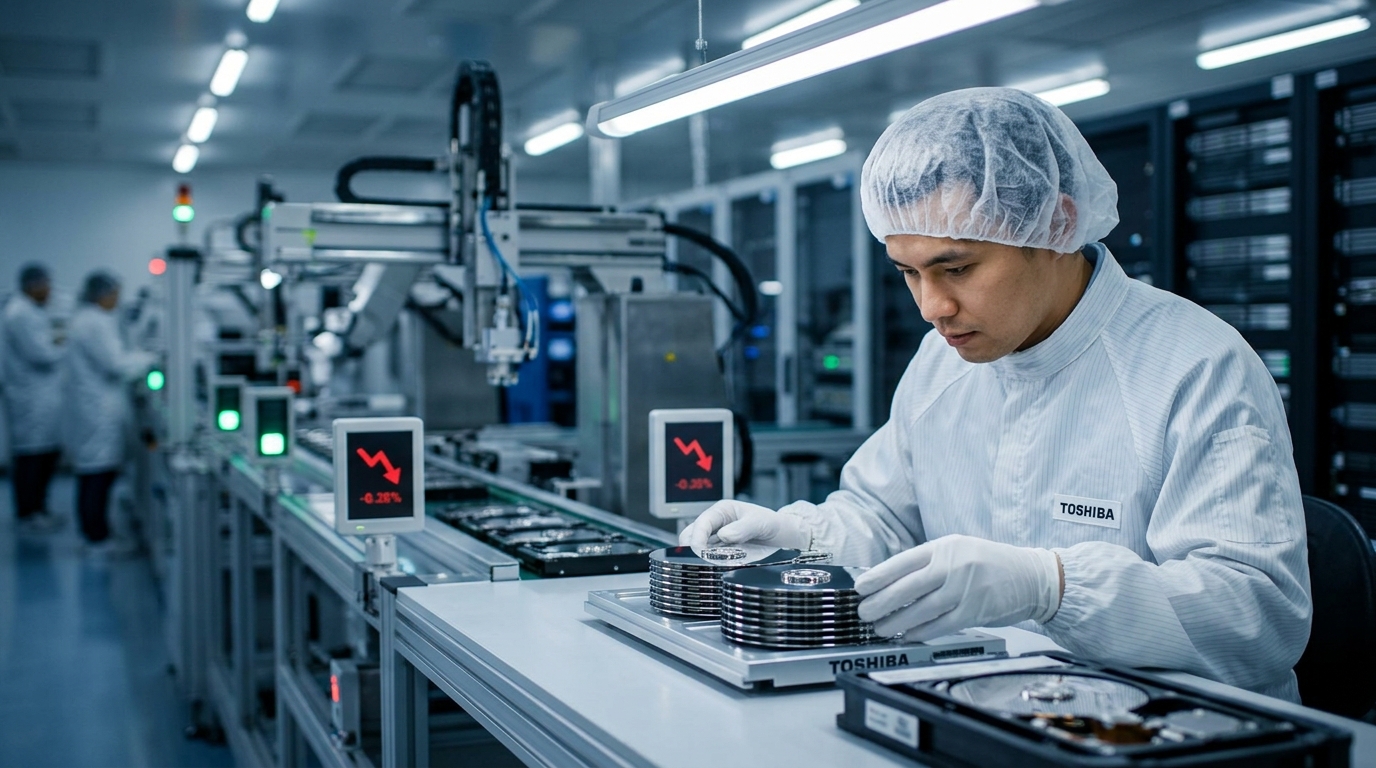
The catalyst: Nikkei Asia reported that Toshiba plans to invest approximately 60 billion yen, roughly $380 million, to double HDD production capacity at its Philippines manufacturing facility in fiscal 2027 versus fiscal 2025. Toshiba currently holds around 10% of the HDD market by exabytes shipped. Its stated medium-term target is 30%. That is not a rounding error. It is a direct challenge to the oligopoly structure that made STX and WDC two of 2026’s most crowded longs.
Why the Bull Case Was So Fragile
Seagate entered Friday up more than 228% year to date. Western Digital had gained roughly 150%. Both stocks beat earnings estimates in every quarter of fiscal 2026. Seagate’s most recent quarter delivered $3.63 billion in revenue, with non-GAAP EPS of $5.71 versus a $5.10 consensus. Management guided Q1 2027 EPS to a $7.10–$7.50 range, above Street expectations. Gross profit has more than doubled over the trailing 12 months to $1.9 billion.
But those numbers reflect a specific market structure: three players, sold-out nearline capacity, and pricing power that belongs to whoever has drives to ship. Seagate said in January that its 2026 nearline capacity was already sold out. Western Digital’s outlook rested on the same supply scarcity. The moment a credible fourth exabyte of supply appears on the horizon, the multiples that justified $848 for STX and $415 for WDC need to change.
What Toshiba Actually Announced
The expansion targets AI data-center nearline demand, the exact segment powering STX and WDC margins. Toshiba also outlined longer-term ambitions for 65-terabyte-class drives around 2030. This is not a vague strategic aspiration. It is a capital commitment aimed at the most profitable slice of the HDD market.
Citi pushed back, noting that Toshiba does not manufacture its own recording media or heads, so external component suppliers would also need to expand, potentially limiting how many exabytes actually reach the market. Morgan Stanley argued the supply-demand gap through 2028 still looks wider than Toshiba’s planned addition. Rosenblatt framed the plan as a market-share recapture bid rather than a flood of capacity, while flagging it as a medium-term risk for contracts running into 2029–2031. All three kept positive ratings on both stocks.
Technical Structure and Key Levels
STX broke sharply below its daily pivot support at $910, with intraday RSI readings reaching deeply oversold territory. Volume on October 2 reached about 13.51 million shares, well above recent averages. WDC traded about 24.72 million shares with a similar structure. Both stocks are now trading below their 20-day moving averages after months of trend-following momentum. The daily MACD on STX remained modestly positive heading into the session, meaning the longer-term trend structure has not yet fully broken, but Friday’s price action has reset short-term momentum decisively lower.
Scenario Modeling
Bull Case
Toshiba’s ramp hits component supply constraints and delivers materially fewer exabytes than planned in fiscal 2027. AI data-center demand absorbs any incremental supply, nearline pricing holds firm, and STX recovers toward the $950–$1,000 range ahead of its next earnings report. Morgan Stanley’s supply-demand gap thesis proves correct through 2028.
Base Case
The market treats Friday’s move as a partial re-rating rather than a full cycle reset. STX and WDC stabilize in the $830–$880 and $400–$430 ranges, respectively, as traders weigh Toshiba’s component dependency against its market-share ambitions. The next Seagate earnings report becomes the next binary. Any guidance reduction on pricing resets the floor lower.
Bear Case
Toshiba executes, component suppliers follow, and the HDD cycle transitions from supply scarcity to oversupply inside 18 months. STX revisits the $700 area, where the pre-AI-premium valuation was last observed. WDC, with Cloud representing 89% of revenue in its fiscal Q4 2026, faces a sharper multiple compression.
Active Trader Framework
Friday’s close at $848.99 for STX represents a 10.2% single-session move on elevated volume. Traders should treat $910 as the level to reclaim for any near-term stabilization thesis to have technical merit. Below $820, the stock opens air toward $780. For WDC, $415 was Friday’s closing area; $440 is the first resistance on any bounce. Position sizing should account for the next STX earnings catalyst as a hard deadline for any thesis resolution. Implied volatility across both names expanded sharply Friday and has not yet reverted, making defined-risk structures more relevant than outright directional exposure ahead of that date.
The supply-discipline trade in HDDs was built on a three-player market where everyone behaved rationally. One Nikkei report changed the math. Preparation now means knowing exactly which levels confirm recovery and which confirm a deeper structural break. The data will tell the story. Let it.