
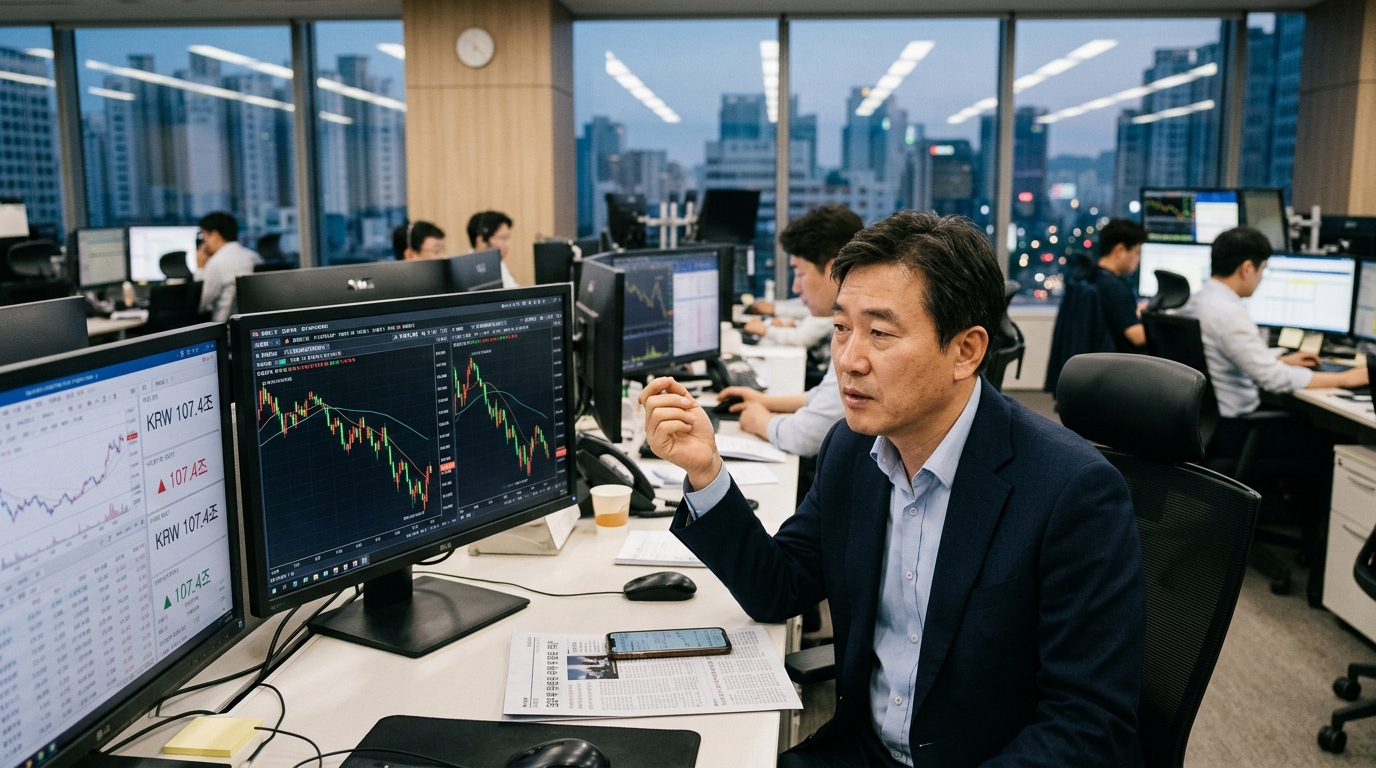
Samsung Electronics closed October 8 at KRW 262,000, down 2.42 percent, on the day it posted a record quarterly operating profit. The market’s verdict on a record-breaking result is the signal. Traders in memory names, from SK Hynix to Micron, need to read it carefully.
The Numbers
Samsung reported preliminary Q3 2026 operating profit of KRW 107.4 trillion, surging past KRW 100 trillion for the first time in the company’s history as AI demand continued to fuel its chips business. Operating profit was 782.5% higher than a year earlier, while revenue of approximately KRW 195 trillion was up 126.6% from the same period in 2025. The result came in above the LSEG SmartEstimate of KRW 106.1 trillion, yet the stock opened at KRW 269,500 and gave it all back by the close.
Revenue came in below the roughly KRW 200.26 trillion consensus reported by Aju Press, a miss on the top line that offset the profit beat in the market’s calculus. Reuters also flagged that a firmer won can restrain reported overseas earnings and pressure future margins.
Why a Record Was Not Enough
This is the second consecutive quarter Samsung has posted a record and watched the stock fall. In Q2, Samsung posted operating profit of KRW 89.4 trillion, roughly 19 times the year-ago figure, but the stock shed as much as 10 percent intraday before settling 6.9 percent lower. The mechanism is the same both times: expectations get priced in before the release, and anything short of a full-range beat triggers profit-taking.
“Samsung’s strong earnings were widely expected and had largely been priced in after its shares rallied ahead of the results,” Albert Yong of Petra Capital Management told Reuters, adding that investors remain concerned about the sustainability of the AI boom and the risk of slower AI infrastructure spending by major US technology firms.
Samsung’s foundry, mobile, TV, and appliance businesses remain a swing factor for consolidated margins once memory pricing momentum normalizes. In Q2 reporting, Reuters highlighted investor focus on how long the AI-driven memory boom can last, with mobile cited as a weaker spot versus chips.
The HBM Context and Peer Implications
The structural question overhanging the sector is high-bandwidth memory share. Counterpoint Research placed SK Hynix at 50 percent of global HBM revenue in Q2 2026, while Samsung more than doubled its position to 33 percent and Micron slipped to 18 percent. Separately, Samsung has said it has advanced its HBM4 roadmap around its 1c DRAM node, and Korean press has reported mass-production shipments beginning in 2026. That share recovery is real, but SK Hynix still controls the dominant Nvidia allocation and the HBM4 ramp for the Rubin platform.
Micron, trading near USD 1,067 heading into today’s session, has already reported and cleared the bar. The company said long-term customer commitments had risen to USD 32 billion from USD 22 billion in June, while management said more than 75 percent of its fiscal 2027 output was already committed. That pre-commitment data is supportive for the cycle but leaves the question of whether current valuations reflect it.
Technical and Scenario Framework
On 005930.KS, the KRW 262,000 close sits below the KRW 268,500 level that held through most of early October. The stock opened at KRW 269,500 and traded in a KRW 262,000 to KRW 270,000 range. The gap between KRW 262,000 and sell-side targets remains wide enough to frame three distinct scenarios.
- Bull case: Samsung’s full Q3 detail on October 29 shows HBM4 volume ahead of estimates and mobile losses narrowing. Memory pricing holds into Q4 and the won stabilizes. Shares recover toward KRW 320,000 to KRW 350,000.
- Base case: Today’s reaction exhausts near-term selling. The stock consolidates between KRW 255,000 and KRW 275,000 into the full results. SK Hynix’s Q3 report, due later in October, becomes the sector’s next directional catalyst.
- Bear case: Revenue below KRW 200 trillion persists into Q4. AI capex commentary from US hyperscalers softens in their October earnings calls. Memory names re-rate lower and KRW 240,000 comes into view for 005930.KS.
Active Trader Considerations
The pattern across both Q2 and Q3 is consistent: Samsung beats on profit, misses on at least one secondary metric, and sells off. Traders running memory exposure need a defined level. KRW 262,000 is now the line that today’s close established. A sustained break below KRW 255,000 on volume shifts the near-term bias. For US-listed names, Micron’s committed forward book can make it a cleaner expression of the AI memory trade than Samsung’s ADR (SSNLF) until the won headwind clarifies.
Detailed divisional results arrive October 29. Preparation, not the headline number, separates disciplined positioning from noise-chasing.