October 19, 2026
Bonus Content: AEP Is Spending $4 Billion to Power Google. Here Is What It Does to the Stock.
Editor’s Note: Former tech executive Jeff Brown picked Bitcoin, Tesla, and Nvidia before they jumped as high as 52,400%, 2,150% and 36,000%. Now he’s recommending an Elon Musk-backed startup that has been called “the fastest-growing business in the history of capitalism.” And you can claim your pre-IPO stake for less than $50. Read more below.
Dear Reader,
I believe Elon Musk is out for revenge…
And it could help make a lot of people rich.
You see, he co-founded OpenAI, the creator of ChatGPT, as a non-profit.
But later he was pushed out of the company…
And the other co-founders turned it into a for-profit business.
Elon even sued them in federal court…
But the case was dismissed on a technicality.
And here’s where his revenge comes in…
Elon Musk is now backing this hot new AI startup that could drive OpenAI out of business.
The Wall Street Journal calls it…
“The front-runner in the race for artificial-intelligence supremacy”
And now that Elon Musk is backing this startup…
I believe business is about to boom.
Click here to get the name completely free of charge…
And I’ll also show you how to claim a stake for as little as $50.
Even though this has nothing to do with robots, self-driving cars, or rockets…
Its CEO is projecting growth of 8,000% for this year…
Enough to turn $1,000 into $80,000.
We have so much to look forward to,
Jeff Brown
Founder & CEO, Brownstone Research
AEP Is Spending $4 Billion to Power Google. Here Is What It Does to the Stock.
When a regulated utility commits $4 billion to a single customer outside its traditional service territory, traders need to re-examine what they are actually owning. That is exactly the position AEP is in today.
The Deal in Plain Numbers
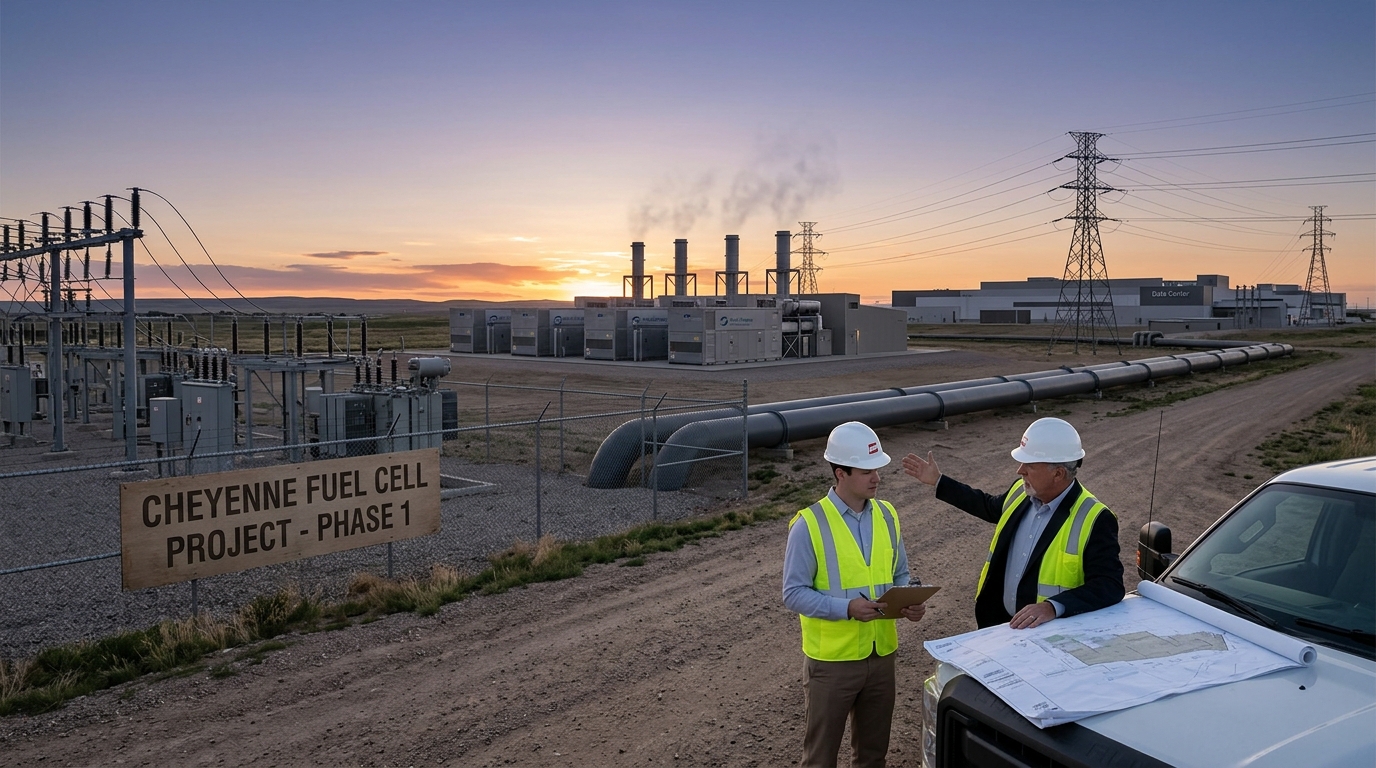
American Electric Power plans to invest approximately $4 billion to advance a new 702-megawatt fuel cell generation project near Cheyenne, Wyoming, under a long-term 20-year power purchase agreement with Google. The project will be developed through Cheyenne Fuel Cell, LLC, approximately 92% owned by AEP and nearly 8% held by funds advised by Basalt Infrastructure Partners. Construction is planned for 2026, with full operations targeted by the end of 2028.
By arithmetic, $4 billion for 702 megawatts works out to about $5.7 million per megawatt. That is a steep cost-per-megawatt versus conventional gas, and no PPA price has been disclosed, so the revenue visibility is contractual rather than transparent. The 702-megawatt facility will run on solid-oxide fuel-cell technology from Bloom Energy rather than a combustion turbine, and AEP says it plans to layer in carbon capture technology as the project matures.
AEP is not alone in Cheyenne. Black Hills Corp. signed agreements through 2048 to serve the same Google campus, and plans to invest $1.8 billion between 2027 and 2029 to construct 564 MW of new natural gas generation. The broader power architecture combines up to 590 MW of grid-connected service with approximately 2.1 GW of third-party resources managed through a private microgrid. Total resource mix for the campus runs to roughly 2.7 GW. This is not a data center with a grid connection. It is a purpose-built power system at hyperscale.
What It Does to AEP’s Growth Algorithm
AEP has reaffirmed its annual operating earnings growth rate of 7% to 9% through 2030, with an expected operating earnings CAGR greater than 9%, supported by its five-year $78 billion capital plan. Additionally, AEP has line of sight to incremental capital investments of more than $10 billion, including the fuel-cell project in Wyoming. The Cheyenne plant is additive to that plan, not a replacement of it.
The credit picture deserves scrutiny. As of June 30, 2026, AEP carried $52.836 billion in total debt, representing 61.4% of its total debt and equity capitalization. As of June 30, 2026, management has cited S&P FFO-to-debt at 14.6% against a targeted range of 14% to 15%. A $4 billion unregulated project layered onto that stack narrows the buffer. The project sits in an unregulated subsidiary, which means ratepayers are shielded but AEP’s consolidated balance sheet absorbs the capital.
AEP’s current forward P/E, market cap, and consensus price target move day to day, so treat any single snapshot as a reference point rather than an anchor. At roughly $124 per share, the stock trades at a modest discount to a typical Street target range, but the unregulated cash flow stream from Cheyenne introduces a return profile that rate-base investors have not been asked to price before.
Scenario Modeling
Bull Case. Full commercial operation by end-2028 on schedule. Google’s contracted payments prove sufficient to generate returns above AEP’s regulated allowed ROEs, which tend to cluster in the high-single-digit range. AEP parlays the Cheyenne model into additional hyperscaler deals, and management’s greater-than-9% operating earnings CAGR target through 2030 gets pulled forward. Stock tests $145 to $150.
Base Case. Construction executes on timeline, the PPA delivers steady unlevered cash flow, and the project is viewed as complementary rather than a distraction from the rate-base business. Full-year 2026 operating earnings land within the raised guidance of $6.25 to $6.55 per share. The stock consolidates near the mid-$120s as the market waits for 2028 operational proof before awarding a higher multiple to the unregulated segment.
Bear Case. Construction cost overruns on a first-of-scale 702 MW fuel-cell installation pressure the balance sheet. FFO-to-debt compresses from the mid-teens toward levels that would pressure the rating agencies’ comfort zone. The unregulated structure, with no rate-base backstop, amplifies the earnings risk perception. Stock gives back ground toward $110 support.
Active Trader Framework
The stock’s 52-week range of $112.54 to $140.58 provides the tactical boundaries. The $124 area is near-term structural support after the October 15 close. A hold above $120 keeps the base case intact; a break below opens a retest of the $112 to $115 floor. On the upside, $131 to $133 represents the zone where ATM equity was issued in Q1 2026, which may act as technical resistance on any near-term recovery.
The volatility regime matters here. AEP carries a beta of about 0.47, so the stock will not move violently on macro risk-off days, but credit spread widening in the BBB utility space could shift the sector faster than earnings revisions. Watch the Bloom Energy supply chain and any regulatory filings in Wyoming for construction milestones.
The Bottom Line
AEP is adding a new instrument to its capital structure: a single-customer, unregulated, long-duration power asset at a scale utilities have rarely attempted outside their franchises. The growth optionality is real. So is the credit sensitivity at $52.836 billion of existing debt. Disciplined positioning means sizing to the credit metric, not the growth story alone, and watching AEP’s FFO-to-debt trajectory as the project ramps funding through 2028.