October 21, 2026
Bonus Content: Korea’s Chip Exports Hit a Record $27.5bn. Here’s How to Trade It.
Gold and silver are in a powerful bull market – and one ultra-low-priced small-cap precious metals company has quietly built a unique way to capitalize on this historic uptrend.
The company is already generating record revenue from producing gold and silver mines.
It has attracted some of the biggest names in the resource arena.
And it just announced the largest transaction in its history.
Yet incredibly… shares remain largely undiscovered below $1.
That creates an intriguing opportunity to get in early and low as this fast-emerging company enters its biggest growth phase yet.
What makes this story especially compelling is the business model.
Unlike the typical mining firm, this company doesn’t have to build or operate a single mine.
Instead, it puts its capital to work in carefully selected mining projects in exchange for a share of the gold and silver produced:
✔ Exposure to multiple producing mines without operating them
✔ Exploration upside and mine-life growth funded by mine operators
✔ Diversification across multiple metals and jurisdictions
✔ Growing cash flow to be deployed into new royalties and streams
✔ Powerful leverage to rising gold and silver prices
In other words… put capital to work once… generate cash flow… reinvest that cash flow into the next opportunity… rinse and repeat.
That’s the power of the royalty and streaming model – and this soon-to-be-known sub – $1 company is reaching a critical inflection point as you read this.
And there’s another piece of this story you absolutely need to know.
Behind the company is a longstanding strategic relationship with a major mining-focused investment firm – giving it direct access to a steady pipeline of deals across the global mining landscape.
And we’re already seeing that secret weapon hard at work.
The company has just inked a new gold streaming deal on an established producing gold mine – by far the largest transaction in its history – signaling just how much bigger this story is becoming.
And the smart money is already paying attention.
One of the sector’s best-known financiers has put his own money behind the firm and believes it has a durable competitive advantage in the royalty and streaming space.
Better still, he joins the company’s CEO in our exclusive interview.
We’ve put together a FREE online report revealing the full story – including:
✔ The royalty and streaming advantage
✔ Producing assets already generating cash flow
✔ Largest transaction in company history
✔ The secret weapon driving the deal flow
✔ Our exclusive in-depth interview with the CEO and special guest
And with shares still below $1, the opportunity to get in early is right now.
Click here for instant access… and discover this fast-emerging gold-silver royalty firm before the rest of the market catches on.
Korea’s Chip Exports Hit a Record $27.5bn. Here’s How to Trade It.
- $27.5bn: South Korean semiconductor exports in the first 20 days of October, up 222.5% year-on-year and a record for the period.
- 44.7%: Chips’ share of total Korean exports, up 16.2 percentage points from a year ago.
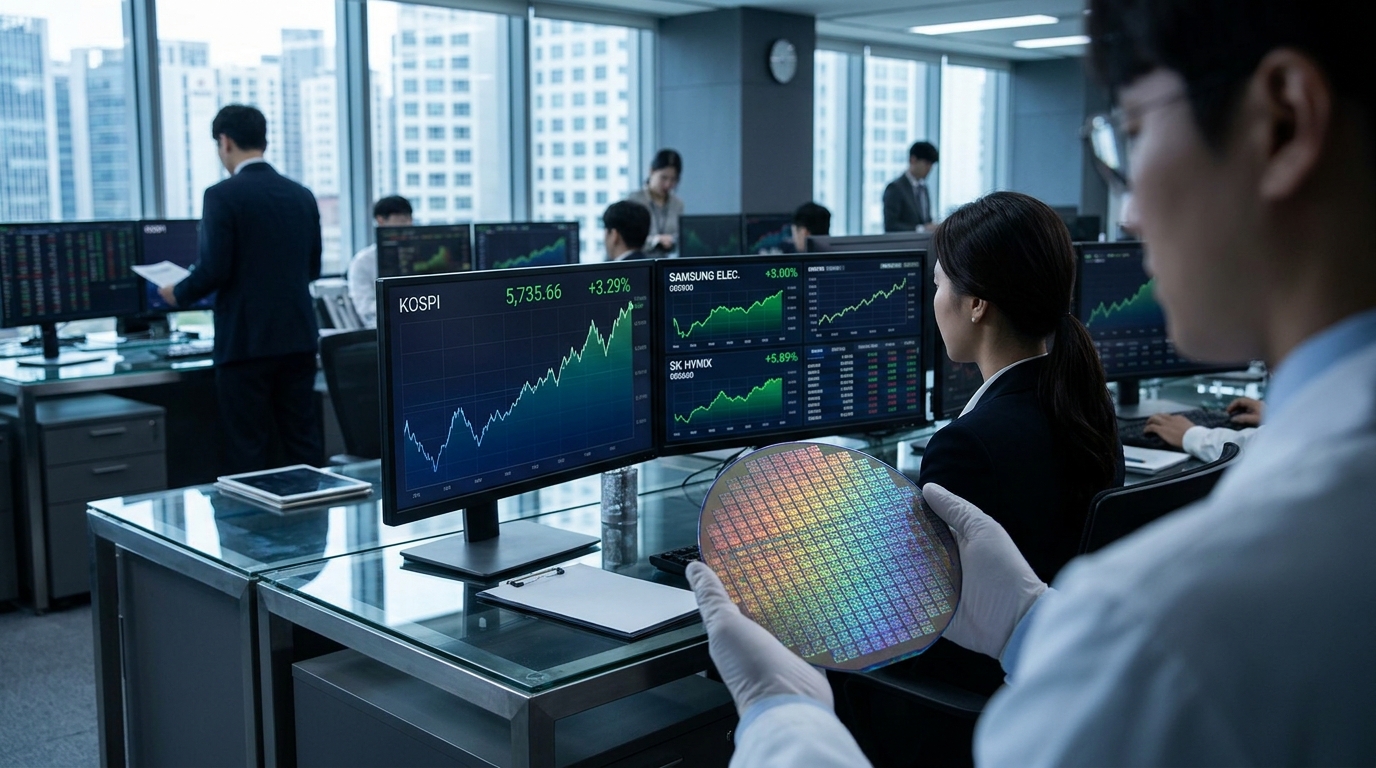
- Kospi +3.29% to 5,735.66 on Wednesday, fully reversing Tuesday’s 3.73% drop on AI-spending doubts.
- Samsung Electronics +3.00% to 223,500 won; SK hynix +5.89% to 1,294,000 won at the close; both touched intraday highs before paring.
- A buy-side sidecar was triggered on the Kospi 200 futures market, the first in two months, as foreign and institutional investors bought in tandem.
- Micron (MU) posted fiscal Q4 revenue of $54.23bn, beating the $50.45bn consensus, with Q1 guidance of $61.5bn, context that primes the Seoul move.
- SK Securities estimates Samsung trades at roughly 3.5x forward earnings; SK hynix at 2.8x, both below prior memory-cycle trough multiples.
Market Context
Tuesday’s session in Seoul had all the hallmarks of a sentiment break. The Kospi fell 3.73% to close at 5,552.75, hitting its lowest closing level since April 7 after dropping as much as 4.76% intraday. The catalyst: fresh doubts about the durability of AI infrastructure spending, the kind of macro fear that hits Korea disproportionately given its chip-heavy index composition.
Wednesday’s customs release changed the calculus fast. Export value during October 1-20 reached $61.6 billion, up 105.4% from the same period last year, and this marks the highest export performance ever recorded for the period from the 1st to 20th. You cannot square that data with a demand slowdown, and the market did not try to.
Sector Breakdown
Semiconductor exports surged 222.5% year-on-year to $27.5 billion, a record for mid-October, with chips accounting for 44.7% of total exports, a 16.2 percentage-point increase from a year earlier. That concentration matters: Samsung and SK hynix together represent the dominant share of those shipments, and Samsung plus SK hynix made up 52.52% of the Kospi by market weight, making the index essentially a referendum on semiconductor demand.
SK hynix’s weight in this story extends well beyond its Kospi share. SK hynix’s U.S. listing and the structural case for HBM demand driving the memory super-cycle frames why foreign investors keep returning to this name.
The geography of the export surge reinforces the AI read. Exports rose to China (+154.4%), the United States (+154.9%), Singapore (+121.1%), and Malaysia (+363.2%). Malaysia and Singapore are AI server assembly hubs; growth there is not consumer-driven cyclicality.
On the U.S. side, Micron reported fiscal Q4 results that beat Wall Street’s expectations, posting adjusted EPS of $33.42 on revenue of $54.23 billion versus estimates of $31.16 per share and $50.45 billion. Management highlighted heavy AI-driven demand for high-bandwidth memory, with more than 75% of fiscal 2027 shipments already committed. That supply constraint is the same one lifting Korean ASPs.
Financial Breakdown
SK Securities analyst Han Dong-hee estimates Samsung trades at about 3.5 times forecast earnings over the next 12 months, compared with just 2.8 times for SK hynix, multiples that have fallen below trough valuations seen in previous memory downturns. Mirae Asset, in a recent note, maintained a Buy rating on SK hynix with a target price of 1,370,000 won. The average brokerage consensus sits well above current prices, and Samsung’s Q3 2026 preliminary guidance showed operating profit of approximately 107.4 trillion won, the first time any Korean company has earned more than 100 trillion won of operating profit in a single quarter.
Technical Framework
The Kospi closed at 5,735.66, up 182.93 points, opened at 5,666.34, and extended its gains through the session. The index reclaimed the 5,700 level, which had served as a reference zone through most of Q3. The key watch now is whether 5,700 converts from resistance to support on any retest. The index remains below its 50-day moving average and is forming a small bearish flag pattern, which suggests the potential to resume a downward trend toward 5,272. For Samsung, the 223,500 won close sits well below the June peak of 362,500 won, leaving considerable technical recovery room but also a meaningful overhead supply zone.
Scenario Modeling
Bull Case
Full-month October chip export data confirms the pace set in the first 20 days. SK hynix’s October 28 earnings call reinforces memory ASP strength and AI-driven demand. The Kospi sustains above 5,700; Samsung targets the 250,000 won consensus, SK hynix approaches 1,370,000 won.
Base Case
The customs data anchors sentiment but macro headwinds, including elevated U.S. Treasury yields and Micron’s Taiwan labor risk, limit upside velocity. The Kospi consolidates between 5,600 and 5,800. Samsung holds the 200,000-220,000 won range; SK hynix oscillates around 1,200,000-1,300,000 won ahead of earnings.
Bear Case
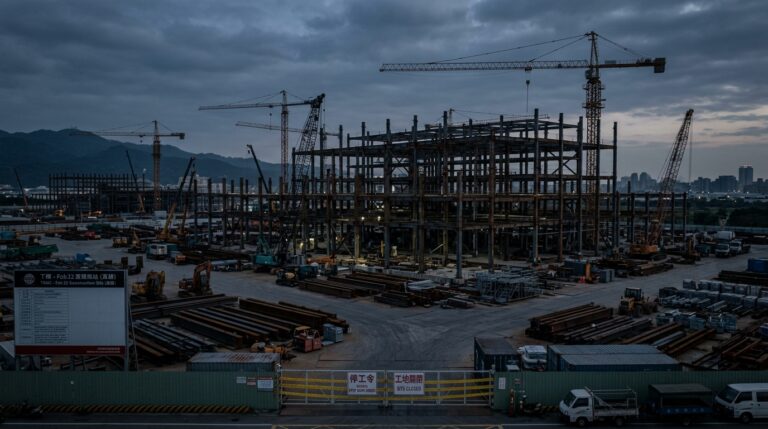
The Taoyuan walkout scheduled for October 22 at Micron’s Taiwan facility spreads concern about supply-chain disruption. If AI hyperscaler capex guidance softens in coming earnings reports, the memory cycle narrative reverses. Kospi loses 5,500; Samsung retests the 190,000 won area; SK hynix risks 1,100,000 won.
The bear case hinges on whether AI capex commitments hold across the supply chain. ASML’s bookings data is the one real-time read on whether AI infrastructure spending translates into committed chip capacity for 2027, making it the clearest leading indicator for the memory cycle thesis.
Active Trader Strategy Framework
Wednesday’s move was fast and broad. The buy-side sidecar activation signals institutional conviction, but single-session reversals of 3%+ after a prior-day 3%+ loss often see follow-through fade within 48 hours. Traders positioned in Samsung or SK hynix should define risk around Tuesday’s closing levels as a reference: a close back below 5,552 on the Kospi would signal the reversal lacked durability.
For MU, the October 22 Taiwan strike date is an idiosyncratic binary. SK hynix’s October 28 earnings call is the next major data gate for the whole complex. Volatility around that event is likely to compress positioning. Size accordingly, and watch volume on any retest of Wednesday’s open gap levels for conviction signals in either direction.
Conclusion
The Korea Customs data released this morning is the most concrete real-demand signal the AI chip complex has produced in weeks. It does not guarantee the upcycle is friction-free, but it materially raises the burden of proof for the bear case. Disciplined traders will use Wednesday’s levels as a map, not a mandate: the data favors the bulls, but the technicals and macro cross-currents demand that entries and stop placement remain precise.