July 22, 2026
SK Hynix Just Pulled Off the Largest Foreign Listing in U.S. History. The HBM Trade Is Just Getting Started.
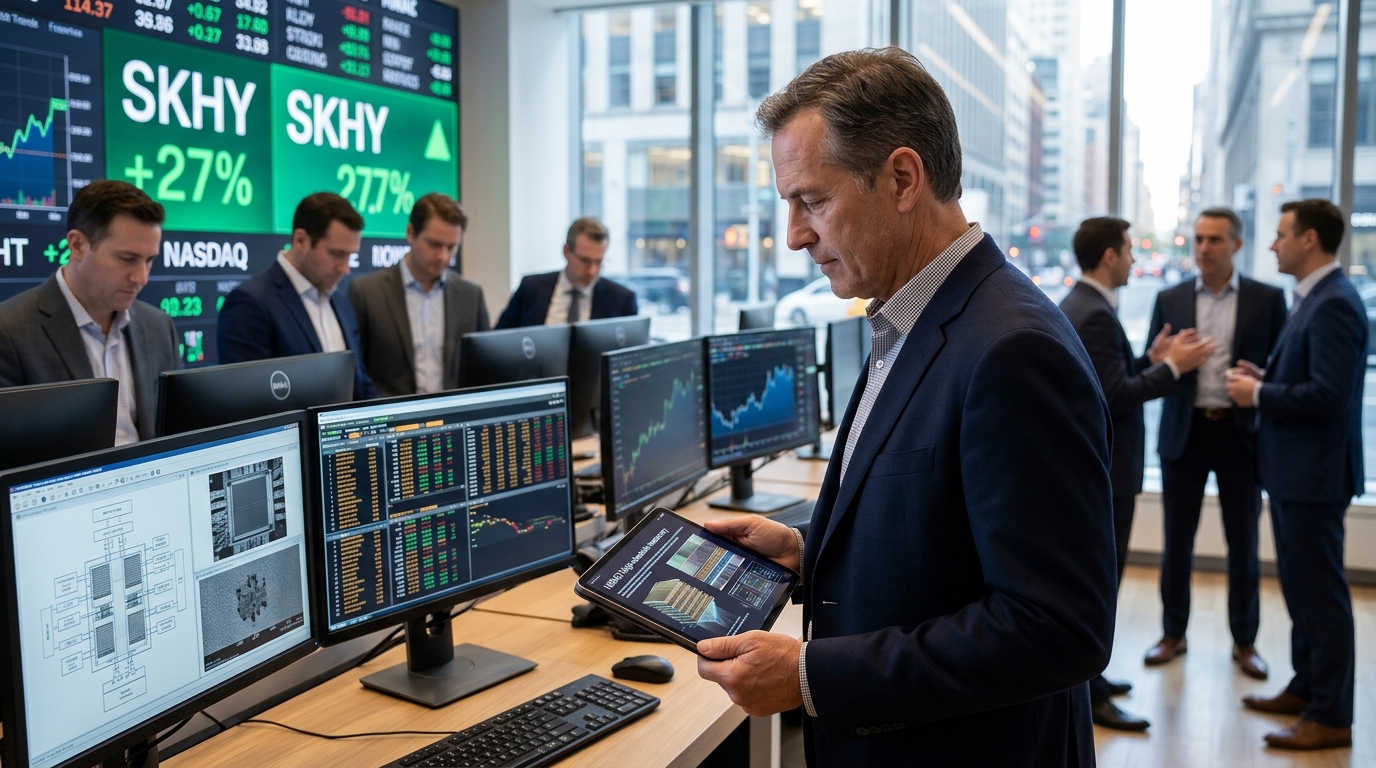
SKHY began trading on Nasdaq July 10 (SKHYV when-issued; SKHY regular-way July 13) after raising $26.5B — and it’s already up about 27% this month. Here’s what the memory super-cycle really looks like from the inside.
Worst News for Stocks in 50 Years
Wall Street’s declared what could be the worst news for the U.S. stock market in 50 years.
If Goldman Sachs and Morgan Stanley are right… this won’t be like the crashes we’re used to. What’s about to hit America next could keep your portfolio in the red for 10 years or longer – unless you make a big change now.
To hear about this decade-long crisis now being predicted by multiple Wall Street banks…
And to see what you can do to prepare your wealth before this hits…
Click here to learn how to defend your portfolio.
Regards,
Keith Kaplan
CEO, TradeSmith
P.S. You may have noticed we see “surprise” crashes every year now. Think about it: rate spikes in 2022… the bank crisis in 2023… $8 trillion wiped out in 2024… $11 trillion wiped out during the tariff crash in 2025… and, this year, $12 trillion was wiped out in 30 days during the Iran War. Something is off and Wall Street suggests this could continue (and worsen) well into the 2030s. Click here to learn the truth about this market and see what you must do now to prepare.
There’s a new name in U.S. markets that most developers haven’t fully mapped yet. SK Hynix — the South Korean chipmaker that supplies the majority of Nvidia’s high-bandwidth memory — began trading on Nasdaq via an ADR offering on July 10, raising $26.5 billion in what’s been widely described as the largest foreign-company IPO/listing in U.S. market history. Trading started under the temporary “when-issued” ticker SKHYV, with regular-way trading under SKHY beginning July 13. It’s already up about 27% in July.
That momentum isn’t noise.
Here’s the part worth sitting with: this isn’t a speculative bet on a future market. The HBM market exists right now, demand is running ahead of supply, and SKHY controls the dominant share of it.
TL;DR
- SK Hynix’s Nasdaq ADR debut began July 10 (SKHYV when-issued; SKHY regular-way July 13), raising $26.5B — widely cited as the largest U.S. listing/IPO ever by a foreign company — and the ADR is up about +27% in July 2026.
- SK Hynix held 56.4% of the global HBM market by revenue in Q1 2026 (IDC, per company filing) and is widely reported to be Nvidia’s primary HBM supplier.
- Micron (MU) reported fiscal Q3 2026 revenue of $41.46B — up about 346% year-over-year — with gross margins of 74.4%, signaling massive pricing power across DRAM, NAND, and HBM.
- Micron has said it expects the HBM total addressable market to exceed $100B by 2028 (and previously described that as ~4x growth from 2024 levels). The specific “$35B in 2025 → $100B by 2028” framing is commonly repeated by market commentary, but Micron’s own cited baseline in its materials is 2024.
- Supply cannot expand instantly — HBM requires advanced DRAM stacking, TSV connections, and multi-year facility timelines. Micron has said it is sold out of its HBM output in calendar 2026.
- Claims that “analysts anticipate DRAM structural undersupply extending through at least 2028” are directionally plausible, but vary by firm; the more supportable point is that major new greenfield capacity is generally expected to take years and is unlikely to materially impact supply before 2028.
- Valuation multiples move daily; MU’s forward P/E has been quoted around ~6.9 in recent market data sources, while a ~5.8x forward P/E figure for SK Hynix appears in recent sell-side research.
What the Numbers Are Saying
Micron’s Q3 numbers were the kind that make analysts do a double-take. $41.46 billion in revenue, ~346% year-over-year growth, gross margins of 74.4%, and GAAP net income of $28.24 billion — that is not a cyclical bounce. That is a memory market structurally reshaped by AI infrastructure spending.
SK Hynix posted KRW 52.5763 trillion in revenue and KRW 37.6103 trillion in operating profit in Q1 2026 alone. Operating margins at that level reflect the pricing power HBM commands when AI data center demand outstrips supply. Which it does.
The supply picture is the part most traders underweight. Producing HBM requires advanced DRAM, vertical chip stacking, through-silicon via connections, sophisticated packaging, and multi-year qualification cycles with hyperscaler customers. You cannot spin up a fab in a quarter. Samsung has been publicly positioning HBM4 as a major focus in 2026, including expanding HBM4 capacity. Micron has said it is sold out of its HBM output in calendar 2026. SK Hynix — already positioning for next-generation HBM formats — enters H2 2026 with its technological lead structurally intact, if narrower than when it previously held an estimated ~69% share.
Tech-Specific Breakdown
- SKHY: ~56% HBM market share (Q1 2026, IDC via company filing); primary Nvidia supplier per multiple reports; forward P/E figures vary by source; U.S. ADR listing creates a new institutional access channel.
- MU (Micron): Q3 FY2026 revenue $41.46B (+~346% YoY); gross margin 74.4%; CHIPS Act domestic manufacturing benefits; broader product mix (DRAM + NAND + HBM) provides cycle buffer.
- Samsung: Publicly claims industry-first commercial HBM4 shipments and proactive expansion of HBM4 production capacity; market share and specific product-level pauses/ramping details are difficult to verify cleanly from primary sources, so treat precise percentages cautiously.
- HBM TAM: Micron expects HBM TAM to exceed $100B by 2028 (Micron materials); AI model size growth multiplies memory footprint per server.
Technical Framework
- SKHY: Up about 27% MTD in its first month of U.S. trading — watch for volume normalization and potential institutional accumulation patterns as the ADR finds its price discovery range.
- MU: Stock near $937 after a brief AI-chip sector selloff around July 13; the selloff happened despite fundamentals that remain structurally intact — that divergence is the signal.
- Key level: Any deceleration in Nvidia’s GPU shipments would read through to HBM demand before financial results confirm it — watch Nvidia order patterns as the leading indicator.
- The risk most mispriced: HBM capacity expansion combined with a macro-driven pause in hyperscaler capex could create a supply/demand reversal in 2028–2029. Not imminent — but worth modeling.
Scenario Modeling
Bull Case: AI model training continues scaling, hyperscaler capex holds at $150B+ annually through 2027, and Samsung’s HBM4 ramp takes longer than expected — pricing remains elevated, and both SKHY and MU sustain 60%+ gross margins. SKHY re-rates toward MU’s forward multiple as U.S. institutional ownership grows.
Base Case: HBM demand grows ~30–40% annually through 2027, supply expands modestly, margins compress to the mid-50s range, and SKHY trades in a 10–15x forward earnings band as the ADR matures. MU outperforms on domestic policy tailwinds from the CHIPS Act.
Bear Case: A sudden deceleration in AI capex spending — triggered by rising interest rates or a macro shock — combined with Samsung’s HBM4 ramp succeeding ahead of schedule, causes pricing pressure. Memory markets have cyclical histories; a 2028 oversupply scenario is the tail risk to model, not the base case.
Strategy Framework
- SKHY’s valuation discount to MU partially reflects real geopolitical risk — Korean won currency exposure and trade policy uncertainty are not trivial.
- MU offers U.S. geopolitical advantage and CHIPS Act subsidies; SKHY offers superior HBM market share and a technological lead in next-gen formats.
- Monitor Nvidia’s Blackwell and Rubin GPU shipment cadence — those orders are the direct leading indicator for HBM pull-through demand.
- Position sizing in memory stocks should account for historical cycle volatility; these are high-beta positions even in structurally favorable environments.
- Watch for whether SKHY’s U.S. ADR attracts index inclusion — an index eligibility/inclusion event would be a significant institutional demand catalyst.
The HBM super-cycle is not speculative anymore — it is audited, reported, and priced into earnings that have already landed. What remains uncertain is duration. The structural supply constraints suggest 2028 at minimum before equilibrium. That is the framework worth keeping in front of you as this earnings season unfolds.
For informational and educational purposes only. Not investment advice. Trading involves risk, including loss of principal.