
The question every investment committee is quietly asking this week is not whether OpenAI raises $30 billion. It almost certainly will. The question is what the terms say about the ceiling on AI private-market valuations, and what that means for the crossover funds that already hold stakes marked at levels closer to the number OpenAI was pitching just weeks ago.
OpenAI is close to finalizing a round of up to $30 billion at a $1.25 trillion pre-money valuation, with investors from the United Arab Emirates and Coatue leading the financing. The deal is being positioned as an opportunistic bridge ahead of a potential IPO. CFO Sarah Friar has told associates the company is aiming for a 2027 listing, though she has also said publicly that OpenAI is not working on an IPO yet.
Here is what the headline obscures. Earlier in October, OpenAI had already presented a fixed $1.4 trillion pre-money price to prospective backers, including BlackRock and UAE fund MGX. The ask dropped by roughly $150 billion in a matter of weeks. The lower valuation came after some investors were hesitant to invest at the higher price, according to the Financial Times. That is not a rounding error. That is investor pushback becoming a data point.
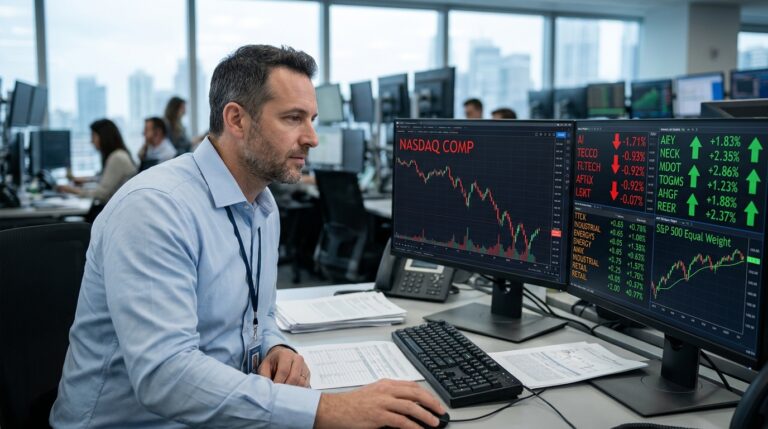
OpenAI’s valuation target dropped from $1.4 trillion to $1.25 trillion even as it pushed to close a round of up to $30 billion. The pullback arrived the same week Wall Street punished Big Tech for its AI spending. The Nasdaq Composite fell 2.60% to 26,008.86 on October 22, its worst session since June, as Meta sank 6.98% after updating 2026 capital expenditure expectations to a range of $135 to $145 billion. Nvidia’s chief executive told CNBC that demand from neocloud providers was “off the charts” but that a lack of capital was limiting their growth, a remark traders read as confirmation that the bottleneck has moved from chips to balance sheets.
The revenue picture adds pressure from a different direction. The round arrives two weeks after OpenAI’s net annualized revenue of roughly $50 billion came in well below the previously circulated gross figure of about $70 billion, a discrepancy tied to how revenue is accounted for across partner channels. OpenAI books sales after subtracting the share kept by partners, while some comparisons have used a grossed-up number to align with how rivals present partner revenue. Reasonable, perhaps, but the clarification landed badly in a market already interrogating AI return on investment.
OpenAI is trying to secure investor commitments before Anthropic’s anticipated IPO in mid-November. Both companies are seeking capital from many of the same institutional investors, creating pressure to attract funding before their rival does. Anthropic’s third-quarter revenue reached $16.8 billion, more than three times what it earned in all of 2025, and the company said it earned $1.70 for every dollar spent on compute last quarter, posting an 11% adjusted operating margin. That kind of unit economics disclosure, once it lands in an IPO prospectus, will invite direct comparison to OpenAI’s own cost structure.
What Investors Are Missing
The markdown is being read as a sign of weakening demand for AI equity. It may be that, but the more important signal is structural. Alongside the new investment, OpenAI is in talks with UAE-linked backers that would pair financing with additional compute capacity. Capital and compute are being packaged together, which means the equity price is no longer the only variable being negotiated. Investors who focus on the valuation number alone are missing the terms beneath it.
Stocks to Watch
Microsoft (MSFT): Microsoft has made total funding commitments of $13.0 billion related to its investment in OpenAI. A lower private-market price for OpenAI does not impair Microsoft’s commercial relationship, but it does reset the implied value of its stake in any pre-IPO model.
Nvidia (NVDA): Nvidia dropped about 4.4% on October 22 alongside the broader AI selloff. If the OpenAI round clears at $1.25 trillion and signals that investor appetite for AI infrastructure spending is moderating, the debate about Nvidia’s forward order book gets harder to resolve in the bull direction.
Coatue: As a lead investor in this round, the firm is writing the most visible private check into AI at this price. How it marks the position between now and a 2027 IPO will be watched closely by every crossover fund sitting on similar exposures.
Anthropic (pre-IPO): Investors face the challenge of allocating capital to two complex, competing offerings within weeks. Some existing and prospective Anthropic investors have argued for a valuation closer to $1.5 trillion instead of the desired $2 trillion, citing third-quarter results. OpenAI settling at $1.25 trillion gives those skeptics a fresh comparable.