
October 28, 2026
Bonus Content: Britain Is Borrowing £249.6bn This Year. Banks Are Paying for It.
Ian Cooper here…
Alert!
If you still haven’t saved your copy of “The Simple Path To Success With Options”…
… do it right now before the download link expires.
We’ll be moving this book behind a paywall in the near future so grab it now while you still can.
You’ll thank me.
FREE: The Simple Path To Success With Options
To your success,
Ian Cooper
Tradewins
Reminder: Grab your copy of “The Simple Path To Success With Options” before we move it behind a paywall.

Britain Is Borrowing £249.6bn This Year. Banks Are Paying for It.
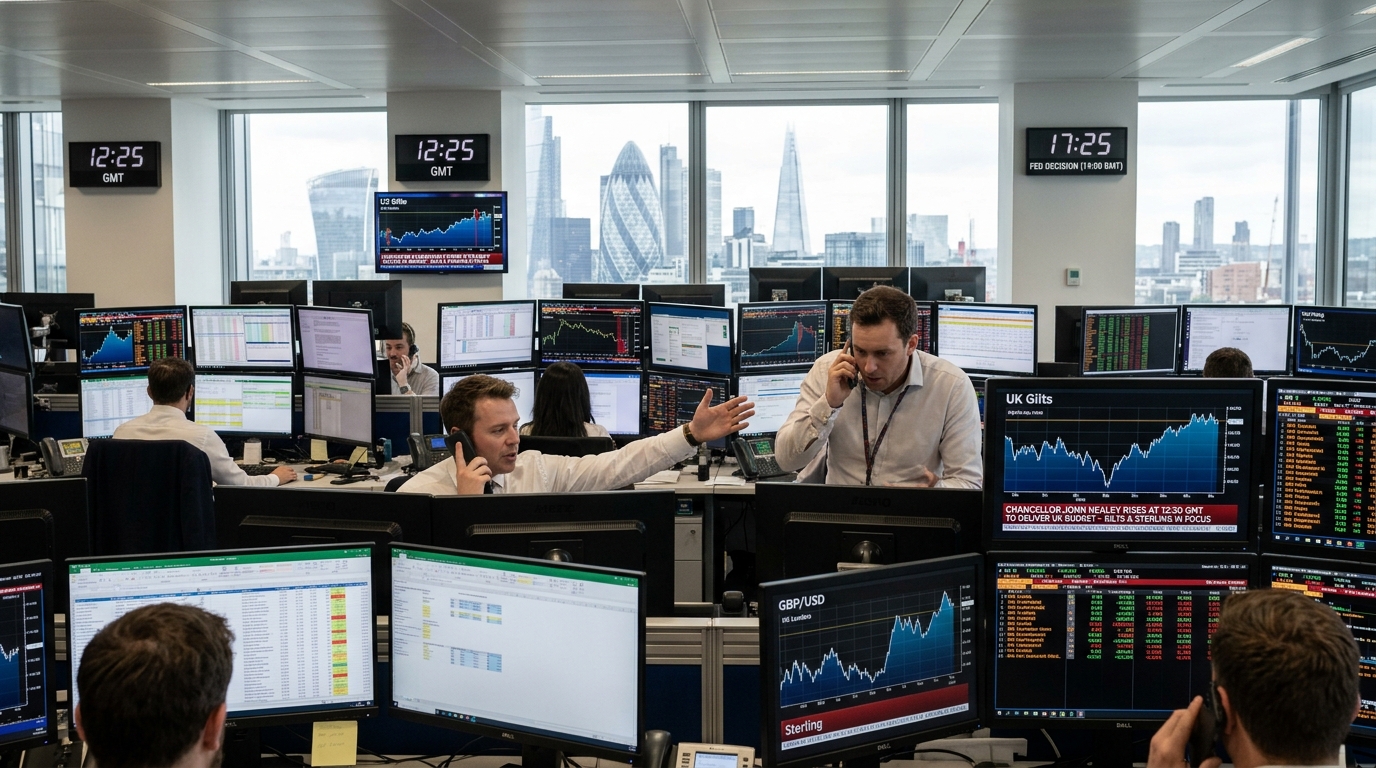
Chancellor John Healey steps to the despatch box at 12:30 GMT today with a financing remit that tells the real story of the Burnham government’s first Budget. The Office for Budget Responsibility publishes its five-year outlook immediately after. Between now and the Federal Reserve’s decision at 19:00 GMT, traders have a narrow window to position across UK gilts, sterling, and a banking sector that is already pricing a potential tax hit of up to £2 billion a year.
The Numbers That Matter
A Bloomberg survey of dealers points to total gilt issuance of roughly £249.6 billion this fiscal year, up from the Debt Management Office’s £246.2 billion April plan, with the consensus centered on a roughly £3.4 billion uplift. Dealers also expect long-dated gilt issuance this year to fall to its lowest since 1990/91 as the DMO targets cheaper, shorter-dated financing. Maturities beyond 15 years are forecast at around 7% of total issuance. That deliberate compression of the long end matters: it caps supply pressure on 30-year gilts and gives the Treasury flexibility without alarming pension-fund buyers.
Dealer forecasts also center on fiscal headroom falling to roughly £15 billion. After the Iran conflict began, benchmark 10-year yields rose sharply, pushing the government closer to its rule that day-to-day spending be covered by taxes by Parliament’s end. As of Monday, the 10-year gilt yield was around 5.35%.
Gilt traders watching the 5.35% level have a parallel in the US market. The 30-year Treasury hitting 5.50% and what finally arrested that selloff offers a framework for where supply and credibility fears peak.
Bank Surcharge: The Swing Item
The bank surcharge is assessed at high likelihood of rising from 3% back to 8%, raising roughly £2 billion a year. Estimates used in parliamentary analysis have put each percentage point at around £0.4 billion over the longer run, but the near-term take will depend on profits and allowances. Goldman Sachs has estimated that restoring the surcharge to 8% would trim Barclays’ net profit by 2% to 3%, and cut Lloyds and NatWest by 6% to 7%.
The numbers are already partly in prices. Bank shares have pulled back as expectations for a higher surcharge built, with the FTSE 350 Banks index lower over the past month. NWG closed Monday at about 644p, around 18% below its 52-week high of 788.2p. LLOY is around 102p and BARC around 421p. HSBA closed Monday near 1,365p. Goldman has said a small surcharge increase would be a headwind to earnings and sentiment but would not fundamentally alter the equity story or overall profitability trajectory. That framing supports a buy-the-fact dynamic if Healey confirms 8% without extending the tax further.
Barclays upgraded NatWest to Overweight from Equal Weight and raised its price target from 740p to 850p on October 13, citing higher-rate earnings potential, continued growth, and the Evelyn Partners business. NWG reports Q3 results on October 30, with the company scheduling that release for Friday.
Sterling: Elevated but Exposed
The pound hit a new 16-month high against the euro earlier this month, reaching 1.1844 before settling near 1.1831, its best level since June 2025. The euro has weakened notably against sterling in recent weeks, with the move widely tied to the energy shock and renewed concerns around French fiscal risk. Sterling’s strength is largely a euro story, not a pound story, which matters for how reversible the move is.
For sterling and gilts, the bar for a positive surprise is high, and with a market-friendly budget already priced in, the path of least resistance can still be lower for the pound and bonds. Fiscal headroom materially below £15 billion would raise concern over whether it can absorb further shocks.
Technical Framework
The 10-year gilt yield has been consolidating around the mid-5% area over recent weeks. A credible headroom print above £15 billion could push yields toward 5.20% to 5.25%, with the long end outperforming if the issuance share is reduced. A disappointment drags 10-year yields back through 5.45% and threatens the 5.53% October peak. On GBP/EUR, 1.1850 remains the immediate upside barrier; 1.1780 to 1.1800 provides initial support. On LLOY, 100p is the next clean support; NWG has a gap to fill toward 620p on a weak read.
Scenario Modeling
Bull Case
Headroom prints at £16 billion or above. Long-dated issuance confirmed at around 7% or lower. Surcharge set at 8% with an expanded profit allowance that softens the bank sector blow. Gilts rally 10 to 15 basis points. GBP/EUR tests 1.1900. LLOY, NWG, and BARC recover 2% to 3% intraday on the allowance offset and clarity.
Base Case
Headroom settles around £15 billion, with targeted tax rises. Surcharge rises to 8%. Gilt reaction is flat to modestly positive as the long-end cut offsets headline borrowing. Sterling holds near 1.18 against the euro ahead of the Fed hold at 19:00 GMT. A Reuters poll conducted October 16 to 20 found 94 of 100 economists expecting the Fed to hold the federal funds rate in a 3.75% to 4.00% range.
Bear Case
Headroom prints below £13 billion. Spending increases are back-loaded and non-credible. Surcharge extends beyond 8% or hits smaller banks not already discounted. 10-year gilts sell off through 5.50%. GBP/EUR drops toward 1.1730. A hawkish Fed statement compounds the pressure on the long end of the gilt curve. FTSE 100 financials lose 3% to 5%.
Active Trader Framework
The sequencing of today is everything. The Budget hits at 12:30 GMT, the OBR follows within the hour, and the Fed decision arrives at 19:00 GMT. Positions need to survive both windows. For gilt traders, the long end is the cleaner expression: reduced issuance at around 7% is a direct supply tailwind, but credibility risk sits there too. On UK banks, the surcharge quantum is known; the variable is whether the profit allowance is raised. A confirmed 8% surcharge with a higher threshold is the constructive outcome, already largely priced for BARC and partially for NWG. Risk management demands defined levels: below £15 billion headroom is the fault line for gilt shorts to press; below 1.1780 in GBP/EUR is where sterling longs need to reassess. Position sizing should reflect that the Fed statement five hours later could shift GBP/USD regardless of what Healey delivers.
Preparation today means knowing which number moves your market. For gilts, it is the OBR headroom figure. For UK banks, it is the surcharge rate and any allowance offset. For sterling, it is both, plus whatever Chair Warsh signals about December. The traders who separate those three signals will navigate the session. Those who treat it as a single macro event will be chasing by the close.