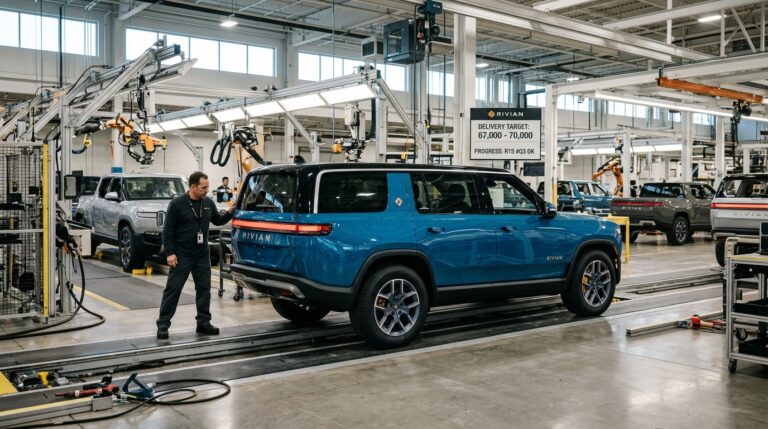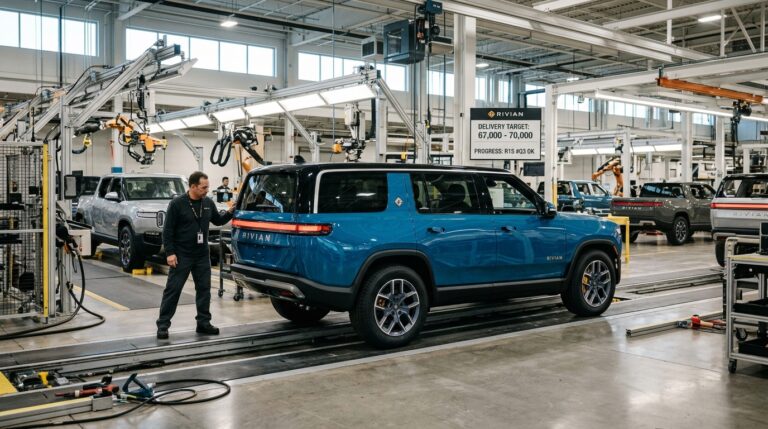
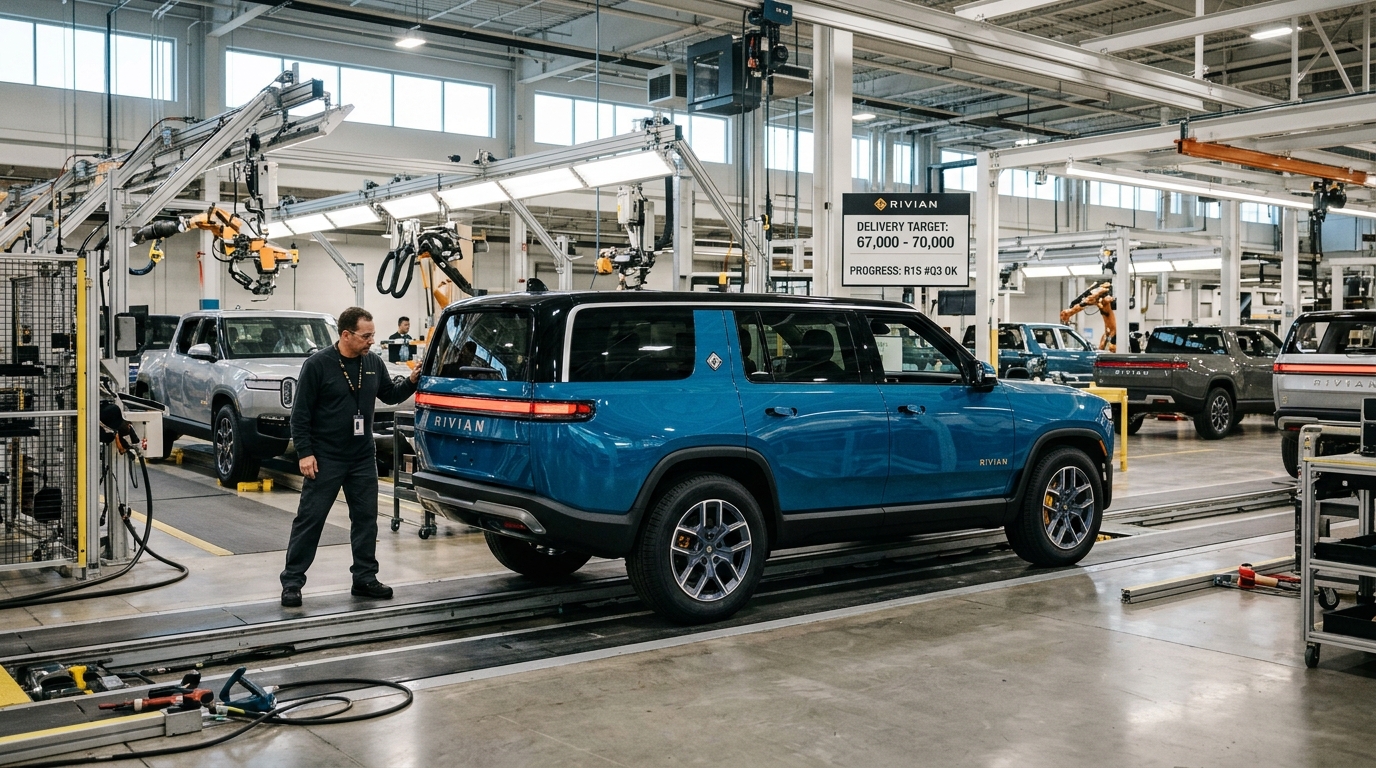
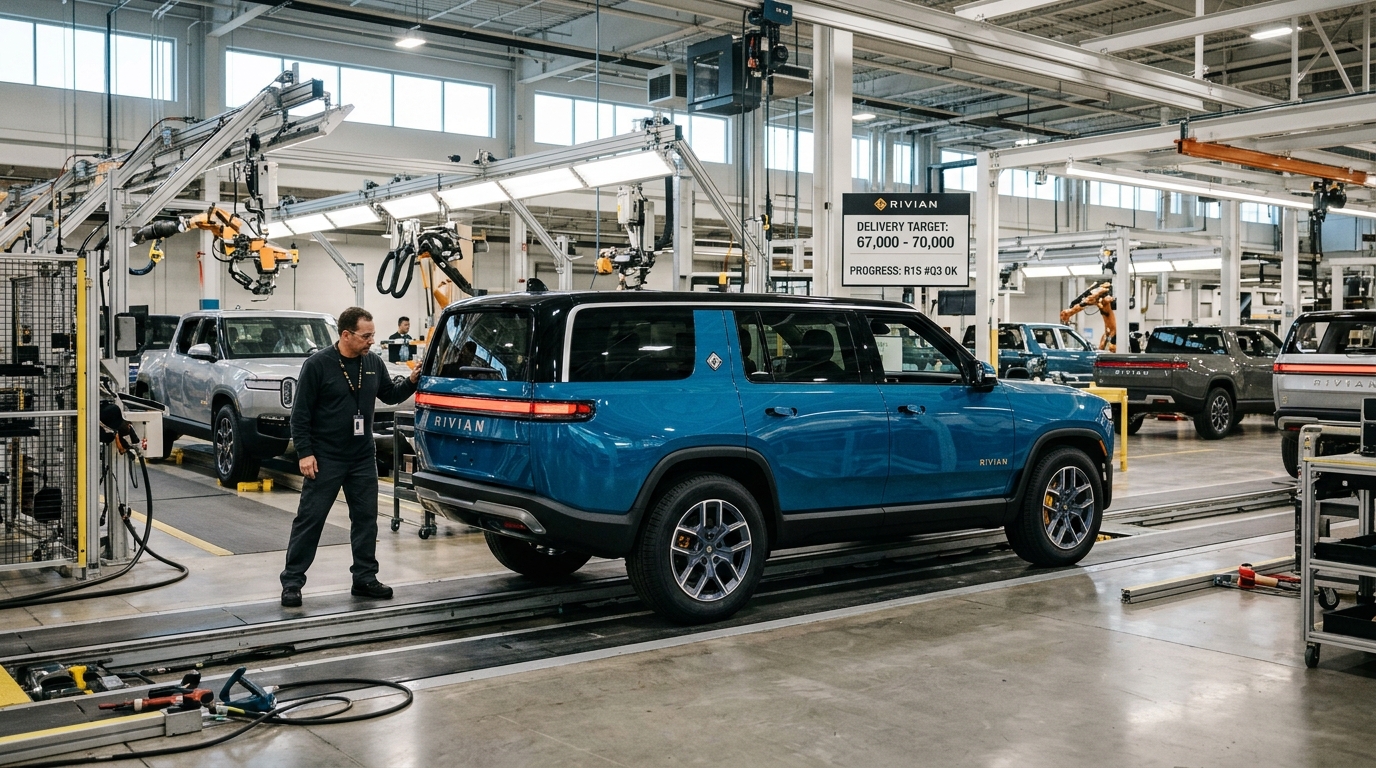
Thursday evening was ugly almost everywhere. Amazon fell after hours on a soft margin outlook. Intel dropped on weak guidance. In that context, one ticker went green and held there: Rivian, up roughly 7% after the close after reporting a quarter that beat on revenue, narrowed its adjusted loss, and lifted delivery guidance from 65,000–70,000 to 67,000–70,000 vehicles for the full year.
That is not a dramatic raise on paper. But the R2 is the reason it matters.
What the Quarter Actually Said
Revenue came in at $2.16 billion, up 38% year over year, well ahead of the roughly $1.99 billion Wall Street had penciled in. The adjusted loss per share narrowed to $0.48 from a $0.65 loss a year earlier, beating the $0.65 consensus. Deliveries hit a record 19,248 vehicles, up 46% from the same period in 2025.
Rivian’s delivery growth lands against a complicated backdrop for the broader EV market. New EV sales have slowed sharply since federal clean-vehicle tax credits expired, while used EV demand has surged to fill the gap.
The R2, which reached its first public customers in June, was already Rivian’s highest-volume model in Q3, outselling both the R1 and commercial delivery vans in its first full quarter of sales. Management was direct: the R2 was responsible for “much of the gain quarter-over-quarter.”
Software and services revenue grew 45% to $605 million at a 42% gross margin, anchored by work tied to Rivian’s joint venture with Volkswagen and the Autonomy+ driver-assistance platform.
The Number Worth Watching
Cost of goods sold per vehicle fell by more than $12,000 in Q3 versus Q2, dropping to roughly $84,700. That decline came from a higher R2 mix and better fixed-cost absorption as volume rose. Rivian still loses money on every car it sells, but the direction of travel is the point: management now expects to exit Q4 with positive automotive gross profit.
Raising the low end of full-year delivery guidance to 67,000 from 65,000 is a signal that the second R2 production shift, which Rivian says is now online and ramping in Normal, Illinois, is already yielding. Q4 needs at least 25,200 deliveries to hit the new floor. The company is saying that number is achievable.
The Broader Architecture
Rivian is not just a car company at this point. CEO RJ Scaringe confirmed Thursday that Rivian is “very confident” it will hit an autonomy milestone before year-end that unlocks a $250 million tranche from Uber. Uber has committed up to $1.25 billion through 2031, starting with an initial $300 million, with additional tranches gated on technical progress. The two companies are targeting a 2028 launch of driverless R2 robotaxis on Uber’s network, starting in a couple of cities and expanding to roughly 25 over about 18 months.
The robotaxi race Rivian is entering with Uber has a well-funded incumbent already scaling fast. Tesla’s Cybercab fleet has grown eightfold in a single month and is already expanding to a second city.
The Volkswagen partnership adds another layer. Volkswagen has said the first Group vehicle featuring a version of the joint venture’s software-defined vehicle architecture is scheduled to launch in 2027, in the entry-level EV segment. The companies have also discussed expanding the partnership to include elements of Rivian’s AI assistant technology.
Cash and cash equivalents were $3.5 billion as of quarter-end, and short-term investments were about $2.0 billion, for roughly $5.5 billion in total liquidity.
What Has to Go Right
Three things, in order of importance. First, the $12,000-per-unit cost reduction has to continue. The automotive segment posted an $80 million gross loss in Q3, despite revenues related to regulatory credits helping the math. If the cost curve stalls as the second shift scales, the profitability story stalls with it.
Second, the Volkswagen relationship has to hold. In Q3, Rivian said about 60% of its software-and-services revenue was attributable to the joint venture with Volkswagen Group. Reports surfaced last week that VW was weighing other software vendors for European vehicles; Scaringe called those reports “noisy” and characterized the partnership as “very positive.” Investors will keep watching.
Third, Rivian still needs more scale than its current Normal plant can support. Scaringe has said the company ultimately needs much higher volumes to drive consistent profitability. The Georgia plant expansion is planned; execution on that timeline will define the medium-term outlook.
The Takeaway
On a night when the megacaps disappointed, Rivian delivered a clean beat with a credible path forward. The R2 is real: it is already the company’s best-selling model and its cost curve is moving the right direction. For anyone modeling when Rivian crosses into positive automotive gross margins, Q4 is now the quarter to watch. The stock may be worth keeping on your radar as that data arrives.