November 2, 2026
Bonus Content: Democrats Favored to Win Congress Tomorrow. Sectors to Watch
Quick reminder.
Your free copy of The 0DTE Game Plan is still sitting there, ready to download.
But the link won’t work forever.

Once it expires, the report goes back to $29.97 on our website.
So do yourself a favor and download it right now. Save it to your computer, and it’s yours to keep no matter what it costs later.
It takes about 10 seconds.
Inside, you’ll find the simple 3-step plan for trading same-day options like a business: Plan it. Profit from it. Protect it.
Make sense?
Click here to download The 0DTE Game Plan before your link expires.
Good Trading,
Bill Poulos
p.s. Free today, $29.97 once this link is gone. Grab your copy here.
Democrats Favored to Win Congress Tomorrow. Sectors to Watch
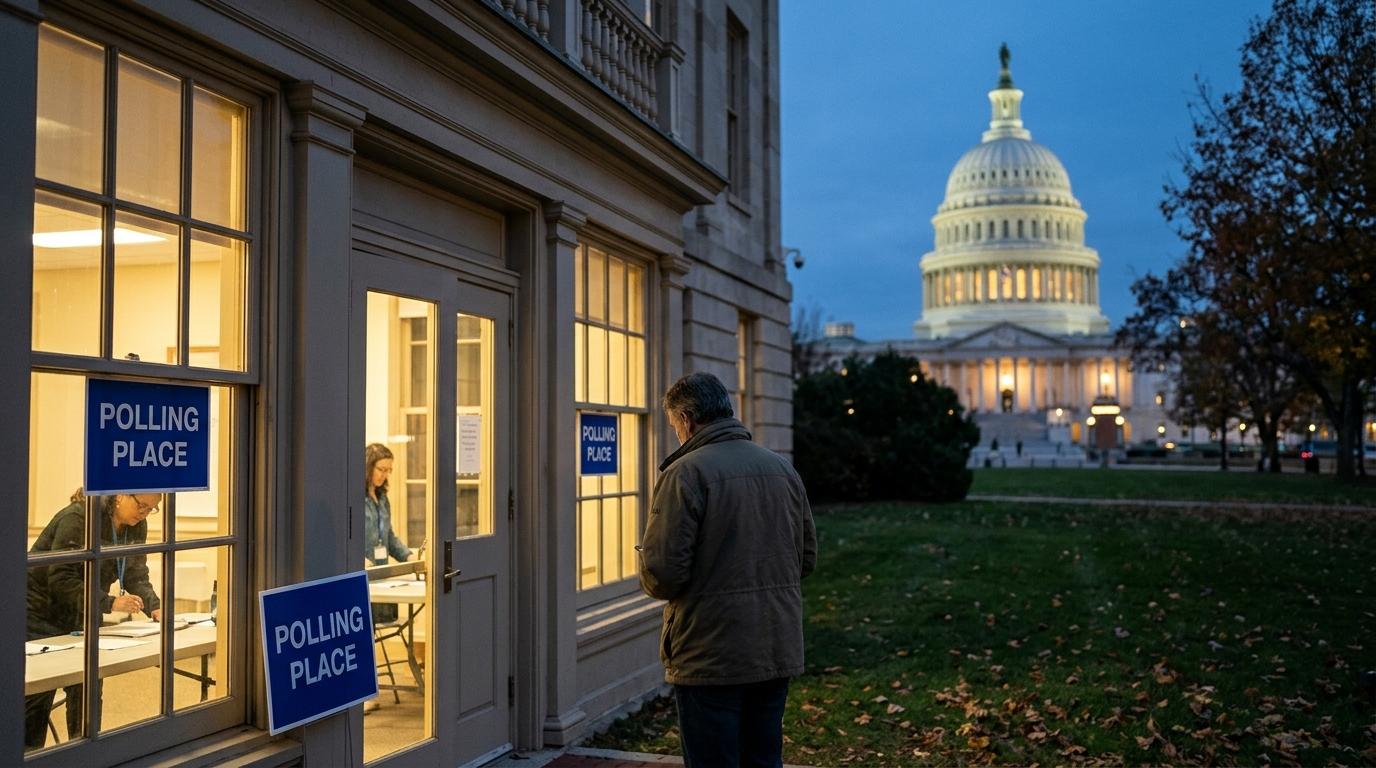
The vote is tomorrow. First polls close at 23:00 UK time on November 3, and today’s session is the final window to act before results begin moving markets. Wall Street broadly expects Democrats to win the House and has them favored to take the Senate as well, though the confidence level depends on the model and the day. Recent prediction-market pricing has generally implied Democrats are likely to win both chambers, with a Republican sweep priced as a low-probability tail. The question for disciplined traders is not who wins, but which policy trades are already priced and which are not.
Macro Context
The DXY opened November 2 at 101.96, holding within a narrow one-month range. The 10-year Treasury yield was near 4.93% at the end of last week after pulling back from levels above 5.30% earlier in October, according to the Associated Press. The S&P 500 dropped 1.8% on Friday, October 30.
A Democratic sweep of both chambers is the outcome most likely to set up a Treasury rally, and more than half of 301 Bloomberg Markets Pulse respondents expect 10-year yields to fall over the 12 months following such a result. That bond bid, combined with a flat dollar, tells you the base case is already embedded. The asymmetric risk is a Republican hold or a delayed count.
Hanging immediately over any newly seated Congress: Congress returns facing a compressed lame-duck agenda, with the current continuing resolution expiring December 11, 2026. None of the 12 regular FY2027 appropriations bills have been enacted. That fiscal deadline is a live volatility catalyst regardless of who controls the chambers come Wednesday morning.
Sector Breakdown: Three Trades, Three Different Levels of Pricing
Healthcare: partially priced, more upside if the sweep holds. Health care has been among the leaders over the past three months, with sector ETF data showing roughly an 11% gain into late October. Democratic control would keep focus on Medicaid and subsidy mechanics tied to this year’s One Big Beautiful Bill Act, which independent fact-checking has described as containing large Medicaid spending reductions over time. The key for traders is not the headline, but the implementation path: timelines, waiver discretion, and reimbursement mechanics.
UNH trades around $406, with a 52-week range of $255.97 to $461.62. UnitedHealth’s October 13 earnings release reported third-quarter 2026 revenue of $112.7 billion and said the company raised its full-year 2026 earnings outlook. The average analyst price target sits at $476.64 against a current price near $407, with the high target at $531. The gap between current price and consensus target implies the market has not fully priced a constructive policy outcome. Medicaid-focused managed care names like Molina Healthcare carry even more direct legislative sensitivity.
Renewables: structurally positioned but veto-limited. NextEra Energy’s investor materials for Q3 2026 said NextEra Energy Resources added 3.7 gigawatts of new generation and storage to its backlog since the second-quarter call. NEE trades near $79 with a 52-week range of $61.70 to $95.90. Democratic gains could improve confidence in longer-lived renewable incentives and permitting support, though the presidential veto limits any immediate statutory change. The policy optionality is real; the cash-flow event is contingent.
Defense: the clearest loser in the priced sweep. ITA closed October 30 near $209. In prediction markets, Democratic House control has generally been priced as highly likely, and that skew has contributed to a more defensive posture across parts of the space. Separately from the election tape, Lockheed reported third-quarter 2026 EPS of $7.97 and disclosed a record $292.0 billion backlog that included $52.5 billion tied to a multi-year PAC-3 MSE interceptor award. Defense News also reported the Pentagon and Lockheed agreed to a 10-year framework targeting at least 850 U.S. F-35 aircraft, pending congressional approval and funding. LMT’s fundamentals have diverged meaningfully from the ETF’s election-driven slide.
The election is not the only variable weighing on defense names. Lockheed’s record $292 billion backlog faces a separate test if Ukraine ceasefire talks advance toward a settlement.
Technical Framework
After reaching the 103.00 area on October 15, the DXY corrected and found support around 101.60, leaving the index consolidating in a narrow range. A Democratic sweep result could pressure the dollar through the 101.60 support; a Republican hold would likely force a swift re-rate toward 103. The 10-year yield near 4.93% sits just below the 5.00% level that acted as resistance through late October. Watch whether a sweep confirmation pulls it back toward 4.70%.
Scenario Modeling
Bull Case (Democratic Sweep Confirmed): Healthcare names extend their three-month outperformance. UNH tests $440-$450. NEE recovers toward $85. The 10-year yield breaks below 4.80%. ITA stabilizes as the defense budget debate gets pushed into December appropriations negotiations rather than immediate cuts.
Base Case (Split Congress): A Democratic House would make major Republican legislation harder to pass, which for investors could reduce the prospect of sweeping changes affecting corporate taxes, federal spending, and business costs. Healthcare holds recent gains. Defense recovers modestly. The DXY remains rangebound near 102. Equity volatility fades after an initial knee-jerk move.
Bear Case (Contested or Delayed Count): A delayed result following the November 3 vote could surprise markets already on edge over borrowing costs and AI-driven positioning. ITA tests its 2026 lows. VIX, which closed October 30 at 19.42, spikes toward 25. The 10-year yield reverses higher, pressuring both healthcare valuations and rate-sensitive utilities.
Active Trader Strategy Framework
Today’s session matters because many of these trades become binary after polls close. Positioning before 4:00 PM ET carries event risk through the overnight count. Sector pairs offer a cleaner expression than outright index positions: healthcare long versus defense short reflects the asymmetry already embedded in prediction markets while limiting net market exposure. For defense specifically, Lockheed has held up better than the ETF in part because its missile-heavy mix has drawn steadier demand. LMT long versus ITA short is a spread worth examining for traders wanting defense-sector exposure without the full headline risk.
December 11 is the next hard deadline. Regardless of Tuesday’s outcome, lame-duck appropriations negotiations will drive another round of sector rotation within six weeks. Preparation for that sequence starts now.