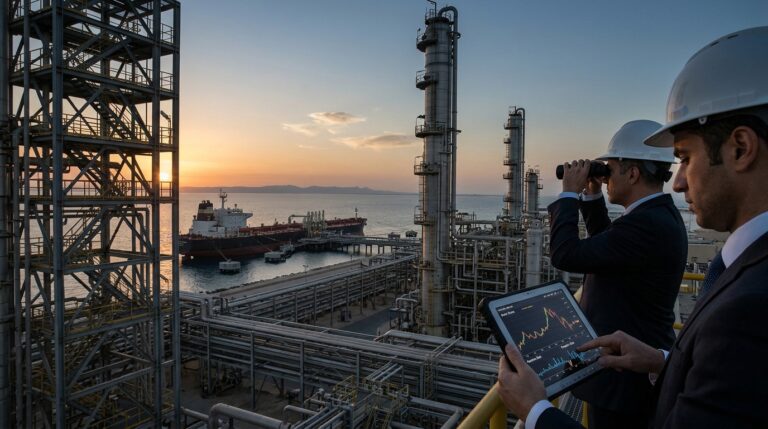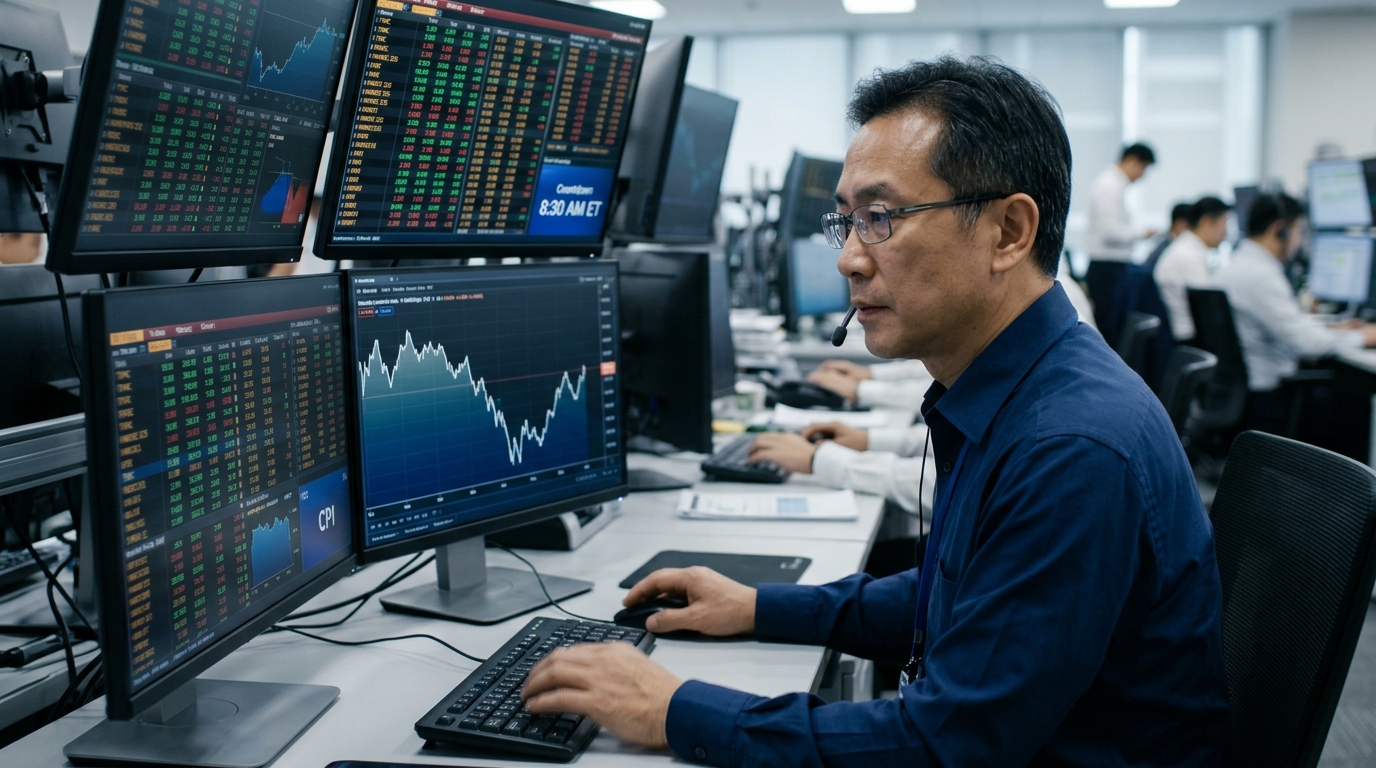
One week after Democrats swept Congress and triggered the most violent AI selloff since 2022, Asia answered Monday morning with its first coordinated dip-buying session of the cycle. The question for active traders is not whether the bounce happened; it did. The question is whether US futures can hold into Tuesday’s Consumer Price Index reading at 8:30 AM ET.
What the Overnight Numbers Actually Said
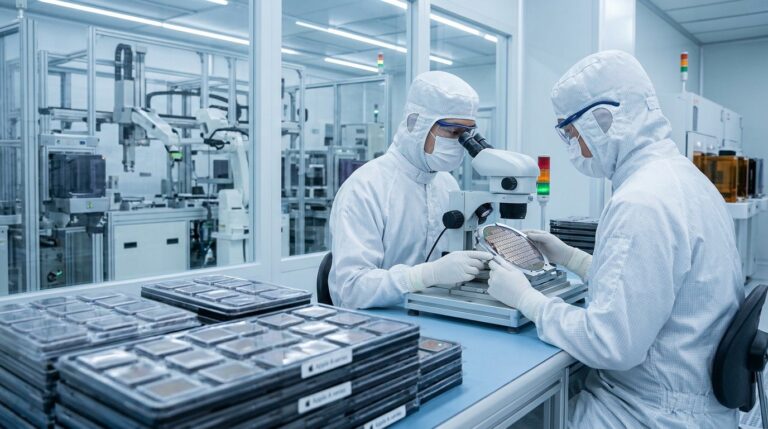
Taiwan led. The Taiex rebounded sharply Monday, with TSMC among the largest drivers. Intraday, the index was up as much as roughly 6% before trimming. TSMC’s October monthly revenue report is due Tuesday at 1:30 PM Taipei time, and the company reported record third-quarter profit while projecting a 12% to 16% jump in current-quarter sales. That Q4 guidance range of $52.3 to $54.3 billion, against a Q3 actual of $46.72 billion, is the fundamental anchor the whole supply chain is trading against right now.
Japan reclaimed a key level, then gave some back. Tokyo’s morning session pushed the Nikkei back above 59,000 before fading. By the close, the Nikkei 225 finished 2.3% higher at 58,775.50, still below 59,000. Context matters: Japan’s benchmark had entered bear market territory on Friday, driven by a broader selloff that wiped about $2.5 trillion from the Nasdaq 100. Monday’s move was a partial recovery, not a reversal of trend.
Korea split in two. Samsung Electronics and SK Hynix were up over 2% and 4% respectively at their intraday peaks. But South Korea’s Kospi gave up a morning gain of more than 1.5% to finish 0.8% lower at 5,018.85. Overseas investors pulled money from the market as the selling fed on itself, and the KOSPI had fallen about 11.7% by the prior week’s close on November 6. Monday’s session illustrated the structural fragility: domestic institutions bought the dip in chip names, foreign funds sold the bounce.
The Catalyst Behind the Wreck
Democrats secured big wins in the midterm elections with many candidates having campaigned against aggressive data center buildouts. Texas governor-elect Gina Hinojosa said she would keep the state’s pause on certain data center approvals in place until legislators pass new state laws next year. Texas is home to many data center projects. UBS strategists warned that a data center slowdown “should impact estimates for AI infrastructure stocks as well as cloud companies.”
Monday’s rally happened despite, not because of, an Nvidia-specific headline. Nvidia CEO Jensen Huang admitted to an affair with a person US authorities suspect to be a Chinese spy, and the company’s board launched an independent investigation. In early US futures trading, Nasdaq 100 contracts dipped before stabilizing. The market separated the company-specific event from the broader AI complex. That is the first constructive sign in a week.
US Futures and the CPI
S&P 500 futures were higher Monday alongside Dow and Nasdaq 100 futures, as investors braced for key inflation data. The October CPI report drops Tuesday, November 10 at 8:30 AM ET. Economists’ estimates vary, and some previews point to a re-acceleration toward 3.9% year over year from 3.7% in September, rather than a drop. Core CPI expectations are clustered around 0.2% to 0.3% month over month, with annual core inflation around the mid-2% area.
After the October jobs report, market-implied probabilities of a December rate increase moved into the high-70% range, though these expectations can shift sharply following CPI. A hotter-than-expected reading would hit the AI complex with a second punch: tighter financial conditions compounding already fragile capex sentiment. A softer number opens room for tech to extend Monday’s Asian bounce into the US session.
The Fed itself is not unified on what the next CPI print requires. Three Fed governors delivered conflicting signals inside a single week, leaving rate-hike probabilities unusually sensitive to a single inflation number.
Scenario Modeling
Bull Case. CPI cools materially versus expectations, and rate hike odds recede. Nasdaq 100 futures build on the overnight bid, TSMC’s October sales data confirms Q4 trajectory, and the index retakes 27,500. TSM ADRs test resistance near prior support at $395.
Base Case. CPI comes in near consensus, and markets digest the number without a sharp directional move. The S&P 500 holds the 7,350–7,420 range. Asian dip-buying fades without follow-through, and the Nikkei remains capped below 59,500 pending further political clarity on data center regulation.
Bear Case. CPI surprises hot, hike odds surge, and the Nvidia investigation widens into a congressional probe. Nasdaq 100 retests the 26,500 level. SK Hynix ADRs (SKHY), already down significantly from their July 2026 offering price, face renewed foreign selling pressure in Seoul. Market participants note that concerns over regulatory tightening have not faded, and cautious views on the outlook for AI-related companies remain deeply rooted.
Active Trader Framework
Tuesday morning runs in two stages. The 8:30 AM ET CPI release is the first gate. If the number is clean, then the 1:30 PM Taipei time TSMC sales report becomes the second. Traders in TSM should size positions to handle volatility through both events, not just one. The VIX remains elevated, with the S&P 500 VIX last quoted near 22. Sizing accordingly reduces the risk of being stopped out between two binary catalysts.
Korea’s close is a warning: a session where domestic buyers step in and foreign funds walk out is not yet a durable recovery. Watch whether SKHY and Samsung hold Monday’s intraday gains into Tuesday’s Asian open. Failure to hold suggests the institutional bid was tactical, not conviction-driven.
Asia’s Monday session proved demand exists below last week’s panic lows. Whether that demand survives Tuesday’s inflation data is the question disciplined traders are asking, not answering in advance.