Dear Reader,
A financial crisis usually doesn’t begin with one company defaulting or one fund taking a hit.
The real danger begins when investors get nervous and start asking for their money back… forcing funds to sell assets, lenders to pull back and credit to dry up.
And very soon, what looked like an isolated problem suddenly spreads across the financial system like wildfire. By the time most investors realize what’s happening, it’s already too late.
Weiss Ratings saw versions of that in 1998, in 2008, and again during the market panic of 2020.
But here’s the most critical part …
55 years of watching financial crises unfold tell us we could be seeing the perfect conditions for another chain sreaction.
And the fallout could reach banks, insurers, annuities, investment funds and retirement portfolios.
That’s why we’ve recorded a special briefing explaining what we’re seeing now … and why we believe investors should take action before the pressure gets worse.
In this presentation, we also reveal five specific steps you can take now to help protect your wealth before this new subprime crisis spreads.
Click here to see our warning before the rush for the exits begins
Good luck.
Sincerely,
Eliza Lasky
Weiss Advocate
Apple Has 100 Million US-Made Chips. iPhone Assembly Isn’t Here.
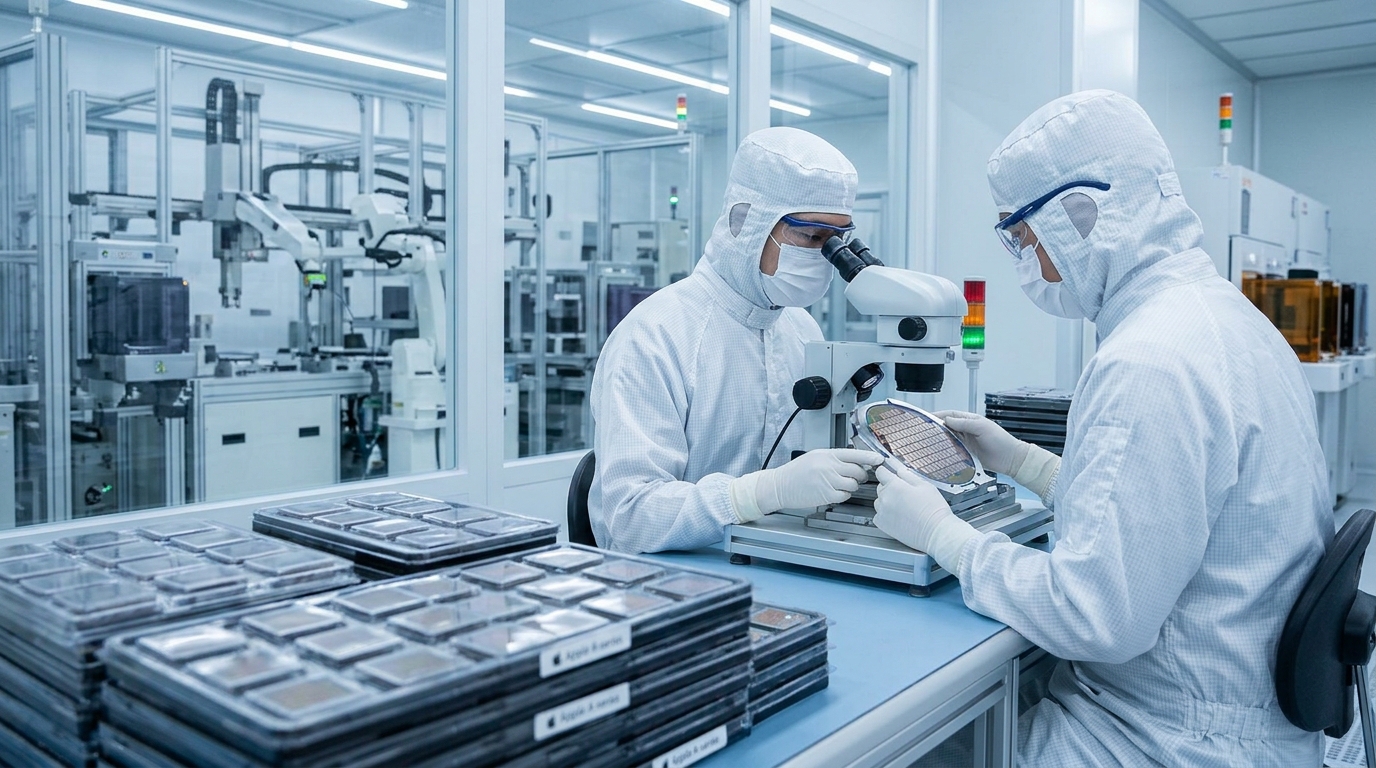
Apple has spent 2026 producing the most visible domestic manufacturing numbers in company history. TSMC’s Arizona chip factory has produced more than 100 million chips for Apple this year, continuing to scale production of advanced chips used across iPhone, iPad, and Apple Watch while construction progresses on the site’s north campus. That milestone is not incidental. It is the clearest signal yet of which layer of Apple’s supply chain is actually moving onshore.
Apple has committed up to $100 million over the next three years to purchase US-made titanium from Perryman, as part of its broader $600 billion, four-year commitment to US manufacturing and innovation. 100% of the cover glass on iPhone and Apple Watch units sold worldwide is now made in the US, sourced from Corning’s Kentucky facility. Add Mac mini production coming to a new factory on Apple’s Houston manufacturing site, doubling that campus’s footprint, and the domestic footprint looks substantial on paper.
Traders should read it differently. The pattern is deliberate: Apple is reshoring components and servers, not final assembly. Final assembly will be completed “elsewhere for a while,” Cook said at the White House. That admission is the most important line in the entire $600 billion pledge.
The labor cost for assembling and testing an iPhone in the US would come in at $200 per unit, up from $40 in China, according to analyst estimates that have circulated since the 2025 tariff debate. Wedbush’s Dan Ives has pegged a fully domestic iPhone at roughly $3,500, more than triple the current retail price of a Pro Max. While final assembly has moved partially to India, those factories remain dependent on Chinese-made subcomponents, and analysts generally expect costs in alternative hubs to run modestly higher than China rather than lower.
What the Supply Chain Build Actually Means for AAPL
AAPL closed at $342.37 on November 6, up roughly 26% year to date, trading at a price-to-earnings ratio around 38x on volume of 44.70 million shares. The 52-week range runs from $243.42 to $355.38, with the stock sitting about 3.7% below that high. At roughly a $5.04 trillion market cap, the market is pricing execution on the domestic component strategy, not a fully reshored iPhone.
Since the American Manufacturing Program launched, Apple has already exceeded its initial target, sourcing more than 20 billion US-made chips from 24 factories across 12 states. Bosch, Cirrus Logic, TDK, and Qnity Electronics joined the program in March, with Apple committing $400 million through 2030 to support these new programs. These are real capital flows. They benefit Corning, TSMC, GlobalFoundries, and Amkor directly.
The distinction between who captures value and who merely passes it through matters here. Component suppliers with genuine pricing authority tend to retain margin that assemblers and integrators cannot.
Three Scenarios
Bull Case ($375+): Apple’s Q4 FY2026 results, already reported, keep the focus on revenue durability and a steadier gross margin profile than feared, even with higher memory costs flagged for the December quarter. The Houston Mac mini line comes online on schedule, analyst targets at $380 to $400 from Bernstein and Evercore get traction, and domestic manufacturing announcements draw fresh institutional flows into AAPL.
Base Case ($330 to $355): AAPL consolidates near its 52-week high. Component reshoring continues at the current pace, the iPhone remains assembled in India, and the stock trades in line with its high-30s earnings multiple without a re-rating catalyst.
Bear Case (sub-$310): A new tariff escalation targeting India-assembled iPhones forces margin compression. Memory cost pressure worsens in coming quarters, gross margin guidance disappoints, and AAPL pulls back toward the 200-day moving average near $299.
The tariff escalation risk in the bear case does not exist in isolation. The broader reshoring capex cycle is now embedded in earnings transcripts and federal appropriations in ways that change the cost calculus for offshore assembly.
Active Trader Framework
AAPL’s 50-day moving average sits at $336, with the 200-day at $299. The stock is extended above both but holding the range established after the November 4 midterm-driven gap higher. A close below $336 on elevated volume would signal distribution. On the upside, $355 is the recent high and the level where sellers have twice emerged.
The domestic manufacturing story is a margin and regulatory risk management exercise, not a catalyst for near-term earnings upside. Position sizing should reflect that distinction. The component suppliers, Corning, TSMC Arizona, and GlobalFoundries, carry more direct leverage to the reshoring theme than AAPL itself at current multiples.
Know the levels. Know what each announcement actually moves, and what it does not.