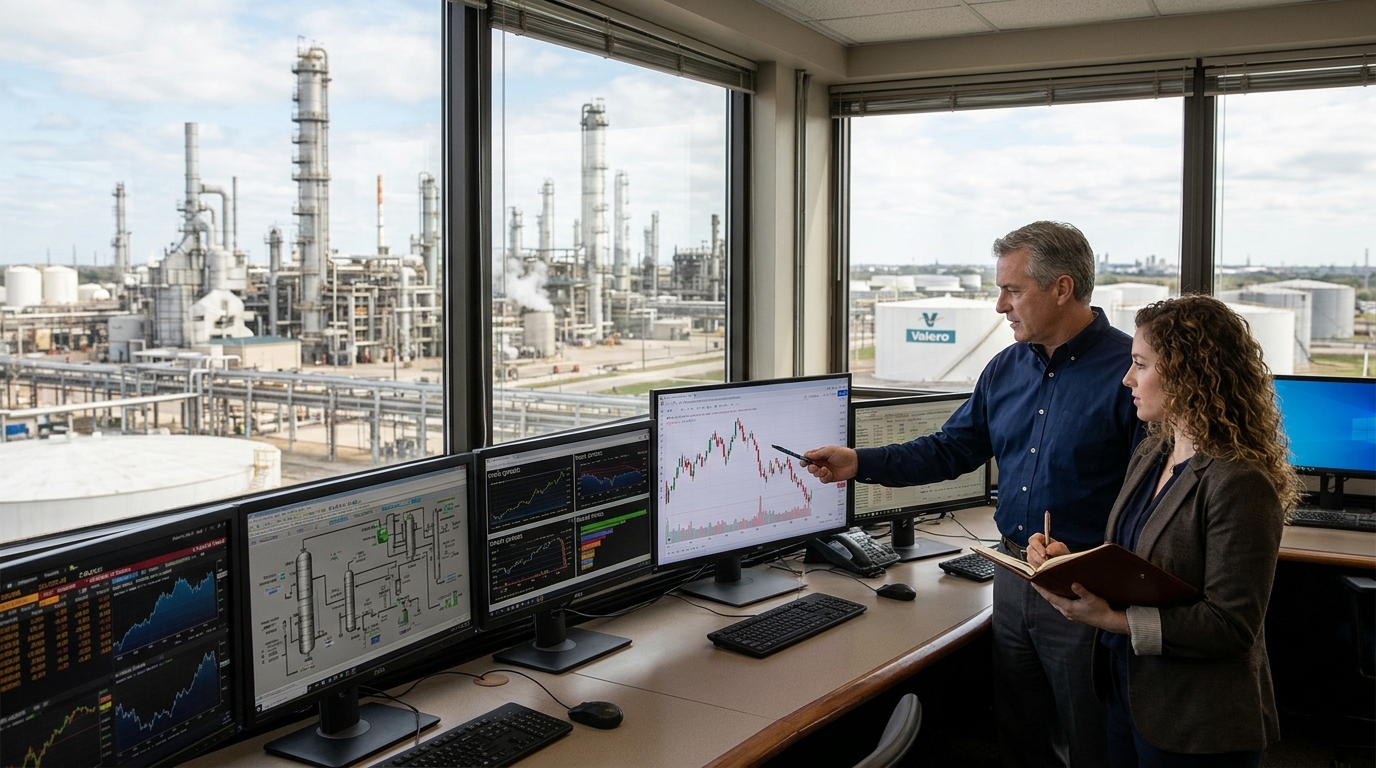
When the 3-2-1 crack spread peaked at $81.86 per barrel in late September, Valero Energy traded around $390. It sits near $350 today. That roughly 10% pullback has been framed by much of the Street as a cycle rollover, a signal that the extraordinary refining margins of 2026 are reverting. The balance sheet and the structural supply picture argue otherwise.
Start with what Q3 actually showed. Refining margin per barrel reached $39.24, up from $13.14 a year earlier, nearly tripling in twelve months. The refining segment produced $8.8 billion in operating income versus $1.6 billion in Q3 2025. Revenue climbed 43% year over year to $46.1 billion. Net income attributable to stockholders came to $6.8 billion for the quarter alone, pushing the year-to-date total to $11.8 billion. That is not a cyclical accident. That is a structurally reset business.
What the market appears to be pricing is a reversion to mid-cycle spreads. What it may be underweighting is how difficult that reversion actually is. In a recent Today in Energy note, the U.S. EIA cited Kpler data showing global crude oil refinery inputs fell by about 4.8 million barrels per day in Q2 2026 following the start of conflict in late February in the Middle East. Seven major U.S. refinery closures since 2019 have removed about 1.2 million barrels per day of domestic processing capacity. Valero itself began idling Benicia, California in Q1 2026 and completed full idling by the end of April. Capacity that is gone does not come back when a ceasefire is signed.
The geopolitical picture adds a floor the headlines miss. Recent public comments from Fed officials have pointed to tanker insurance and avoidance costs through the Strait of Hormuz adding roughly $20 to $30 per barrel, which has made it materially more expensive to move crude around disrupted routes. That freight premium can benefit Gulf Coast refiners, which source cheaper Western Hemisphere crude while competing against global product prices. Valero’s refining throughput averaged roughly 3.0 million barrels per day in Q3, and its Gulf Coast operations are positioned to capture that differential.
The balance sheet now becomes the thesis on its own. Valero ended September with $9.8 billion in cash against $8.6 billion in total debt, meaning it is effectively net cash positive. The debt-to-capitalization ratio net of cash sits at 4%. On October 27, the board authorized a fresh $10 billion share repurchase program. The company returned 52% of adjusted net cash provided by operating activities to shareholders last quarter and is still building cash.
The valuation deserves a closer look than the pullback suggests. At roughly $350, VLO trades at about 7.9 times trailing earnings. Wells Fargo’s Sam Margolin carries a $489 target with an Overweight rating; BMO sits at $505. Across widely followed consensus trackers, the median or average target is roughly in the low-to-mid $400s, implying meaningful upside from current levels.
The honest counterargument: crack spreads have already pulled back. The 3-2-1 benchmark was around $46 per barrel on November 10, well below the September record. If geopolitical tensions ease faster than expected and Middle East crude supply normalizes, margins compress and so does the thesis. Investors should monitor the Brent-WTI spread narrowing, Hormuz shipping conditions, and whether OPEC+ accelerates production into 2027.
But a company generating nearly $12 billion in net income through nine months, sitting on more cash than debt, buying back stock at a pace that could retire meaningful float inside two years, and trading below its historical earnings multiple is not an obvious sell. The cycle may be maturing. The cash machine is not.