From the man who tabbed NVIDIA before it soared 6,271%
over 7 years at its peak
Wall Street’s Hottest Stock Has a Waiting List. Here’s How to Skip It.
Wealthy investors are lining up for Anthropic shares and coming up empty. Tech Visionary, Matt McCall, says you can get into a backdoor opportunity today for less than $100 a share.
Anthropic, the company behind Claude, is set to go public at a record $2 trillion valuation.
It could top SpaceX as the biggest IPO in history.
And right now, almost nobody can buy a single share.
One Wall Street broker, whose firm trades about 1,000 private stocks, told TechCrunch:
“The hardest stock to source in our marketplace is Anthropic. There’s just no sellers.”
Even Goldman Sachs is charging clients 15% to 20% of their profits just for a way in.
The Line Is Out the Door
Meanwhile, people who already own a piece of Anthropic are holding on tight.
While everyone else is stuck in line. Even wealthy investors are struggling to get shares.
And it’s all leading to the most anticipated IPO in history.
When Anthropic finally goes public, millions of regular folks will rush to buy whatever they can get.
But tech legend Matt McCall isn’t getting in line.
“Most people are going to wait for Anthropic to go public and then buy as many shares as possible,” he says. “But I think that’s a huge mistake.”
Who Is Matt McCall?
There is a short list of analysts in America who were early on the AI boom.
Matt McCall is one of them.
He’s the Head Innovation Strategist at Monument Traders Alliance and editor of The McCall Innovation Report.
Over the past two decades, McCall has written about 50 stocks that went on to peak gains of 1,000% or more. Including:
- Tesla, before it climbed as high as 3,129%
- NVIDIA, before it soared a peak 6,271% in 7 years
- AMD, which he singled out in 2009
That’s why people call him “Mr. 1,000%.”
On March 6, 2009, McCall went on FOX Business and gave away nine stocks. One was AMD, trading around two dollars. By 2026 it rose 25,000%, enough to turn a $5,000 stake into more than $1.28 million.
No Waiting List Required
McCall’s play isn’t Anthropic. It’s a stock linked to Anthropic that you can buy right now in a regular brokerage account.
No waiting list. No special broker. No fighting Wall Street for scraps.
He calls it a “Second IPO.”
It may sound too good to be true. But it has happened before.
When Rivian went public in 2021, Ford owned a 12% stake. In the six months around Rivian’s IPO, Ford shares roughly doubled.
Yahoo quietly built a huge stake in Alibaba. In the two years around Alibaba’s IPO, Yahoo shares could have tripled your money.
It happened again shortly after EchoStar acquired $8.5 billion in SpaceX shares. In the months leading up to the SpaceX IPO, its shares soared 600%.
Now it’s happening again!
Anthropic’s “Silent Partner”
Years before the IPO frenzy, a much smaller firm took a $100 million stake in Anthropic. It beat Apple, NVIDIA, Amazon and Google to the punch.
Today, the entire company is valued at less than $15 billion. That’s 100x smaller than Anthropic.
McCall believes its early stake could cause it to double or triple in the years ahead.
And you can buy it for less than $100 a share.
We sat McCall down in front of our cameras to get the whole story. He even gave away the name and ticker.
For the time being, you can watch it free.
|
“If history repeats… investors could double or triple their money in the years ahead.” – Matt McCall
Producer Prices Are Expected to Hit 6.6%: What It Means for Rate Hikes and Stocks
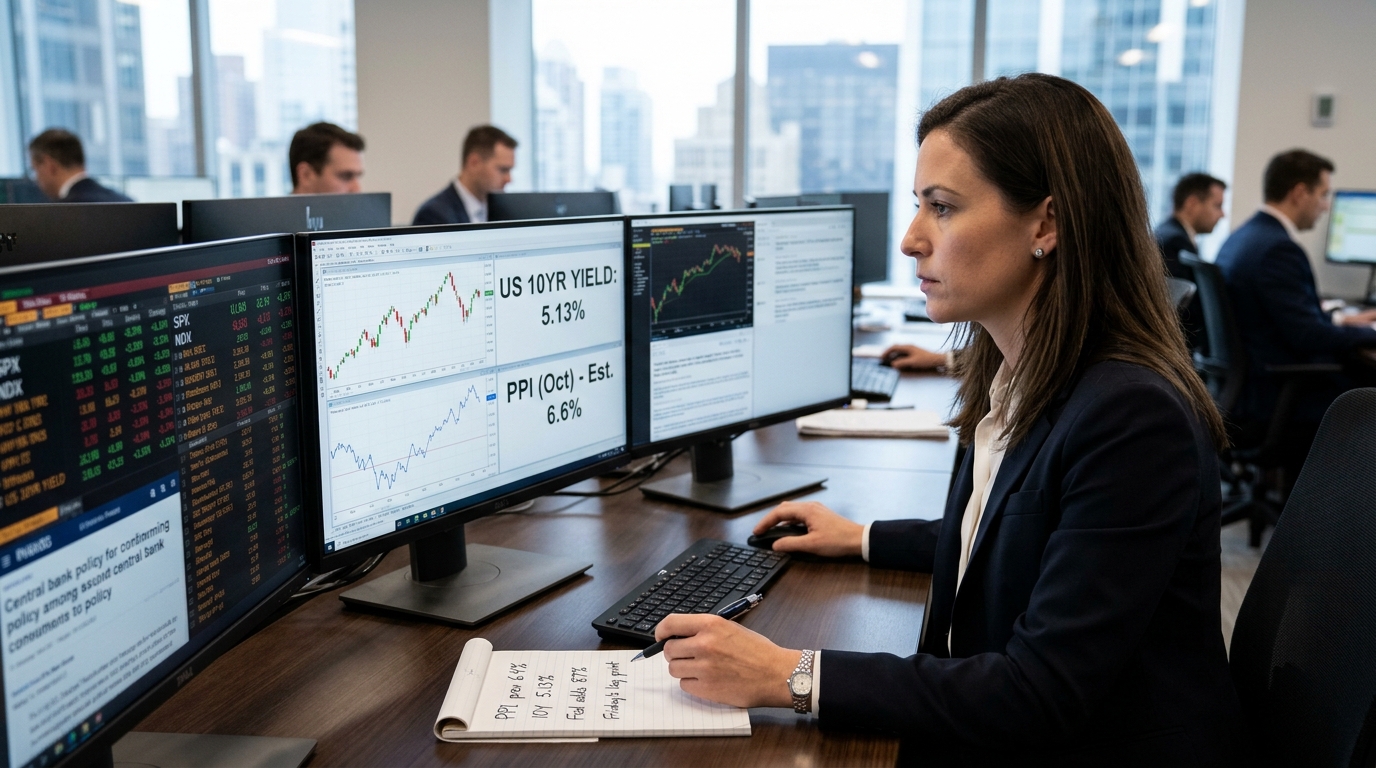
The October Producer Price Index lands at 8:30 ET this morning, and the bond market is already telling you exactly how much it cares. The 10-year Treasury yield sits at 5.13%, pinned at a level that compresses equity valuations, tightens financial conditions, and forces every sector rotation decision through a higher-rate filter. The question is not whether inflation is elevated. It clearly is. The question is whether this morning’s reading gives the Federal Reserve political cover to go bigger than 25 basis points in December.
Market Context
Markets expect a 6.6% annual rise in headline producer prices, up from 6.3% in September, with core PPI seen at 5.0% year-over-year and the monthly headline at 0.4%. That September figure was no anomaly. September final demand prices rose 1.3% on the month and 6.3% over the year, the largest monthly gain since March 2022. Energy drove much of that move, with gasoline prices jumping 20.3% and accounting for about half of the rise in final demand goods.
Treasury yields edged higher early Friday as investor expectations for a December rate hike gathered strength, with the 10-year near 5.13%. That follows a bruising Thursday session. The 10-year jumped more than 13 basis points to above 5% on Thursday, while the 2-year soared more than 15 basis points, making it the worst week for the front end since 2024.
The auction backdrop adds texture. The Treasury sold $25 billion in 30-year bonds Thursday, with indirect bidders taking 68.1% of awards and dealers receiving 11.4%. The takeaway is another soft auction, with the higher dealer allocation particularly notable. When dealers absorb supply that institutional and foreign buyers pass on, term premium tends to stay elevated.
Soft auctions are not a new phenomenon this cycle. Treasury’s tripled buyback operation failed to suppress long-end yields even when the government intervened directly, a pattern that explains why term premium remains sticky regardless of demand optics.
Fed Rhetoric and Rate Pricing
Governor Christopher Waller put a December increase firmly on the table, saying he would back a 25-basis-point hike at the FOMC’s December 8-9 meeting even if inflation showed some improvement. He went further. Waller said a larger move should be considered if inflation readings come in hotter than expected, including the possibility of a 50-basis-point hike in December.
Chicago Fed’s Austan Goolsbee described the inflation data as “borderline disturbing,” particularly on services inflation. When asked about a larger 50-basis-point hike in December, he said “everything is always on the table.” Cleveland Fed President Beth Hammack said restrictive rates are needed to return inflation to 2%, citing broad-based price pressures. New York Fed President John Williams said inflation “is still too elevated” and that the central bank “still has work to do” to reach the right monetary policy stance, Reuters reported Thursday.
According to the CME FedWatch tool, traders are pricing roughly high-80s odds of a 25-basis-point hike at the December 8-9 meeting, with a low-teens probability of a half-point increase.
Equities in the Crossfire
The S&P 500 closed at 7,592.40 Thursday, down 0.35%, and sits roughly 3% below its October record high of 7,818.93. The record high of 7,818.93 was reached on October 6, 2026. An index trading 3% from its peak, with the 10-year above 5.1%, is not deeply discounted. A 6.6% PPI print that firms 50-basis-point pricing would pressure growth multiples further, particularly in technology and consumer discretionary. Rate-sensitive sectors including utilities and real estate remain structurally challenged at current yield levels. Energy companies retain relative insulation as long as inflation’s composition remains commodity-driven.
The pressure on rate-sensitive equities is not confined to US markets. Global bond markets are repricing in lockstep, with 30-year gilt yields hitting 28-year highs as fiscal credibility concerns spread beyond any single central bank.
Scenario Modeling
Bull Case
PPI prints at or below 6.3% year-over-year, monthly core comes in at 0.2% or below. December 50-basis-point probability collapses below 5%. The 10-year rallies toward 4.90%, S&P 500 recovers toward 7,700. Duration assets and growth equities lead the bounce.
Base Case
PPI lands in line at 6.6% year-over-year, 0.4% month-over-month. The 10-year holds the 5.10-5.15% range. December 25-basis-point hike remains fully priced. The S&P 500 trades in a 7,520-7,650 band ahead of next week’s December FOMC meeting communications.
Bear Case
PPI surprises above 7.0% year-over-year with a hot core reading. The 50-basis-point probability surges above 30%. The 10-year breaks to 5.25% or higher, testing September’s 5.29% cycle high. The S&P 500 breaks 7,500, with high-multiple technology names down 3-5% intraday.
Active Trader Framework
Key levels to monitor: 5.15% on the 10-year as the near-term ceiling, 5.29% as the cycle inflection point. On the S&P 500, 7,550 is the near-term support; a close below 7,500 on a hot print changes the weekly structure. Volatility positioning ahead of the number warrants tight stops. Options premiums will compress sharply after the 8:30 release regardless of direction, so traders holding straddles should evaluate exit timing before the number resolves. Avoid adding gross exposure into the print. The asymmetry is in defining your re-entry levels before 8:30, not scrambling to position after.
Conclusion
This week’s data flow has forced market participants to confront a durable inflation problem, not a transient one. Multiple Fed officials leaned hawkish this week. The long bond auctioned softly. The 2-year yield had its worst week since 2024. All of that sets the stage for a PPI number that either validates the reset in rate expectations or provides temporary relief. Preparation means knowing your levels before the data arrives, sizing accordingly, and respecting that even a low-teens probability of a 50-basis-point December hike is not noise. That probability moves meaningfully on a hot print, and disciplined traders will have already decided what they do in that scenario before the BLS publishes a word.