Dear Reader,
Physical gold has NEVER paid a dividend…
…NEVER generated income…
Its price can rise. But it has never paid you just for holding it.
Tokenized gold can change that. It’s real, vaulted gold that you own as a digital token.
Think of it like real estate.
You already own the house. Instead of letting it sit empty, you rent it out… and collect rent while you still own it.
With tokenized gold, you can deposit your tokens into a shared pool that other investors use to swap between gold and dollars.
Every time someone swaps, they pay a small fee. And a share of every fee goes to you.
The more people trading… the more fees you can collect.
Now, I’ll be straight with you. Those fees rise and fall. And if gold’s price moves a lot, the pool rebalances… so you may end up with less gold and more dollars than you started with.
That’s the trade-off. But for 5,000 years, gold never even gave you the option.
In my free video, I walk you through a real, live pool.
To your wealth,
Alex Grandwileski
Decentralized Masters
P.S. Gold has never paid you to hold it. See how tokenized gold can earn while you hold it →
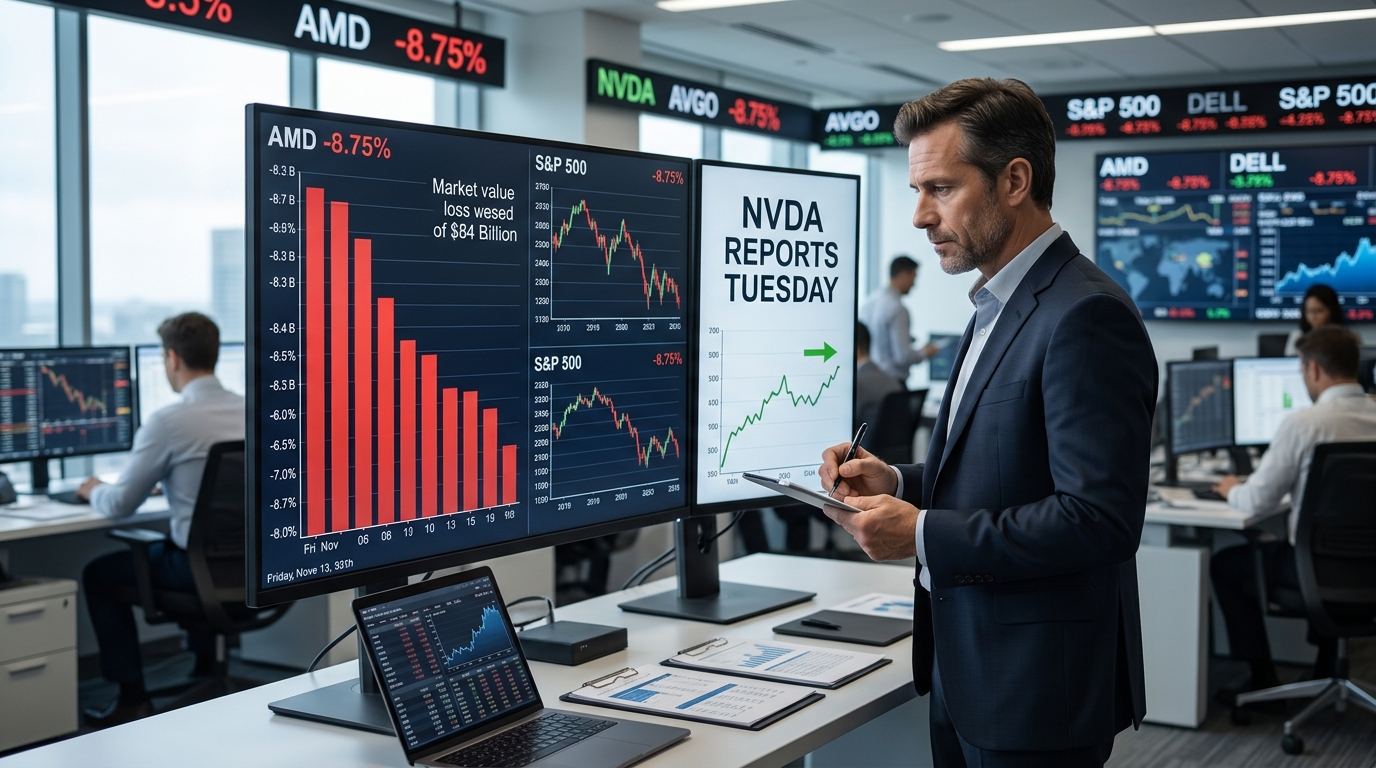
AMD Lost $84 Billion in One Session. Nvidia Reports Tuesday.
Friday, November 13 was a dissection, not a selloff. The S&P 500 fell just 0.40%, but that number conceals what actually happened: roughly 317 of its 500 members rose while AI hardware names were demolished in size. AMD dropped 8.75%, Broadcom fell 4.8%, Dell slid 7.18%, Fabrinet 7.31%, Nebius 9.92%, and CoreWeave 6.13%. AMD’s 8.75% drop erased about $84 billion of market value, while the equal-weight S&P 500 rose 0.20%. That breadth split is the entire story.
This was not a macro shock. The equal-weight index gained 0.20%, and staples, communications, financials, healthcare, and utilities all advanced. Large-cap value beat growth; banks and homebuilders posted modest gains despite higher long-term yields. Capital was moving, not fleeing.
What Friday Actually Killed
The trade that broke was the “Huang vacuum” thesis: the idea that AMD, Broadcom, and other hardware names would collect revenue that Nvidia’s leadership crisis would redistribute. AMD sank 8.75% as chip stocks reversed part of their post-Huang rally, with the Philadelphia Semiconductor Index down about 3.4%. AMD fell 8.75% to $534.06, giving back about 37% of the roughly 31% it had gained from its November 6 close through November 12. That is the rotation unwinding in one session.
Cisco made the picture stranger. Q1 FY2027 revenue came in at $18.5 billion, up 24% year over year, with non-GAAP EPS of $1.40. CEO Chuck Robbins called it the strongest revenue and non-GAAP EPS growth rates for Cisco in over 15 years. The stock fell 6.24% anyway. Non-GAAP gross margin came in at 65.6%, down 250 basis points year over year, as product growth significantly outpaced services. Markets read the margin compression, not the headline beat.
The Numbers Behind the Positioning
AMD’s fundamentals have not broken. Revenue reached $13.377 billion last quarter, up about 45% year over year and above the roughly $13.1 billion estimate. Data Center sales of $8.546 billion rose 97% and accounted for 64% of total revenue. Management guided Q4 to roughly $17 billion, implying about 66% growth. The consensus analyst price target sits around the mid-$650s, with a majority Buy rating. At Friday’s close of $534.06, that is still a meaningful gap between the business and where the stock is trading.
Broadcom’s situation is comparable. Not one of 51 analysts rates it a Sell or Strong Sell, and the consensus target of $533.42 sits about 49.6% above the $356.54 opening price on November 13. In fiscal Q3, it posted non-GAAP EPS of $3.32. AI semiconductor revenue rose 221% to $16.7 billion, and Q4 guidance calls for AI semiconductor revenue of $21.7 billion.
The Event That Resets Everything
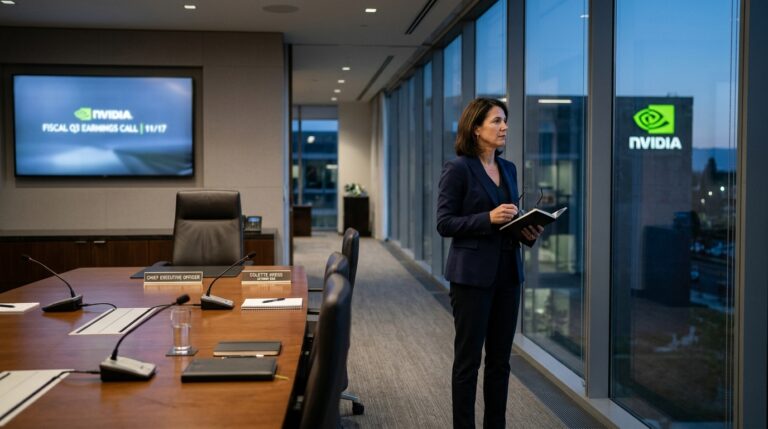
Nvidia is scheduled to report earnings on November 17, 2026, after the market close. Consensus sits around $2.49 per share, with revenue expectations clustered around $109 billion. CFO Colette Kress will report as interim CEO. Three triggers follow: results against the roughly $108 billion revenue outlook, the timeline for any congressional testimony tied to the Huang matter, and the naming of a permanent CEO. Options markets have been pricing a move around the low-double-digits into the event window.
The revenue bar Nvidia must clear did not appear from nowhere. Nvidia’s Q2 beat and the AWS commitment to deploy 3 million GPUs through 2028 set the capex expectations now embedded in the $109 billion consensus.
Nvidia has now fallen for six straight weeks, putting it on its longest weekly losing streak since October 2012. In prior episodes when semiconductors and tech were deeply off their 52-week highs, the S&P 500 was typically already in a larger drawdown; today it is down only low single digits. The broader index has barely registered the damage concentrated in AI hardware.
Scenario Framework
Bull case: Nvidia’s numbers clear the roughly $109 billion consensus cleanly, interim leadership lays out a credible succession timeline, and AMD/Broadcom recover toward their pre-rotation levels. AMD reclaims $580; Broadcom approaches $400.
Base case: Nvidia beats on revenue but the absence of a permanent CEO keeps institutional positioning cautious. AMD and Broadcom grind sideways between current levels and their 50-day moving averages. Broadcom’s 50-day moving average stands at $346.13. AMD’s sits near $554.
Bear case: Nvidia guides below $115 billion for Q4 or provides no succession clarity, triggering another leg down. AMD retests $490; the SMH ETF revisits its November 6 lows. Cisco’s margin compression becomes the new frame for every AI hardware name that follows.
Active Trader Framework
The asymmetry into Tuesday is real but not simple. AMD and Broadcom have given back a third of their post-Huang gains in a single session, which compresses the risk on fresh short positions. At the same time, holding through a low-double-digit implied-move event in Nvidia without a hedge is a sizing decision, not a conviction call.
Key levels: AMD $520 is the first technical support; a close below it reopens the $490 region. Broadcom needs to hold $340. Cisco at $95 is testing a level that held through the summer. On the upside, AMD above $580 would signal the rotation trade has resumed rather than reversed.
Volatility will compress into Tuesday’s close and expand sharply after. Position sizing relative to that move matters more than directional conviction. The discipline is in knowing what you are actually trading: a corporate governance resolution, not a revenue model. Those two things resolve on different timelines.