
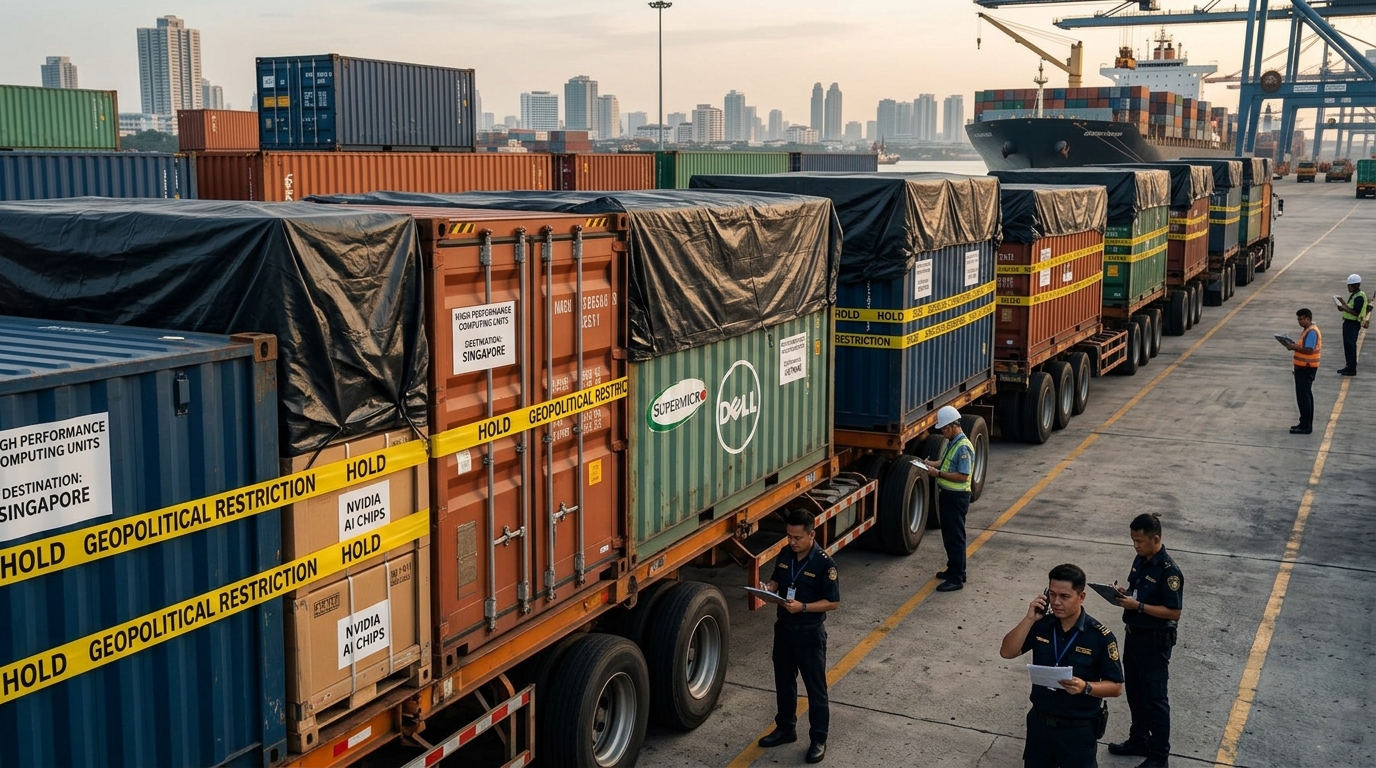
Investment committees arguing over Nvidia’s demand outlook now have something concrete to fight over. The question is no longer whether Southeast Asia carries geopolitical risk. It is how much of the AI order book was quietly underwritten by Chinese firms using the region as a chip relay, and what happens to 2027 estimates if that pipe stays shut.
What Changed This Week
Nvidia told its manufacturing partners to stop shipping AI servers to Malaysia, Singapore, Thailand and Indonesia, the Financial Times reported on 26 November 2026. Dell and Supermicro told customers in those four countries that Nvidia would block their shipments, citing three people familiar with the matter. It remains unclear how long the suspension will last.
The rule that triggered the halt imposes new controls on advanced chips bound for overseas data centers that remotely supply significant volumes of compute to companies headquartered in China and certain other countries, and it requires licences for shipments of advanced chips to Indonesia, Malaysia, Singapore, Thailand and Brazil, which the Commerce Department views as higher-than-normal diversion risks. The interim final rule took effect on its Federal Register publication date, November 19, 2026. US-headquartered customers are exempt from the five-country licence requirement if the exporter meets the rule’s reporting requirements.
The Bull Case: Licences, Not a Ban
Bulls point out that this is a licensing regime, not an outright prohibition. The rule creates friction, not a wall. Data centers outside the United States that remotely supply significant volumes of compute to companies headquartered in China and certain other countries are now in scope of new controls, which adds paperwork and timing risk. Shipments to US-headquartered cloud operators were never the core issue. The long-run demand case, hyperscaler spending, sovereign AI buildouts, enterprise clusters, remains intact outside the five listed countries. If licences start flowing in weeks rather than months, the disruption stays short-term noise.
The Bear Case: The Singapore Revenue Figure Is a Problem
A separate Singapore number is being thrown around in analyst notes and headlines, and it can be easy to misread. Nvidia’s filings for fiscal 2025, the year ended 26 January 2025, put revenue billed to customers in Singapore at $23.7 billion, or 18 percent of its $130.5 billion total. Nvidia also said customers use Singapore to centralise invoicing while its products are almost always shipped elsewhere, and that shipments to Singapore were less than 2 percent of revenue that year.
That caveat does not fully reassure. The four countries had become favoured destinations for Chinese AI developers seeking to bypass US export restrictions on advanced chips. The bear argument is straightforward: strip out demand that was manufactured by regulatory arbitrage and what remains is smaller than the consensus model assumes.
The Evidence the Market Is Weighing
The financing freeze is the clearest signal that professionals are taking the downside seriously. Bloomberg reported this week that lenders including Citigroup and Standard Chartered, as well as Singapore’s major banks, launched a sweeping review of data centre clients. The deals on hold span four separate loans: an upsized $6.6 billion Bridge Data Centres package facing extra due diligence, a $372 million Digital Halo loan one bank already declined, and a $300 million GMI Cloud loan at least one fund has walked away from. One additional facility referenced in some market chatter could not be independently confirmed, so investors should treat any all-in tally as fluid while due diligence plays out.
The halt also disrupted a project by Singapore-based cloud provider Aolani to lease advanced computing capacity to ByteDance, the Chinese owner of TikTok. Since 2023, loans to data centre companies in Asia Pacific have soared from virtually zero to more than $49 billion, according to data compiled by Bloomberg. That entire market now has a compliance question hanging over it.
What Investors Are Missing
Most commentary today focuses on Nvidia’s direct revenue exposure. The more important second-order question is what this does to Dell and Supermicro’s AI server backlog. GPU servers for university clusters, national research computing facilities and AI research labs are commonly bought through server makers such as Dell and Supermicro. Some of those buyers are legitimate and will apply for licences. Others will not qualify. Neither Dell nor Supermicro has quantified Southeast Asian exposure as a share of their AI pipeline, which means the market is currently guessing. The uncertainty itself is the risk. Senators have already called on Commerce to pause or reconsider Nvidia export licences more broadly following a Justice Department indictment tied to Supermicro over an alleged scheme to divert restricted AI servers to China.
Stocks to Watch
Nvidia (NVDA). The headline name. Direct revenue exposure to the four countries is contested, but the cloud-access channel Chinese labs relied on is now more tightly constrained by the new remote-access rule. Watch how quickly the licence pipeline opens.
Dell Technologies (DELL). Dell told buyers in the affected countries that orders would not ship. Dell’s AI server backlog has been a key part of the bull case; any recalibration of Southeast Asian demand changes that calculus.
Super Micro Computer (SMCI). Highest direct risk. Supermicro is simultaneously blocked from Southeast Asian shipments and linked to the Justice Department case. Two separate overhangs compressing the same stock.
Alibaba and Tencent. The new controls on overseas data centres and the licensing requirement for several Southeast Asian destinations raise obstacles for Chinese firms trying to expand compute access in the region. For both stocks, Southeast Asia had been viewed as a practical route to Nvidia silicon. That route is now gated.