July 22, 2026
Abbott Just Beat and Raised. The Real Story Is a $21 Billion Bet That Nobody Is Fully Pricing Yet.
ABT jumped on fresh Q2 results and raised guidance — but the Exact Sciences acquisition may be the biggest unrewarded catalyst in healthcare right now.
AI’s NEXT Magnificent Seven
Dear Reader,
The Original Magnificent Seven Produced 16,894% Average Returns Over 20 Years.
$1,000 in each turned into $1.18 million!

But the Man Who Called Nvidia at $1.10 Says “AI”s Next Magnificent Seven Could Do It Even Faster.”
He says $1,000 in these seven stocks could turn into $1 million+ in less than six years.
See His Breakdown of the Seven Stocks You Should Own Here.
Sincerely,
Rachel Gearhart
Publisher, The Oxford Club
P.S. The first company on his list just signed a MAJOR deal with Apple.
The company’s tech is going to be included in the iPhone and iMac until 2040!
That’s why Alex says this company might be America’s 7th trillion dollar company.
Something happened Thursday that got buried under the semiconductor carnage.
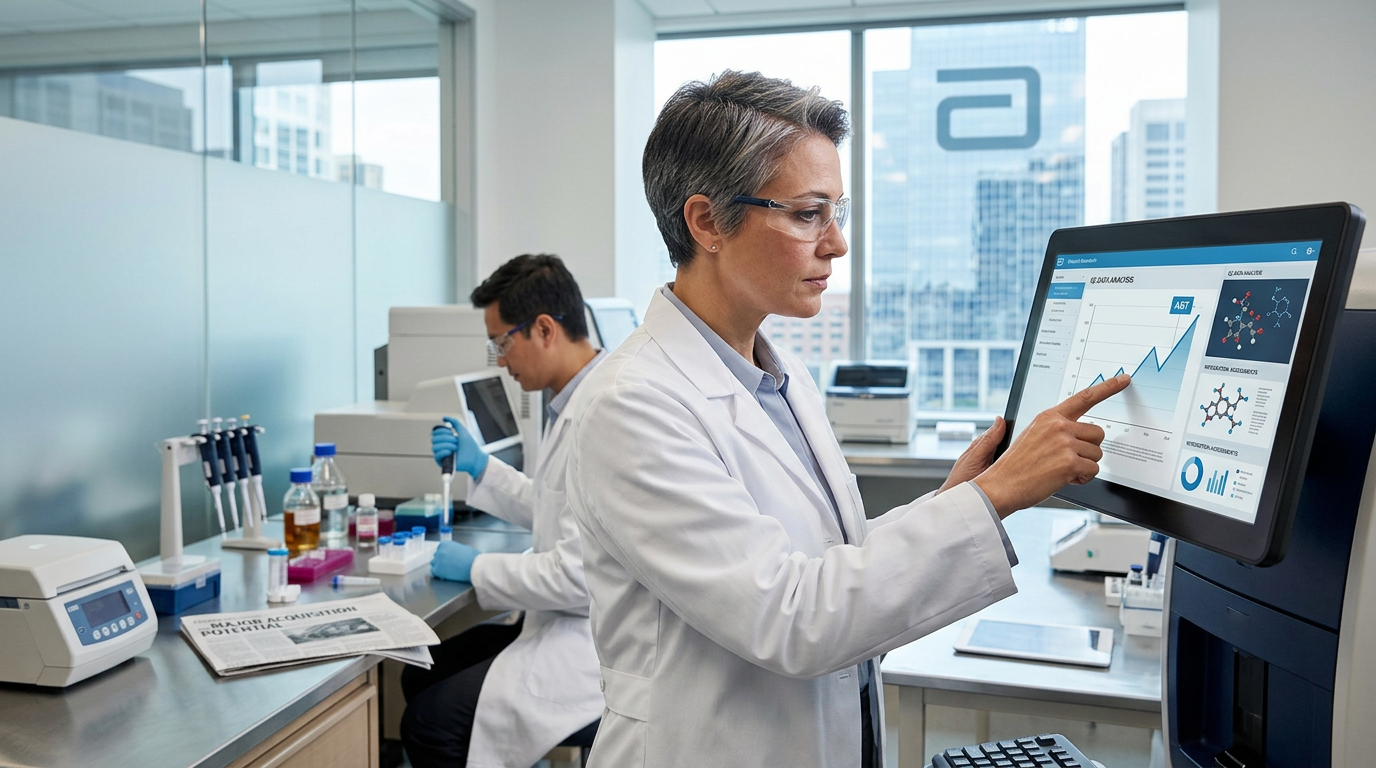
While Micron, AMD, and Broadcom were getting dismantled — the PHLX Semiconductor Index fell about 5% — Abbott Laboratories (NYSE: ABT) quietly printed one of its biggest single-session moves in years. The stock surged roughly 10.7%, closing near $98.81 after briefly tagging $101.87 intraday. On a day when the Nasdaq dropped 1.5% and tech looked like it was being restructured in real time, a medical device company carrying a roughly $160+ billion market cap was the quiet winner in the tape.
That matters. And not just because ABT went up.
What the Numbers Actually Said
Abbott reported Q2 2026 results on July 16. Adjusted EPS of $1.31 beat the consensus estimate of $1.28 — a 2.34% beat that marks the fifth consecutive quarter of meeting or exceeding Wall Street’s bottom line. Revenue came in at $12.59 billion, representing reported growth of 13.0% year-over-year and a modest beat versus the $12.52 billion consensus.
Then came the guidance raise. Abbott lifted its full-year 2026 adjusted diluted EPS guidance to a range of $5.45 to $5.60, up from $5.38 to $5.58 previously. The midpoint of $5.53 sits above the analyst consensus of $5.48. Full-year comparable sales growth guidance was maintained at 6.5% to 7.5%. For Q3, the company guided to adjusted EPS of $1.38 to $1.46.
Solid quarter. Clean beat. Raised guidance. That’s what the surface reads.
But the real trade isn’t the Q2 print.
The Exact Sciences Acquisition Is Still Underappreciated
On March 23, 2026, Abbott completed its approximately $20.6 billion acquisition of Exact Sciences — the maker of Cologuard, a leading non-invasive colorectal cancer screening test. Abbott paid $105 per share in cash. The deal added a high-growth oncology diagnostics vertical; at announcement, Abbott described Exact Sciences as a roughly $3.2 billion revenue business (2025).
Slight tangent, but it matters: Exact Sciences had been growing its cancer diagnostics franchise at high-teens rates organically. Abbott’s global distribution infrastructure — spanning 160 countries, 115,000 employees, and four diversified business segments — gives Cologuard a commercialization runway that Exact Sciences alone could never have accessed. That’s not a small synergy narrative. That’s a structural revenue acceleration sitting inside a legacy medtech balance sheet.
The Q2 Diagnostics segment confirmed early traction. Revenue climbed to $3.09 billion, rising 42.3% on a reported basis. Cancer Diagnostics (the newly folded-in Exact Sciences assets) contributed $96 million from the acquisition date through the end of Q1. Q2 represented the first full quarter of contribution — and that full-quarter read is still working its way into forward estimates.
Medical Devices: The Engine Nobody Talks About
Ignore the Exact Sciences headline for a second. Abbott’s core Medical Devices division generated $5.85 billion in Q2 revenue, up 9.0% on a reported basis and 8.4% on a comparable basis. That acceleration isn’t a fluke — it’s the twelfth consecutive quarter of strong device performance.
Within that segment, the FreeStyle Libre continuous glucose monitoring franchise delivered $2.08 billion in Q1 revenue, growing 13.8%. In Q2, diabetes care posted high-single-digit comparable growth. CEO Robert Ford has repeatedly emphasized that the global CGM market is expanding from roughly 12 million users today toward an eventual 80 million — a demand curve that doesn’t depend on macro cycles, AI capex, or Fed rate decisions.
Electrophysiology posted low-double-digit growth. Rhythm Management grew high-single digits. Heart Failure devices — an undercovered category — also came in with high-single-digit gains. The breadth here is the point. This isn’t a one-product MedTech story. It’s a multi-platform device and diagnostics operation that happens to be priced like something is broken.
What the Chart Is Actually Saying
ABT has been grinding off a brutal 52-week low. The stock touched approximately $87.83 on June 22 — a low driven partly by EPS guidance cuts tied to Exact Sciences dilution, partly by a FreeStyle Libre recall that weighed on sentiment throughout early 2026. From that low, the stock has staged a methodical recovery: higher lows stacking almost every few sessions, the 10-day moving average crossing bullishly above the 50-day on June 25, and the 50-day itself reclaimed just ahead of Q2 earnings on July 15.
Post-earnings, the key technical battlefield is clear. $100–$101.87 is the intraday resistance zone that capped Thursday’s rally. Mid-$98s represent near-term intraday support. A clean break and hold above $101.87 on volume would represent the first confirmed breakout above the post-low consolidation pattern — and potentially open a path toward the $112 region where Evercore’s Outperform target sits.
The 200-day moving average at approximately $112 is the longer-term overhead resistance that’s going to matter over the next two to three quarters. Closing that gap is the multi-month thesis.
Analyst Targets After the Print
Baird initiated coverage at Outperform with a $121 price target, citing 6%–8% annual sales growth, low double-digit earnings growth, and upside from new products plus Exact Sciences synergies. Evercore ISI carries an Outperform with a $112 target, trimmed from $120 but explicitly flagging healthy MedTech procedure volumes. Citi’s sum-of-the-parts framework pegs ABT in a $99–$104 band, framing the post-earnings close as fair value on near-term fundamentals with optionality on the Exact Sciences integration. The median target across 13 analysts sits at $121. The average across 34 is near $120.77 — implying roughly 22% upside from current levels.
That’s not a consensus that’s capitulating. That’s a consensus that’s waiting for execution confirmation.
The Macro Backdrop for the Healthcare Rotation
Thursday’s session told a bigger story. Eight of eleven S&P 500 sectors closed positive. The equal-weight S&P rose 1% even as the cap-weighted index fell 0.5%. Consumer Staples (XLP) rose 2.9%. Healthcare (XLV) outperformed. REITs held firm.
This is the broadening rotation that macro strategists have been calling for since late 2025. Capital is leaving crowded semiconductor and AI hardware positions — the Philadelphia Semiconductor Index has shed over 10% from its all-time high — and looking for businesses with predictable cash flows, real earnings visibility, and valuations that haven’t been stretched to 100x forward multiples.
Abbott fits that template precisely. Trailing revenue near $44.3 billion. Gross margin of 56.3%. EBIT margin around 19.2%. Return on equity above 18%. Forward P/E near 25x. That’s a quality-growth company trading at a reasonable multiple inside a sector that the market is actively rotating into.
Three Scenarios Worth Modeling
Bull Case
Exact Sciences integration accelerates ahead of schedule. Full-year Cancer Diagnostics revenue tracks toward $400–$450 million, meaningfully above current estimates. FreeStyle Libre sustains double-digit growth as DexCom competition stabilizes. Electrophysiology and structural heart continue compounding. The stock reclaims the $112 Evercore target by Q4 2026 as the 200-day moving average becomes a magnet rather than resistance. Catalyst: Q3 earnings (expected October 14, 2026) confirm full-quarter Exact Sciences contribution and raise full-year guidance again.
Base Case
Abbott executes cleanly on existing guidance — $5.45 to $5.60 full-year EPS, 6.5% to 7.5% comparable sales growth. The stock grinds toward the $105–$110 range over the next two quarters as the Exact Sciences dilution narrative fades and Cancer Diagnostics begins contributing meaningfully to reported revenue. The multiple re-rates modestly from 25x toward 27–28x as the market gains confidence in the new platform. Near-term range: $100 to $110.
Bear Case
Exact Sciences integration proves more disruptive than modeled — margin dilution persists beyond 2026, integration costs exceed guidance. FreeStyle Libre faces escalating reimbursement pressure or additional recall scrutiny. A Fed rate hike in September (currently priced at roughly 60% probability) pressures healthcare valuations broadly. ABT fails to hold $95 support and retests the $87–$89 range. Catalyst: Q3 miss or guidance cut driven by Exact Sciences integration headwinds.
Active Trader Framework
The short-term structure is clear. The stock squeezed from the high-$80s to briefly tag $101.87 intraday — that’s a $14 move off a defined low. After a run of that magnitude in a compressed timeframe, consolidation is the base expectation. The $100–$101.87 resistance zone is the level to watch on any continuation attempt. A sustained close above $101.87 on above-average volume is the signal that the breakout is absorbing the post-earnings selling.
On the downside, the mid-$98s have acted as intraday support, with buyers consistently defending dips into that zone. A failure below $96 would be the early warning that the squeeze is stalling. The June 22 low near $87.83 is the structural floor — a retest of that level would represent a full mean-reversion of the post-earnings catalyst, which is not the base case but is the defined risk to manage against.
Volatility is elevated post-earnings. Position sizing matters more than entry precision in this environment. The Stochastic RSI had flagged oversold conditions in mid-July, and the 10-day/50-day golden cross from June 25 remains technically intact. Both conditions support the idea that the path of least resistance has shifted — but overbought short-term signals warrant patience on new entries.
For longer-horizon positioning, the Exact Sciences integration timeline runs through at least mid-2027 before synergies are fully visible in the numbers. That’s not a short-term trade — it’s a re-rating story that requires conviction and time.
What’s Worth Watching From Here
The next hard catalyst is Q3 2026 earnings, expected October 14. That print will be the first clean read on a full quarter of Exact Sciences contribution inside Abbott’s consolidated Diagnostics segment. It will also show whether the Medical Devices momentum — particularly in electrophysiology and structural heart — is durable or peak-of-cycle.
Separately, Abbott is licensing ALZpath’s pTau217 antibody to build a blood-based Alzheimer’s test on its Alinity ci-series analyzers. That product is still pre-commercial, but it represents exactly the kind of high-value diagnostic optionality that doesn’t appear in current consensus models. If that program advances toward a CMS reimbursement pathway, the addressable market expansion would be material.
The DOJ closed its long-running baby formula investigation with no criminal charges, and DOJ is working toward a civil settlement with the company in a parallel False Claims Act case. That removes a meaningful legal overhang that had been suppressing institutional positioning in the stock for nearly two years.
None of this makes ABT a slam dunk. The integration risk is real. The valuation isn’t cheap enough to be a screaming value play. And the semiconductor rotation trade has a history of reversing sharply when AI sentiment recovers — which could pull capital back out of healthcare relatively quickly.
What it does make ABT is the kind of setup worth understanding. A quality business, a defined catalyst calendar, a fresh breakout off a multiyear low, and a $21 billion bet on oncology diagnostics that the market is still working out how to value.
That’s the trade — not the Q2 headline.
For informational and educational purposes only. Not investment advice. Trading involves risk, including loss of principal.