
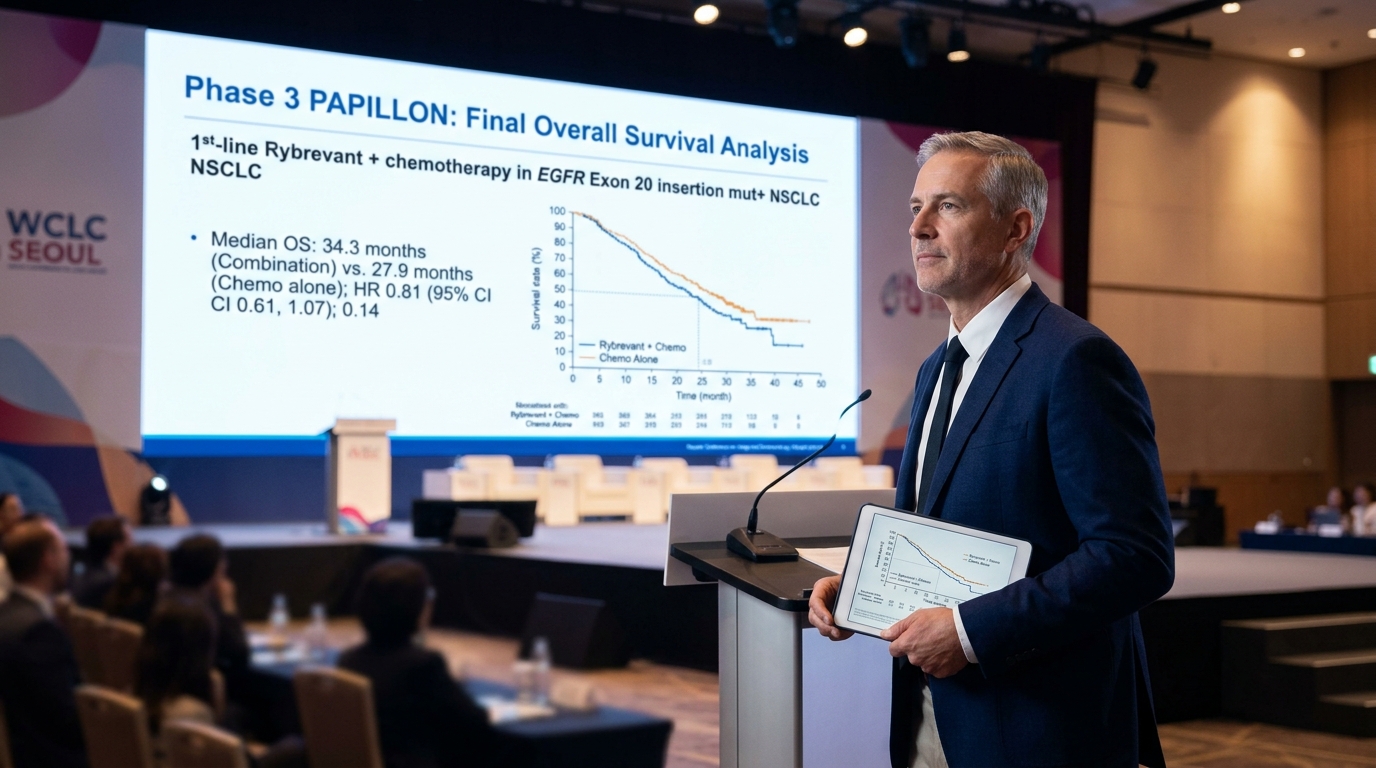
On September 13, Johnson & Johnson stood at the Presidential Symposium of the World Conference on Lung Cancer in Seoul and delivered the kind of data that rewrites clinical standards. The final overall survival analysis of the Phase 3 PAPILLON study showed that first-line Rybrevant plus chemotherapy produced a median overall survival of 34.3 months, compared with 27.9 months for chemotherapy alone. That represents the longest reported median OS in this patient population, nearly twice the historical median.
The context makes the number more impressive. The combination extended median survival by more than six months despite a high share of patients in the chemotherapy arm crossing over to Rybrevant after disease progression. When researchers applied a crossover-adjusted analysis, the adjusted result cut the risk of death by 43%. In an era of noisy clinical readouts, that kind of durability through a contaminated control arm is rare.
Unlike more common EGFR mutations, exon 20 insertion mutations have been difficult to treat with targeted medicines, leaving patients with few options and poorer outcomes. Historically, median OS in this population has been reported in the mid-teens to low-20s months, with real-world five-year overall survival reported as low as 8%. Rybrevant has fundamentally shifted that range.
Why This Data Matters for Long-Term Shareholders
J&J is in an unusual position: posting genuinely impressive oncology results while still managing the revenue hangover from Stelara’s loss of exclusivity and ensuing biosimilar competition. J&J has disclosed that the Stelara sales decline was a meaningful headwind to first-quarter 2026 growth. While J&J’s Innovative Medicine segment grew 7.4% operationally in the first quarter of 2026, management said results were partially offset by an approximate 920-basis-point impact from Stelara, illustrating the hole left behind.
The company’s answer to that hole is running through immunology and oncology. In the first quarter, Tremfya and the oncology portfolio posted roughly 68% and about 20% operational growth, respectively. Rybrevant is central to the longer-term oncology thesis. J&J has said the Rybrevant-lazertinib opportunity has the potential to be a $5 billion-plus asset.
Rybrevant’s reach is also broadening beyond the exon 20 niche. J&J has produced data suggesting that Rybrevant combined with Lazcluze could challenge AstraZeneca’s Tagrisso as a standard of care in first-line EGFR-mutated NSCLC, with the Mariposa trial showing a 25% reduction in the risk of death versus Tagrisso. AstraZeneca is pushing back, licensing a new oral agent for the exon 20 setting in July 2026 and acquiring worldwide rights to Zegfrovy, an oral EGFR inhibitor approved in the U.S. and China for previously treated patients with exon 20 insertion mutations. Competition in this space is intensifying, not fading.
Building a Position Around the Thesis
For investors weighing J&J as a long-term holding, the dividend remains a foundation. J&J’s indicated annual dividend is $5.36 per share, and the company has raised its dividend for 64 consecutive years, with five-year dividend growth of around 5%. That consistency does not require Rybrevant to win every indication. It requires the oncology pipeline to keep growing fast enough to offset immunology erosion, and so far the numbers support that trajectory. J&J has guided to 2026 sales around the $100 billion level, and its updated 2026 outlook has been raised above its earlier $100.5 billion midpoint.
Position sizing matters here. J&J is not a speculative bet on a single drug. It is a diversified healthcare company where Rybrevant’s success is one of several necessary contributions. Investors who already hold it should weigh the PAPILLON data as confirmation that the oncology engine is running. Those considering entry should recognize that much of the Stelara drag is now visible in the stock price, and the pipeline quality being demonstrated in Seoul is not yet fully reflected in how the market values the shares.
Risks Worth Watching
The PAPILLON hazard ratio of 0.87 did not reach conventional statistical significance, which AstraZeneca’s camp will note. The survival benefit is clinically real but leaves room for debate in label expansions and prescriber conversations. Subcutaneous Rybrevant Faspro, presented alongside the PAPILLON data at WCLC, offers improved tolerability, cutting administration-related reactions from 66% to 13%, but adoption requires oncologists to shift established habits. Talc litigation remains an unresolved cash flow variable.
The core lesson for wealth builders is straightforward. When a company can generate a 34.3-month survival milestone in one of oncology’s hardest mutations, while managing a major patent loss without breaking its dividend streak, it is demonstrating exactly the kind of operational discipline that compounds over a decade. Watch how Rybrevant-Lazcluze market share develops against Tagrisso over the next four quarters. That is the growth engine the whole investment case depends on.