
August 4, 2026
Butterfly Network’s Hidden Growth Engine
Featured: Butterfly Network’s Hidden Growth Engine
What If The Best Time To Look At Gold Is: RIGHT After It DROPS 11%?
Sounds backwards, but that’s exactly what MarketWatch just reported, noting that gold has fallen nearly 11% since the Iran war began while the reasons to buy the metal are piling up again.
Why would analysts say that? Because the ceasefire cooled the headlines, but it didn’t touch the risks that sent oil and gold soaring in the first place.
- The Strait of Hormuz? Still the world’s most critical oil chokepoint.
- America’s emergency oil reserve? At its lowest level since 1983, per CBS News.
- The next flare-up? Nobody can predict when.
This isn’t just theory. CNBC reported gold and oil moving together on every twist of the U.S. – Iran deal talks.
But here’s what most savers miss.
An energy shock does not stop at the gas pump. Higher oil costs can work through nearly everything Americans buy, and history suggests that when oil spikes, inflation can get sticky. In those environments, investors have historically turned to physical gold and silver as a potential diversification tool.
That’s why many retirement savers see this pullback differently: not as a warning, but as a window to review their options before the next headline.
We put together a FREE Precious Metals Retirement Guide that explains how eligible IRA and 401(k) accounts may be diversified into physical gold and silver through a properly structured self-directed IRA, without taking a taxable distribution when completed correctly.
Get your free guide now by clicking here >>
Or call [PHONE NUMBER] to speak with a precious metals specialist.
Because pullbacks like this don’t announce when they’re closing.
Butterfly Network’s Hidden Growth Engine
Most people still think of Butterfly Network as a handheld ultrasound company. A scrappy medtech player trying to put a doctor’s-office-grade imaging device in a coat pocket. That framing isn’t wrong, but it’s incomplete in a way that matters right now.
On July 30, 2026, Butterfly reported its strongest quarter on record. Revenue came in at $32.6 million, up 39% year over year, beating the high end of its own guidance. Gross margins hit 71.4%. Adjusted EBITDA loss narrowed 78% to just $1.4 million. And management promptly raised its full-year 2026 revenue outlook to $119 million–$123 million.
CEO Joe DeVivo’s explanation for what drove it was short and pointed. The company’s Butterfly Embedded segment – its semiconductor licensing and co-development business – exploded. Embedded revenue hit $10.8 million in the quarter, a 439% year-over-year increase, powered almost entirely by milestone payments and development work tied to a co-development deal with Midjourney.
That last sentence deserves a pause.
The Midjourney Deal Nobody Fully Price In
In November 2025, Butterfly disclosed a five-year agreement with Midjourney – the AI image-generation company – under terms that included a $15 million one-time fee, a $10 million annual license, and additional milestone, revenue-sharing, and chip purchase payments totaling up to $74 million over the contract term.
Most investors shrugged. Midjourney makes AI art. What does that have to do with ultrasound chips?
The answer landed publicly in June 2026 when Midjourney unveiled Midjourney Medical and the Midjourney Scanner, a prototype full-body imaging system that uses sound waves and water. The current prototype incorporates 40 Butterfly ultrasound-on-chip modules per system. Future generations are expected to use substantially more modules, reflecting the platform’s planned scalability. The company said the announcement became a trending topic on X, as noted on Butterfly’s earnings call.
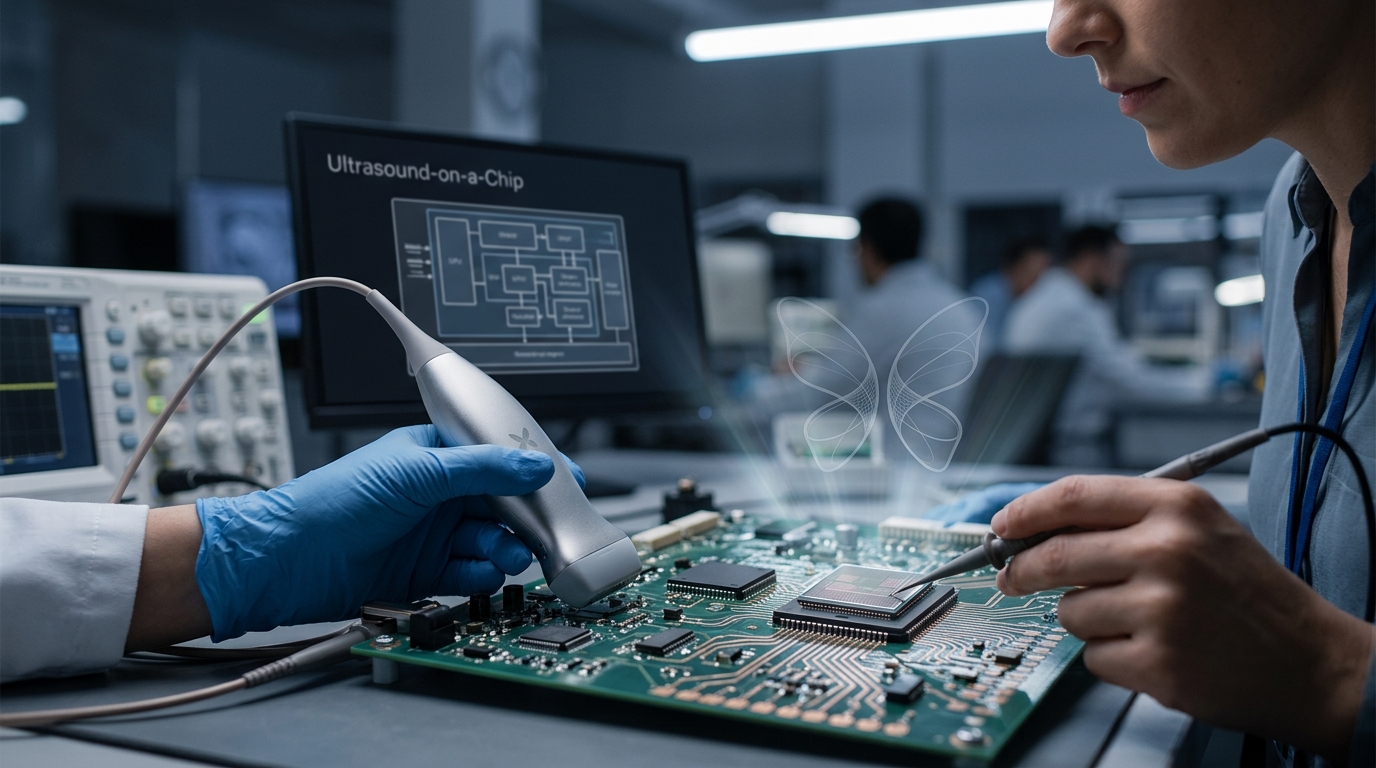
What’s interesting is that this isn’t a one-off curiosity deal. It’s the clearest proof yet that Butterfly’s proprietary semiconductor architecture – the Ultrasound-on-Chip platform – can function as licensable infrastructure for applications that have nothing to do with bedside point-of-care imaging. Each module that gets embedded in a Midjourney scanner is essentially a royalty stream. And as the scanner evolves to later generations, the module count grows. That’s a compounding dynamic that looks more like a chip foundry model than a medical device company.
Apollo chip deliveries to Midjourney are scheduled for late 2027 or early 2028, coinciding with the transition of Butterfly’s fourth-generation chip from research to development. That’s when the commercial relationship moves from software milestones to physical hardware at scale.
Be Ready by Tonight
A few small changes tonight could leave you ready to place your first options trade – without risking real money first. This free playbook walks you through the setup, one simple step at a time, in a single evening.
The Core Business Isn’t Standing Still Either
Slight tangent, but it matters: the 39% growth figure gets cleaner when you look at what’s driving the non-Embedded side of the business.
U.S. revenue hit $27.6 million in Q2, up 57% year over year. Core revenue – probes, subscriptions, enterprise software – rose 2%, but the pipeline is building. Butterfly’s Compass AI enterprise software pipeline has grown fivefold since last year, and six enterprise deals were signed in Q2. The company now says it has a presence at more than 81% of U.S. medical schools.
In Q2, a landmark partnership with Edward Via College of Osteopathic Medicine (VCOM) provided every incoming student with an iQ3 device and established a longitudinal insights program, representing over $10 million in total contract value over four years. Management described it as a potential template for future education relationships. The idea is that students trained on Butterfly devices carry those habits into clinical practice, converting the education investment into a long-term installed base.
The government channel is also opening. Butterfly said it secured provisional authorization to sell across the full VA healthcare system in Q2 and expects full FedRAMP certification in Q3, which would make it one of only approximately 530 FedRAMP Certified cloud service offerings listed in the FedRAMP Marketplace. DeVivo was blunt on the call: the U.S. government is the largest purchaser of healthcare in the country, and that channel is about to become accessible.
Brazil regulatory authorization was also secured in the quarter, opening one of the world’s largest and fastest-growing ultrasound markets.
The Margin Story Is the Real Tell
Here’s where it gets interesting. Butterfly’s gross margin of 71.4% in Q2 – up 7.7 percentage points year over year – is not a hardware number. Hardware companies selling medical probes don’t post those margins. The improvement reflects a business that is increasingly weighted toward software and licensing revenue.
In Q2, software and services reached $16.9 million, nearly triple the prior-year period, and represented 51.8% of total revenue. That’s the first time in the company’s public history that software has crossed half of quarterly revenue. The shift matters because licensing revenue has almost no incremental cost. Each additional dollar of Embedded revenue flows through at dramatically higher margins than a probe sale ever could.
The company’s remaining performance obligations – essentially contracted future revenue – stood at $85.8 million at quarter end. That’s a floor, not a ceiling, because new Embedded partnerships keep getting added. The company now has 11 Embedded partners, and management characterized the pipeline as having no near-term cap on scalability.
What the Market Is Still Debating
The risks are real and worth naming. International revenue fell 14% year over year in Q2 to $5.0 million, reflecting timing shifts and some exposure to macroeconomic uncertainty. The blended average selling price on probes dipped about 12% in the quarter, partly because of subsidized pricing in the VCOM education deal. And the company remains in investment mode, burning $13.3 million in cash during Q2 with a full-year adjusted EBITDA loss guide of $19 million–$23 million. Cash stood at roughly $125 million at quarter end.
There’s also execution risk in the Home and Community Care segment, which is scheduled to begin its first commercial implementation on October 1, with revenue expected to materialize in Q4 2026. The CFO noted that 2026 contribution will be limited given the late-year launch but projected multiple millions of dollars from the program in 2027.
None of that erases the core question the market is trying to answer: is this still a niche medical device company on a lucky licensing streak, or is the Ultrasound-on-Chip platform genuinely becoming a horizontal semiconductor infrastructure play?
The Midjourney deal moved the dial on that question. The next-generation P5.1 probe is on track for a 2027 launch with improved cardiac imaging. The iQ Station – a move into the multi-billion-dollar ultrasound cart market – is planned for later 2027. And full FedRAMP certification, if it lands as expected in Q3, would unlock federal procurement at a scale the company has never had access to before.
DeVivo has been here before. He scaled InTouch Health to a sale to Teladoc at $1.1 billion and served as independent chairman of Caption Health before it was acquired by GE HealthCare. The pattern is the same: build a technology wedge into a large addressable market, license the platform as broadly as possible, and let the recurring economics take over.
Whether Butterfly is in the middle of that arc or near the beginning of it is the open question. The Q2 numbers suggest the flywheel is turning. The Midjourney scanner is just one of 11 embedded partners, and the Apollo chip hasn’t shipped yet.