September 24, 2026
Bonus Content: United Airlines’ Premium Cabin Is Outearning Expansion
If you own any ETFs or index funds…
You might hold risky AI stocks without even knowing it.
And that’s bad, because…
My research shows a handful of the market’s most hyped AI stocks could fall as much as 77% starting as soon as November 15.
Look, I’m not saying the AI story is done.
Far from it.
I’m saying the hype has gone too far.
Because one household name AI company manages to LOSE $104 million every day!
And I called NVDA at $6 a share. 6 years later, it has shot up 3,100%.
So I get the big bucks side of AI as well.
Bottom line, I believe the stock market is about to split…
And some of the super popular AI names everyone owns will be on the wrong side of the split.
While one small corner of the AI market stands to deliver generational gains.
What side will YOU be on?
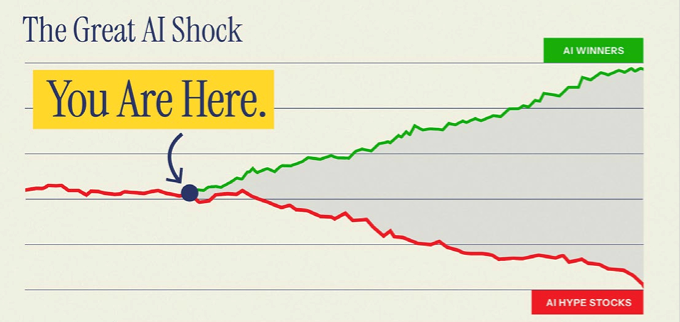
You should unload any toxic AI stocks you might hold, before the stock market splits.
To your wealth,
Matt McCall
P.S. I also reveal the details on my #1 AI stock for right now. To repeat, my NVDA call paid 3,100% over six years. Here are the details…
United Airlines’ Premium Cabin Is Outearning Expansion

United Airlines is running the most aggressive transatlantic expansion of any U.S. carrier, and the market is mostly focused on the wrong number.
The route map is real. United now covers 46 transatlantic destinations, with new nonstop service from Newark to Split, Bari, Glasgow, and Santiago de Compostela launched in May 2026. That monopoly on certain routes matters, because United is the only U.S. airline offering those city pairs nonstop.
But the route count is not the trade. The margin structure inside those cabins is.
Where the Money Is Actually Coming From
Q2 2026 earnings told the real story. Premium revenue rose 16% year-over-year, contracted business revenue climbed 27%, and overall yields were up 12% in the quarter. In Q1, premium revenue rose 13.6% on only 4.4% higher capacity, with premium revenue per available seat mile outpacing the main cabin by 4 full points. That ratio is what premium-first investing looks like when it works. Polaris business class fares on long-haul transatlantic routes routinely run $3,000 to $6,000 round-trip, and those seats carry a disproportionate share of total route revenue relative to their count in the cabin.
Total Q1 operating revenue reached $14.6 billion, up 10.6% year-over-year. Q2 delivered pre-tax earnings of $1.0 billion on a 5.8% pre-tax margin despite a fuel bill $2.3 billion, or 84%, higher than the prior year. Management expects to recover 80% to 90% of the fuel cost increase in Q3 and the full amount by Q4.
The Variable Traders Cannot Ignore
Full-year 2026 EPS guidance sits at $9 to $11. The company guided to an average fuel price of $3.69 per gallon for Q3. That $2 spread in EPS guidance is the problem. The stock’s fair value swings nearly 40% depending on whether fuel costs compress the high end or management’s yield recovery closes the gap. UAL closed at about $111 on September 24, and 26 analysts carry an average price target of roughly $157, implying meaningful upside if the fuel recovery executes. Rothschild & Co Redburn maintained a Buy on September 18 while trimming its target to $150.
Technical Structure and Scenario Framework
UAL has traded in a compressed range after the Q2 earnings beat. The 50-day moving average near $112 represents the first line of support, with Q2 earnings-day lows around $100 as the structural floor. TRASM guidance calls for Q3 and Q4 growth to exceed Q2’s 12.1% rate, which is the data point traders should watch on the October earnings call.
- Bull case: Fuel retreats toward $3.00 per gallon, Q4 premium cabin load factors hold above 85%, and full-year EPS prints near the $11 ceiling. Stock reclaims the $130-plus range.
- Base case: Fuel stabilizes near current levels, management recovers 80% to 90% of the increase in Q3 as guided, EPS lands near $9.50. Stock trades sideways in the $105 to $120 band into year-end.
- Bear case: Fuel spikes above $4.00, transatlantic load factors soften on new capacity additions, and premium yield growth decelerates. EPS risk shifts toward the low end of guidance; $90 to $95 support comes back into scope.
Discipline here means sizing around the fuel variable, not the route announcement. United’s premium architecture is working. Whether the stock rewards it in 2026 depends on how fast the cost recovery compounds.