August 11, 2026
Sony Is Going Fab-Light. TSMC Is the Reason.
First a note from Brownstone Research
Editor’s Note: Jason Bodner spent two decades on Wall Street. He placed huge trades for the biggest funds and richest people on Earth. Along the way, he built a tool that does one thing. It catches big firms quietly buying a stock – before the rest of the market wakes up. Right now, it has flagged something odd. BlackRock, Goldman Sachs, and Vanguard are sneaking cash into two overlooked AI stocks. And they’re doing it before the November 3 election. Read more below.
Dear Reader,
The year was 2002.
The dot-com bubble had recently burst…
Investors were discouraged. The market seemed like it might be down forever.
A major event sparked a shocking run in tech stocks.
Avaya was up 428% in the next year.
Corning went up 215%.
And Yahoo jumped 175%.
What happened? Why did these stocks, in the middle of a historic bear market, all of a sudden jump?
And how did the S&P 500, down 23% in 2002… go up 26% the next year?
It’s because of a surprising historical phenomenon.
It’s happened every single time… going back 78 years.
And it’s happening again this fall.
On November 3, to be precise, we expect the start of a historic boom.
Now, here’s what’s even better…
I know exactly where Wall Street is putting its money…
Before this potential explosion on November 3.
In this video, I’ll tell you exactly what’s going on that day.
And why two overlooked stocks could see the biggest move up.
Click here for the full story.
Regards,
Jason Bodner
Founder, Outlier Intel
Sony Is Going Fab-Light. TSMC Is the Reason.
Sony has held a singular position in image sensors for more than a decade. As of 2025, Sony Semiconductor Solutions commands roughly 63.6% of the global image sensor market by revenue, a figure no rival has come close to challenging. The question active traders need to answer today is not whether Sony is winning the sensor war. It is whether the structure of that victory is about to change fundamentally, and what that restructuring unlocks for both Sony and TSMC shareholders.
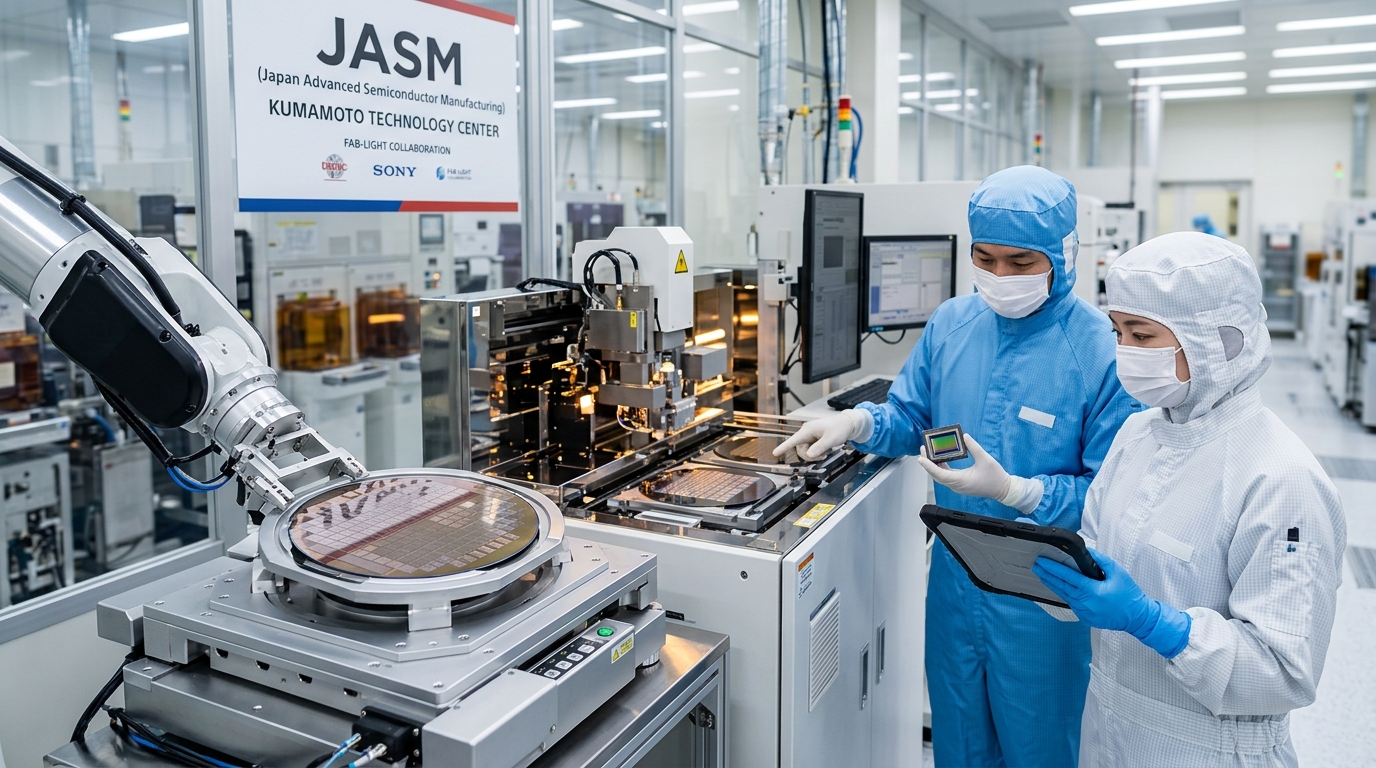
On August 11, the answer is moving closer in Kumamoto Prefecture, even if the definitive joint-venture terms still require final agreements beyond the May 8 memorandum of understanding.
Market Context Analysis
The semiconductor cycle is running hot. TSMC reported Q2 revenue of $40.2 billion, up approximately 34% year-over-year, with net income jumping about 77% and gross margin at 67.7% and operating margin at 60.3%. The newest 2-nanometer node made up 3% of wafer revenue in that quarter, leaving a significant scaling runway ahead. Against that backdrop, TSMC trades at roughly the mid-20s times forward earnings, pricing in a sustained capacity-driven growth story. Short interest remains low, suggesting institutional holders see little reason to fade the position.
The broader image sensor market reinforces the timing. The global market was valued at $25.6 billion in 2025 and is expected to grow to $27.4 billion in 2026, reaching $39.9 billion by 2031. That trajectory is not driven purely by smartphones. Automotive ADAS, industrial robotics, and physical AI applications are now the growth engines, and they demand sensors that consumer-class products simply cannot supply. Automotive-grade imaging systems require extreme dynamic range and robust LED flicker mitigation to reliably capture scenes that include both a bright noon sky and a dark underpass simultaneously, a performance bar that many consumer-class sensors cannot meet.
The macro environment adds strategic urgency. U.S.-China tensions have accelerated the regionalization of semiconductor supply chains. Japan has explicitly prioritized domestic chip capacity as a national security interest, and Economy, Trade and Industry Minister Ryosei Akazawa has pointed to government financial support for image-sensor capacity in Kumamoto. That subsidy floor matters: capital contributions to the planned partnership are expected to be made in phases depending on market demand, and the expectation of Japanese government support is part of the capacity planning itself.
Sector Breakdown
The Sony-TSMC image sensor joint venture proposed in May is positioned at the intersection of three sectors that institutional capital has been rotating toward aggressively in 2026: semiconductors, physical AI infrastructure, and Japan-based technology manufacturing.
Sony’s Imaging and Sensing Solutions segment posted operating income of 357.3 billion yen in the fiscal year ended March 31, 2026, representing one of the strongest profit engines within the Sony conglomerate. That divergence is why Sony has framed the TSMC partnership as a first step toward becoming fab-light. Sony had previously handled research, development, and a large share of manufacturing in-house. The shift is structural, not cyclical.
For TSMC, the joint venture would secure a long-duration, high-volume customer relationship in a specialized manufacturing category. Sony’s sensor designs require advanced process technology and precisely calibrated stacked architectures. A meaningful stake in the production entity could help anchor demand that cannot easily be redirected to a competing foundry. The arrangement would ease capital demands on Sony while giving TSMC a dependable and recurring revenue stream tied to the world’s dominant sensor manufacturer.
The competitive map for image sensors matters here. Samsung, OmniVision, STMicroelectronics, and Onsemi occupy secondary positions but are investing aggressively. In May 2026, ams OSRAM sold its CMOS image sensor business to indie Semiconductor for €40 million, illustrating the pressure on mid-scale players to exit or consolidate. Sony and TSMC are not just building capacity. They are widening the moat against any challenger who lacks comparable process technology and manufacturing scale.
Apple Price Hikes Reveal Mode’s Big Opportunity
Apple will potentially raise prices on Macs and iPads by $200 or more, another reminder that the devices we rely on keep getting more expensive.
Mode Mobile, is building the countertrend: technology that turns everyday smartphones into income-generating assets.
Its EarnOS platform has already helped users earn and save $1B+, reached 490M+ users, and powered 32,481% three-year revenue growth, earning Deloitte’s #1 fastest-growing software company ranking.
Now, Mode has secured the Nasdaq ticker $MODE, and its pre-IPO investment offering is open at $0.52/share with up to 20% bonus shares. But that window is closing fast.
Please read the offering circular at invest.modemobile.com. This is a paid advertisement for Mode Mobile’s Regulation A+ Offering.
Stock-Specific Financial Breakdown
Sony Group’s full-year FY2025 results established the clearest baseline. Record operating income of 1,447.5 billion yen, up 13% year-over-year, was led by the I&SS segment alongside record results in Games and Network Services and Music. The I&SS segment’s 357.3 billion yen in operating income in FY2025 provides context for the venture’s capital scale: the investment discussed publicly around this partnership has ranged into the high single-digit billions of dollars, depending on scope, phasing, and government support.
Sony’s FY2026 guidance calls for operating income of approximately 1.6 trillion yen, an 11% increase, even as consolidated sales tick down roughly 1% to 12.3 trillion yen. The operating margin is forecast to expand to 13.0%, with net income projected to climb 13% to 1.16 trillion yen. That guidance was set before any final joint-venture capital structure and subsidy package is disclosed in full. The phased investment model means the immediate balance sheet impact can remain manageable: capital contributions would scale with demand, not be front-loaded into a single fiscal year.
For TSMC, the Sony partnership would be incremental to a business already generating record financials. The 2-nanometer node at 3% of wafer revenue in Q2 is a long-cycle growth story. A Kumamoto sensor venture with volume production targeted around 2029 would sit on that same timeline. By the time the venture reaches full output, TSMC will have had several additional years to prove out its process leadership in sub-2nm architecture.
Sony’s most recent quarterly operating income figure in the draft cannot be confirmed from Sony’s official disclosures as written here, and segment-level near-term guidance details should be tied to Sony’s latest quarterly report. The core point still stands: Sony has already signaled a modest moderation in mobile sensor volume growth, and the partnership’s strategic objective is to expand higher-value demand in automotive and robotics where performance and reliability requirements are stricter.
Technical / Trading Framework
Sony shares climbed as much as 2.2% in early trading on August 10 following the Bloomberg report, while TSMC gained up to 1.7% before the formal joint statement. The controlled, orderly reaction is notable. Neither stock gapped violently. That behavior suggests institutional positioning was largely anticipated after the May 8 MOU announcement, and the August confirmation is a reaffirmation of a thesis already partially priced.
TSMC’s short interest remains low, limiting short-covering as a meaningful price catalyst. Sony’s short interest is also low, telling the same story. For both names, the positioning question is whether the next leg of appreciation comes from earnings revisions triggered by the JV timeline, or from multiple expansion as the physical AI sensor story becomes more widely understood by generalist allocators.
On TSMC, the critical technical level is the forward earnings multiple. In the mid-20s times range, it sits above the stock’s five-year historical median but below the premium commanded during peak AI hardware scarcity in late 2024. Volume patterns on the NYSE-listed ADR since the Q2 earnings report on July 16 show accumulation rather than distribution, consistent with institutional building into confirmed earnings momentum. The 50-day moving average has acted as a floor since the earnings release, and the stock has not closed below it in six consecutive weeks.
For Sony, the I&SS segment’s operating income trajectory is the single most important technical anchor. Momentum in that segment has historically correlated with the stock’s forward P/E re-rating cycles. The current forward multiple is meaningfully below TSMC’s, particularly if the JV reduces Sony’s manufacturing capital intensity and shifts the I&SS business model toward a higher-margin, IP-intensive structure.
Scenario Modeling
Bull Case
Japanese government financial support is confirmed at a meaningful scale, compressing the effective capital cost for both partners. TSMC’s 2-nanometer process technology proves well-suited to the stacked sensor architectures required for automotive ADAS, and Sony secures two or more top-tier automotive OEM design wins before the 2029 production start. The global image sensor market approaches the $40 billion level ahead of consensus, driven by physical AI infrastructure buildout in robotics and autonomous vehicles. In this scenario, TSMC revisits its all-time high with a price target in the $260 to $280 range on NYSE, and Sony’s I&SS valuation begins to attract a standalone re-rating argument from activist or institutional shareholders. Sony ADR could push toward the $24 to $26 range.
Base Case
The 2029 production timeline holds. Phased capital contributions proceed on schedule. Smartphone sensor demand stabilizes at a modest decline in line with Sony’s current guidance assumptions, while automotive sensor revenues begin contributing meaningfully to I&SS segment sales by FY2028. TSMC maintains gross margins in the 66% to 68% range as the 2-nanometer node scales from 3% to roughly 15 to 20% of wafer revenue by 2028. Sony’s operating margin expands modestly toward 14% as the fab-light model reduces capex intensity. Both stocks continue grinding higher with the semiconductor sector, with TSMC sustaining a forward multiple of roughly the mid-20s times and Sony trading in a range of $20 to $23.
Bear Case
The smartphone sensor market decelerates more sharply than Sony’s cautious FY2026 guidance implies, driven by major customers accelerating internal sensor efforts or shifting share to rivals. Samsung launches a new flagship-class mobile sensor and captures meaningful share in mid-tier Android handsets. Japanese government support is delayed or sized below expectations, forcing a slower phasing of capital contributions. In this scenario, the 2029 production target slips to 2030, the I&SS segment’s operating income falls 10 to 15% below internal planning expectations, and Sony ADR retests the $17 to $18 range. TSMC is insulated by its broader AI and HPC customer base, but the Sony JV contribution to sentiment becomes neutral rather than positive.
Active Trader Strategy Framework
The most important discipline today is separating the long-duration structural thesis from the near-term catalysts that will actually move these stocks. The 2029 production start means there is no earnings inflection from this specific venture for approximately three years. Traders who size positions based on that timeline need to anchor to intermediate catalysts: Japanese government support confirmation, OEM design win announcements, and quarterly I&SS segment operating income trajectory.
For TSMC specifically, the next hard catalyst is the Q3 earnings report. Watch the 2-nanometer revenue contribution percentage. If it moves materially higher from 3% in Q2, the node ramp is tracking ahead of consensus, and the Sony partnership’s reliance on TSMC’s advanced process technology becomes a forward earnings driver, not a balance sheet event. The gross margin line at 67.7% in Q2 is the floor to defend. Any erosion toward 65% on higher depreciation from overseas expansion would attract negative revisions.
For Sony, the volatility event is the next I&SS quarterly disclosure. The segment has been delivering record profitability, but mobile sensor growth is no longer a straight line. The mix shift toward higher-value automotive and industrial sensors is the thesis. If upcoming I&SS results show the product mix improving faster than any volume headwind, the stock has room to close the valuation gap versus TSMC. Conversely, any further inventory caution language around smartphone customers would reset expectations downward.
Position sizing should account for yen/dollar dynamics. Both Sony ADR and TSMC ADR carry currency translation risk that is not trivial. Sony’s earnings are primarily yen-denominated and the FY2026 guidance was built on specific foreign exchange rate assumptions. A sharp yen strengthening would pressure the translated earnings even if the underlying business executes cleanly.
Volatility on both names is relatively contained given the low short interest. The options market is not pricing in a near-term binary event for either stock off this announcement. That is an opportunity for longer-dated spread strategies rather than directional premium purchases at current implied volatility levels.
Professional Conclusion
The Sony-TSMC image sensor joint venture is not simply a factory agreement. It is a formal declaration that Sony’s capital allocation model is changing. Decades of tightly integrated design-and-manufacture is giving way to a more fab-light structure where Sony retains the IP and TSMC absorbs more of the process complexity. That shift, if executed cleanly, should structurally improve Sony’s return on invested capital in the I&SS segment over a multi-year horizon.
For TSMC, the strategic logic is equally clear. Locking in the world’s largest image sensor manufacturer as a co-investor in a dedicated production facility would extend the foundry relationship from transactional wafer purchases to a deeper capital partnership. That is a different category of customer relationship, and institutional funds holding TSMC should assess it as a durability signal rather than a one-time announcement.
The physical AI market, where sensors capable of navigating construction zones at dusk and reflective road surfaces at noon are table stakes for autonomous vehicles, is the long-duration tailwind behind this deal. Both companies are positioning for a market that does not yet fully exist in volume form. Traders who act with discipline and manage the three-year production horizon correctly will find that the preparation done now, tracking segment margins, JV capital phasing, and government subsidy confirmation, puts them ahead of the consensus when the 2029 inflection arrives.
For informational and educational purposes only. Not investment advice. Trading involves risk, including loss of principal.