
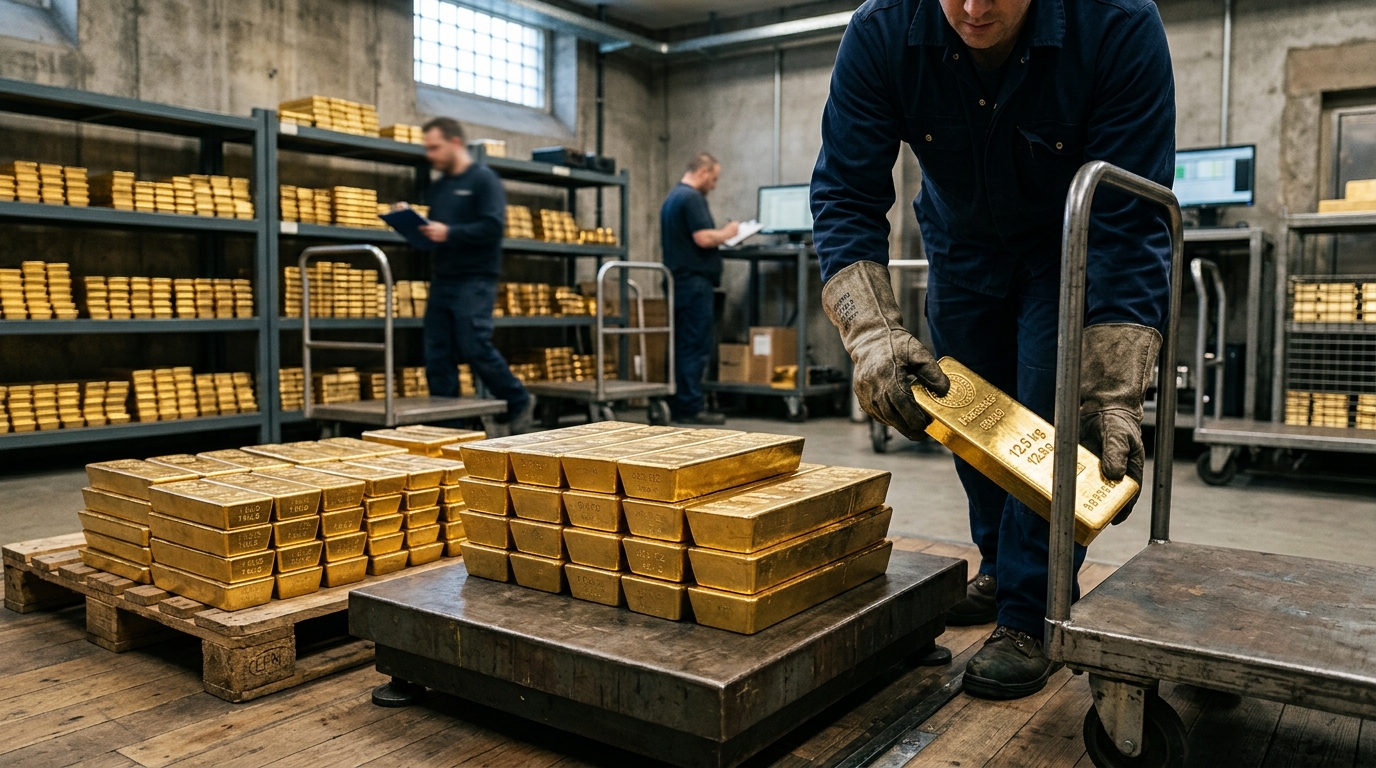
Gold is doing something unusual this Tuesday morning. Prices have been trading above $4,400 again, even as the U.S. and Iran remain locked in a standoff that is still weighing on risk sentiment. Most commentary treats the Iran conflict as the primary fuel. That framing misses the more important story: the bid under gold right now is structural, and it was built during a quarter when prices were falling sharply.
What’s Driving the Market
The surface-level read on $4,445 gold is geopolitical fear. The deeper read is a sovereign reserve rotation that accelerated precisely when retail investors were selling. While gold posted its worst quarter since 2013 during Q2, the world’s central banks bought more of it than in any second quarter on record. Central banks netted a Q2 record 289 tonnes of gold, up about 74% year-over-year, per the World Gold Council.
The National Bank of Poland was one of the largest reported buyers, and the People’s Bank of China also added meaningfully, with the WGC noting China’s reserves at 2,346 tonnes after a large June addition. What makes those figures striking is the context: the buying came during a quarter in which gold prices fell about 16%, the asset’s worst quarterly performance since 2013. Sovereign buyers treated the pullback as an entry, not a warning.
The survey data behind the buying is just as telling. The WGC’s 2026 Central Bank Gold Reserves Survey shows 89% of reserve managers expect global gold holdings to rise in the next 12 months and 74% anticipate lower U.S. dollar holdings over the next five years. A 74% majority institutional verdict against the dollar-centric reserve order does not reverse on a single ceasefire headline.
Now layer in the Fed calculus. Gold crossed back above $4,400 following the weak July U.S. jobs report, and markets pared back September rate-hike odds into the low-40% range from the mid-50% range the prior day, according to widely cited FedWatch-based estimates. The July CPI is due Wednesday, and markets are focused on whether the slowing job market is coupled with slowing inflation or whether price pressures remain persistent. Inflation risks from volatile oil prices still back the case for at least one rate hike in 2026, which supports the dollar and may cap gold ahead of that report. The metal is caught between two gravitational forces: a structural sovereign bid pulling it higher and a potential Fed hike pulling it lower. Wednesday’s CPI number decides which force wins in the near term.
The Iran situation itself is more complicated than a simple risk-premium trade. Diplomatic efforts around the Strait of Hormuz have been ongoing, and mediators have been trying to keep commercial traffic flowing. A deal is possible. But the structural sovereign-reserve rotation that built gold’s floor happened independently of those diplomatic swings.
The Investment Opportunity
With gold holding above $4,400 on structural demand rather than war panic, the more durable opportunity sits with producers generating cash at current prices, not with traders positioned for another geopolitical spike. Barrick Mining reported Q2 results Monday and delivered a headline beat on production: Q2 gold production increased 11% over Q1 to 796,000 ounces, exceeding guidance of 730,000 to 770,000 ounces, driven by the ahead-of-schedule ramp-up at Loulo-Gounkoto, a faster-than-expected recovery at Pueblo Viejo following planned Q1 maintenance, and record underground tonnes at Cortez as the Goldrush project continues to ramp up.
The more consequential development was a deal with Newmont that reshapes Barrick’s North American asset base. Here, the draft overreaches on specifics. Barrick and Newmont have historically excluded Fourmile (Barrick) and Mike and Fiberline (Newmont) from the Nevada Gold Mines joint venture, and those assets have long been discussed as possible later inclusions. But I could not verify, from primary company releases available at review time, the claim that both companies are now vending those specific properties into the JV with Newmont paying Barrick $1.95 billion in cash within thirty days, or that the transaction was directly tied to support for a planned North American listing. Treat that as unconfirmed until the companies publish definitive terms.
The AISC math is hard to argue with at current gold prices. The draft’s specific claim that Newmont and Barrick have stabilized AISC between $1,400 and $1,700 per ounce, and that this was achieved through autonomous hauling and AI-driven deposit modeling, is not something I could verify cleanly from primary filings in a way that supports those exact numbers and the stated cause-and-effect. More broadly, both companies have been emphasizing cost discipline and productivity initiatives, and at $4,445 gold, margins are clearly substantial. But the draft’s claim that both companies can “easily achieve gross profit margins of well over 160%” is not a standard or reliably comparable margin metric for miners as written, and it should not be stated as a precise figure.
Newmont’s side of the ledger adds income context. Newmont’s Board declared a $0.26 dividend for Q2 2026, payable September 28, 2026 to holders of record as of September 3, 2026. Recent earnings coverage has noted solid operational performance alongside mixed reactions to other line items, but the draft’s specific reference to an earnings-per-share miss is too vague to stand without a clearly attributable, time-stamped source in the text. The larger point holds: if the market is still debating durability of the gold bid, high-quality operators with shareholder returns can offer a longer-duration way to express the theme.
Risks to Monitor
The most immediate threat to this framework is Wednesday’s CPI reading. The U.S. July CPI consensus has been widely discussed around 3.4% year-over-year. A hotter result could revive Fed hike bets and create volatility that tests gold’s current position. If the data comes in above consensus, September hike odds will likely rise and gold will face dollar headwinds that no central bank buying program can fully offset in the short run.
On the geopolitical side, the risk cuts both ways. A genuine resolution to the Strait of Hormuz situation would likely collapse the war premium embedded in oil, reducing energy-driven inflation and lowering the Fed’s incentive to hike. That scenario can be constructive for gold if it reduces real yields without triggering a sustained dollar rally. A further escalation pushes oil higher, adds to inflation, and keeps the hawkish rate path intact, which is the environment where gold’s structural bid competes against rising opportunity cost. Gold’s near-term trajectory is heavily dependent on oil price movements, which are likely to stay volatile and shaped by geopolitical developments until a more lasting peace emerges.
On the miner-specific side, jurisdiction risk remains real. Barrick’s Loulo-Gounkoto asset is in Mali, where government relations have been volatile. The recent ramp-up is ahead of schedule, but any renewed friction in West Africa would affect production guidance and amplify the stock’s discount to net asset value rather than narrow it.
Finally, jewellery demand dropped to 278 tonnes in Q2, one of the weakest on the World Gold Council’s record, as high prices limited affordability. The Middle East saw an overall annual decline of 19%. Price-sensitive consumer demand is not supporting gold at these levels. The entire bull case rests on institutional and sovereign conviction holding. If central banks slow their pace of accumulation in Q3, that floor weakens.
Bottom Line
Gold above $4,400 is easier to explain with one data point than any Iran headline: central banks bought a quarterly record of 289 tonnes while the price fell about 16% in Q2, its worst quarter since 2013. They were not buying geopolitical fear alone. They were buying reserve-diversification conviction into weakness. That bid does not disappear when a ceasefire is announced. It disappears when sovereign reserve managers decide the dollar-centric order is stable again, and 74% of reserve managers anticipate holding less USD over the next five years, a majority institutional verdict that the dollar-centric reserve order is winding down. Wednesday’s CPI decides the near-term direction. The structural argument decides the year.