August 22, 2026
The Black Sea Grain War Is Escalating
Featured: The Black Sea Grain War Is Escalating
Editor’s Note: What if you could go for $1,000 in the markets, no matter which way stocks are going? Long-time friend and colleague Larry Benedict is revealing the strategy he used to make hundreds of millions of dollars for his Wall Street clients. Read more below.
Dear Reader,
Nobody seems to know…
Bull market, or historic meltdown?
One week, stocks reach record highs, and investors rush in.
The next it’s the next Great Depression.
If the markets have you feeling whiplashed, you’re not alone.
According to legendary trader Larry Benedict, history shows nearly every tech-driven bull market plays out the same way – and none of it really matters if you have the right strategy.
He says:
“I’ve been trading the markets for four decades, and I’ve seen the markets do this exact song-and-dance before.
Today, I’ll show you how to potentially make your first $1,000 whether we see record highs or a complete meltdown. It’s all noise, and I’ll show you why.”
Go here now to see Larry’s plan to make money in any market.
Best,
Lauren Wingfield
Managing Editor, The Opportunistic Trader
The Black Sea Grain War Is Escalating
Bullet Summary
- 97% offline: Attacks on ports and shipping have shut down more than 97% of Russia and Ukraine’s combined grain export capacity in the Azov and Black Sea basin, according to Reuters calculations as of August 20, 2026.
- 26.1 million tonnes gone: All three Novorossiysk grain terminals, collectively handling 26.1 million tonnes of annual export capacity, halted operations following Ukraine’s August 12 drone strike. Tuapse, the smallest deep-water terminal, is the only active Russian port remaining.
- Ukraine slashes export forecast 54%: Ukraine’s Agriculture Ministry has cut its 2026-27 agricultural export estimate to 29.6 million tonnes from 64.4 million, with wheat shipments forecast to plunge 53% to just 8.3 million tonnes.
- Russia’s August exports at a decade low: SovEcon projects Russian wheat exports for August at 3.0 to 3.4 million tonnes, against a five-year August average of 5 million tonnes — the lowest monthly total since the 2016-17 marketing year.
- CBOT wheat up 35% year-over-year: Chicago SRW wheat settled at 683.50 cents per bushel on August 20, up 34.77% over the past 12 months. The September 2026 Kansas City HRW contract is at 754.50 cents, carrying a 74-cent quality premium over Chicago SRW.
- Russia’s export shortfall could reach 35 million tonnes: Russia’s Union of Grain Exporters and Producers warns the season-long wheat shortfall could total 30 to 35 million metric tons, roughly 15% of total global wheat trade, with no credible alternative supply to cover the gap.
- Asian buyers stranded mid-contract: Asian processors booked 2.0 to 2.5 million tonnes of Black Sea wheat for delivery from July through September, representing 30% to 50% of regional import needs. Many cargoes could not be loaded.
- Managed money still net short Chicago SRW: The August 11 CFTC report shows managed money net short 33,400 contracts in Chicago wheat, representing significant short-covering fuel if bullish catalysts build further. KC wheat managed money is net long 25,606 contracts.
Market Context: Why This Week Is Different
The grain corridor that feeds a third of the world’s bread basket is not under pressure. It is, by any operational measure, closed. What began as an escalating tit-for-tat between Russian and Ukrainian military planners has become a bilateral demolition of each other’s agricultural export infrastructure, and the commodity markets have spent the better part of six weeks catching up to a reality that analysts flagged before August even began.
This is not a supply disruption story. It is a supply removal story. The difference matters for every trader, portfolio manager, and sovereign import official watching CBOT wheat at levels not sustained since 2022.
Attacks on shipping have shut down more than 97% of Russia and Ukraine’s grain export capacity in the Azov and Black Sea basin, cutting off a major source of low-cost supplies and helping to drive up global prices. Russia and Ukraine together exported an average 7.2 million metric tons of grain a month from terminals in the Azov and Black Sea region last season, according to Reuters calculations based on official data and analyst estimates. That monthly volume is now, for practical purposes, zero.
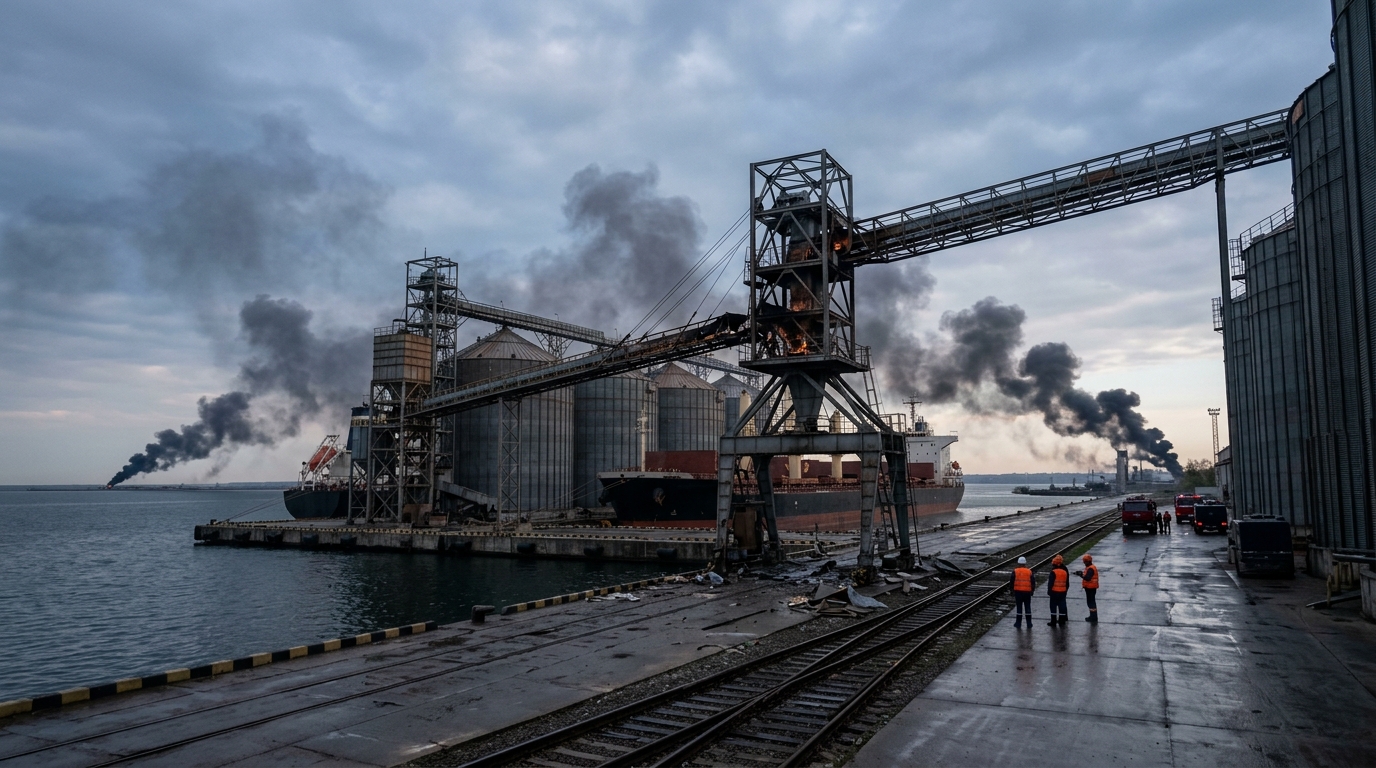
The August 12 Novorossiysk strike was the inflection point. Three of Russia’s largest grain terminals in the Black Sea port of Novorossiysk halted operations after being damaged in a massive overnight drone attack by Ukraine. All three Novorossiysk grain terminals halted work, taking 26.1 million tonnes of annual export capacity offline. Grain shipments from Novorossiysk are currently impossible because of serious damage to terminal infrastructure. A loading gallery at United Grain Co.’s Novorossiysk Grain Plant collapsed after the strikes and several silos were damaged, while a gallery and truck unloading facility at Demetra’s terminal were also hit.
Navigation in the Sea of Azov has been suspended since July, while a grain terminal at Taman halted operations in late July. Two Novorossiysk terminals, NKHP and NZT, stopped operating on the same day, followed a day later by KSK, the port’s largest terminal. Tuapse, the smallest of Russia’s deep-water grain terminals, is now the only port in the region still operating, according to Andrei Sizov, managing director of the SovEcon agricultural consultancy.
Sizov has described the Russian Black Sea and Azov grain-export system as effectively shut, with roughly 250,000 tonnes a month of residual capacity at Tuapse standing in for a region that previously loaded millions of tonnes. Approximately $15 billion of annual Russian grain-export revenue is sitting behind that bottleneck.
On the Ukrainian side, the damage predates August. Grain exports from Ukraine’s Black Sea ports dropped 75% during the first two weeks of August compared to the same period last year, as escalating Russian attacks on ports, cargo vessels, and maritime infrastructure crippled one of the world’s most important agricultural export corridors. Ukrainian seaports in the Odesa port hub effectively ceased operations at the end of July. As of mid-August, no new ship calls had been recorded, Agriculture Minister Taras Vysotskyi confirmed.
The macro context makes the timing worse. August is the peak of the Black Sea export season. Both countries’ harvests were moving toward terminals at the highest seasonal volumes of the year when the strikes intensified. The disruption did not clip the shoulder months. It decapitated peak throughput.
Sector Breakdown: Who Absorbs the Shock
The commodity shock does not distribute evenly. The two major grain exporters have intensified attacks on ports and shipping over the past month, leaving importers in the Middle East, Africa, and Asia facing the prospect of sourcing grain from higher-cost suppliers such as Australia and the United States.
Asian processors booked between 2 million and 2.5 million tonnes of Black Sea wheat for delivery from July through September, representing roughly 30% to 50% of regional import needs. Maxence Devillers, a grain analyst at Argus Media, said buyers facing delayed or entirely canceled shipments from the region