
Phase 1: Market Snapshot
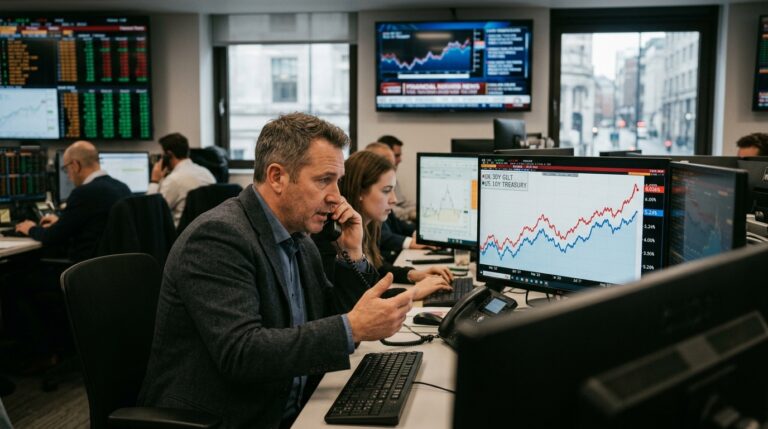
The week ending August 21 delivered a fractured tape. The S&P 500 rose on Friday as investors tried to find their footing following a steep selloff driven by rising Treasury yields, with the broad market index climbing 0.43% to end at 7,674.37, while the Nasdaq Composite rose 0.43% to 26,180.45. That Friday bounce masked what was otherwise a losing week. Information technology shed more than 3% over the last five days, putting the S&P 500 on track to finish the week in the red.
The Dow gained 517.80 points, or 0.98%, supported by gains in healthcare stocks such as Merck and Johnson & Johnson, closing at 53,277.01. The financials sector offered a boost, with crypto-related stocks seeing sizable gains as bitcoin posted a weekly advance of about 22%. Robinhood shares jumped almost 14%, while Coinbase added 8%.
The dominant macro force of the week was the long end of the Treasury market. The Treasury Department said it will more than double the size of its government debt repurchases, sending yields sharply lower. With fixed-income markets under pressure and yields surging to levels not seen in nearly 20 years, the announcement targeted the 10- to 20-year and 20- to 30-year portion of the market, which has seen a buyers’ strike since late June. The relief proved short-lived. Bond yields advanced on Thursday, with the yield on the 10-year Treasury note climbing back above the level it was at just before the buyback announcement.
Gold surged to a record, and bitcoin cleared $77,000 by Friday’s close, its best weekly performance in three years. The 30-year Treasury yield rose to about 5.25% on Friday, approaching its year-to-date high.
Phase 2: Stocks in Focus
Coinbase (COIN) and the September 15 Clock
A record $2.7 billion in bearish crypto bets were wiped out in a single 24-hour window on Wednesday, the largest short liquidation event in records going back to 2021, sending Bitcoin to its highest level since early June and lifting crypto-linked equities sharply.
The trigger was policy, not price. President Donald Trump on Wednesday hosted crypto executives in the Roosevelt Room at the White House, with Coinbase CEO Brian Armstrong, Robinhood CEO Vlad Tenev, Kraken co-CEO Arjun Sethi, and Tyler and Cameron Winklevoss of Gemini among those attending. CFTC Chair Mike Selig and SEC Chair Paul Atkins were also present. Trump reiterated his support for U.S. leadership in cryptocurrency and urged Congress to pass the CLARITY Act, which would establish regulatory standards for digital assets.
The legislative calendar is the key variable. The Senate delayed a floor vote ahead of the August 2026 recess due to partisan disagreements over ethics rules and banking opposition, scheduling a procedural vote for September 15, 2026, a cloture vote on the motion to proceed that requires 60 votes to overcome a filibuster. Investors had started to view the bill as effectively dead for 2026 after the Senate left for its August recess without a vote, and failure to clear that September 15 hurdle could effectively end the bill’s chances this year as other priorities steal focus heading into the midterm elections.
Coinbase’s underlying business is stronger than the policy volatility implies. Q2 2026 showed Coinbase logging its 14th consecutive quarter of positive adjusted EBITDA. COIN is back in play because the company is executing while the regulatory backdrop finally starts to tilt its way.
The risk is visible. Coinbase reported trailing-12-month revenue of about $7.18 billion, yet the company still posted a quarterly net loss of roughly $359 million and a negative profit margin near negative 16%. The stock is not an earnings machine yet. It is a regulatory option priced by a calendar. Watch September 15.
Applied Materials (AMAT): The Free Cash Flow Disconnect
Applied Materials posted record revenue of $9.12 billion for its fiscal third quarter ended July 26, 2026, up 25% year over year and above the consensus estimate of about $8.99 billion. Q4 guidance came in with revenue expected at $10.25 billion, and non-GAAP EPS expected at $4.02.
The stock fell anyway. Applied Materials shares fell 5.4% in pre-market trading after the semiconductor equipment maker’s record results failed to impress investors following the stock’s substantial year-to-date rally. As of the close on August 18, AMAT traded at $514.33, some 28.9% below its closing high of $723.00 set on June 30, 2026, having still exactly doubled year to date from its $256.99 close on December 31, 2025.
The number that explains the reaction is not in the income statement. Across the first nine months of fiscal 2026, Applied’s GAAP net income rose to $7.37 billion. Over the identical nine months, its non-GAAP free cash flow fell to $3.58 billion from $3.66 billion.
There is also a China question. China accounted for approximately 28% of Applied Materials’ total sales during the period, compared with around 35% a year earlier.
The industry backdrop is unambiguously strong. Lam Research management raised its calendar 2026 wafer fabrication equipment spending outlook to the low $150 billion range, up from a previous view of $140 billion with upside bias. AMAT’s selloff is a valuation reset, not a thesis break. The free cash flow gap is what the market is demanding an answer on.
Ross Stores (ROST): Off-Price Earns Its Premium
Ross Stores reported strong results for the 13-week second quarter ended August 1, 2026, with sales up 13% to $6.26 billion and comparable store sales rising 10%, driven primarily by higher customer traffic.
The margin story has a caveat. Operating income reached $1.10 billion and operating margin expanded 610 basis points, including a 405-basis-point benefit from about $253 million of IEEPA tariff refunds. Earnings per diluted share were $2.66, including roughly $0.60 from the refunds, compared with $1.56 a year earlier.
Strip out the refund and the underlying business still beats. The operating margin expanded 610 basis points, including a 405-basis-point benefit from tariff refunds. Excluding that benefit, the operating margin improved 205 basis points year over year. CEO Jim Conroy noted that comparable-store-sales growth was driven by new customer acquisition and higher engagement from returning shoppers, both income and age groups broadening simultaneously. Ross opened 47 new stores in the quarter and raised its 2026 plan to 115 openings.
The forward guide is where traders need to pay attention. Despite facing significantly more challenging year-over-year comparisons in the back half, management raised its outlook for both the third and fourth quarters, with comparable store sales now expected to increase 6% to 7% in Q3 and 4% to 5% in Q4. Full-year EPS guidance was raised to a new range of $8.61 to $8.77, versus estimates of $7.79. Second-half comps of 6-7% following a 10% Q2 print means the easy money is behind it. The store expansion and the demographic broadening are what the long-term case rests on now.
CrowdStrike (CRWD): August 26 Is the Only Number
CrowdStrike stock trades near $188 after dropping 16% over the past five days as investors trim positions before the cloud security firm reports its second-quarter financials after market close on Wednesday, August 26. Wall Street expects the company to report $0.29 EPS and $1.44 billion in revenue.
Despite the price drop, growth in AI security tools gives CrowdStrike solid operational backing. Ending annual recurring revenue for its new AI Detection and Response unit jumped over 250% quarter-over-quarter, backed by a second-quarter pipeline exceeding $50 million. Total ARR across its main Falcon software platform reached $5.51 billion at the end of Q1.
The 16% pre-earnings drop is a positioning flush, not a verdict. CrowdStrike stock fell in June after beating estimates because forward guidance came in under what analysts were modeling on revenue and billings growth of 18% was light. Guidance sets the next two quarters of expectations, so a beat on a finished quarter carries less weight than a soft outlook on the ones ahead. The same dynamic applies Wednesday. Net new ARR, not revenue, is what the market is pricing. Options imply about a 10% earnings move. That is the range traders are pricing for this week’s most consequential result.
Phase 3: Sector Watch
Crypto Equities. This is the week’s undisputed sector leader. Stocks tied to bitcoin and the broader crypto space were headed for big weekly gains. The move is policy-driven more than price-driven. Regime change in regulation lifts all exchanges, custody providers, and stablecoin issuers simultaneously. The September 15 vote decides whether this week’s gains hold or retrace.
Semiconductor Equipment. The industry thesis, confirmed by both AMAT and Lam Research, is the strongest in a decade. Lam Research CEO Tim Archer described the 2027 outlook as “extraordinary,” noting that customers have announced multi-year timelines for new fab projects, with the company expecting 8 to 10 new fabs to come online supporting continued AI-related demand. The stocks are not reflecting the thesis cleanly because valuations ran ahead of free cash flow. AMAT, LRCX, and KLA all pulled back sharply in August. The equipment cycle is real. The re-entry timing is the debate.
Healthcare. The $19 billion Vanguard Health Care Index Fund rose to a record. Defensives are winning because yields are hurting growth multiples. That rotation is not exhausted.
Phase 4: Catalyst Calendar
- August 26: CrowdStrike earnings (CRWD), after close. Consensus is $0.29 EPS on $1.44 billion revenue. The real signal is net new ARR. Stock already down 16% into the result.
- August 26: Nvidia earnings (NVDA), after close. Excitement over Nvidia’s earnings announcement on Wednesday, August 26 is building, with the analyst community estimating about 97% year-over-year growth. Both CRWD and NVDA report the same evening, creating compounded risk for the AI complex.
- August 26: July PCE price index. Despite earnings season winding down, next week looks eventful on the economic and policy fronts. Wednesday brings the July Personal Consumption Expenditures price index alongside Nvidia’s results. With inflation still above target and the 30-year yield near 5.25%, a hot PCE would force another reset of the September Fed meeting.
- September 15: CLARITY Act Senate procedural vote. The Senate’s first CLARITY Act floor test is scheduled for September 15. A 60-vote cloture threshold against an unresolved ethics dispute means this is not certain. Failure ends the bill’s 2026 prospects.
- October 13: Applied Materials investor breakfast at SEMICON West. Management lays out its longer-term framework at the October 13 investor breakfast at SEMICON West, which may reset the story before the next earnings result. First checkpoint on whether the China revenue slide has stabilized.
Phase 5: Technical Radar
- COIN: The daily chart shows a powerful squeeze from the mid-$140s in late July 2026 up into the low-$170s by August 20, with several sharp reversal days. Intraday, COIN’s range between $180 and $184 showed repeated failed pushes above $184.50, signaling active selling into strength. The $175 level is now support. $192 is the next meaningful target cited by multiple analysts.
- AMAT: AMAT touched a 52-week high of $739.67 in late June, then fell to an intraday low near $436 on July 29 during a sharp semiconductor pullback, a 39.63% peak-to-trough drawdown, before clawing back above $500. JPMorgan raised its price target to $660 from $515 and maintained an Overweight rating, while B. Riley lowered its target to $700 from $790 but maintained Buy. The $500 level is the line in the sand between a pullback and a trend break.
- CRWD: Wall Street has a Strong Buy consensus on CrowdStrike with an average price target of $211.92. The stock trades near $188 after dropping 16% over the past five days. August 26 resolves the directional question. Options pricing implies a 10% swing.
- ROST: Stock rose roughly 8% in after-hours trading on the Q2 beat. The 10% comparable-store-sales increase is unlikely to repeat in Q3, given management’s own 6-7% comp guide. The stock’s next test is whether the second-half deceleration is already priced in or will produce another reset.
Phase 6: Risk Radar
- Treasury yields. The 30-year yield rose to about 5.25% on Friday, approaching its year-to-date high. Higher yields put pressure on speculative assets by making fixed-income investments more attractive and tightening financial conditions. The Treasury’s buyback program bought one day of relief. It did not change the underlying dynamic of a $40 trillion debt load meeting rising borrowing costs.
- Double-result risk on August 26. CrowdStrike and Nvidia both report the same evening. If either disappoints on forward guidance, the combined reaction could hit the entire AI complex simultaneously. Traders holding concentrated positions in both should understand the single-evening exposure.
- CLARITY Act failure. Investors had started to view the bill as effectively dead for 2026 after the Senate left for its August recess without a vote, with negotiations still hung up over the ethics provision. A September 15 procedural failure would likely give back a significant portion of this week’s crypto equity gains. Strategy, Coinbase, Robinhood, and Circle all surged on the same catalyst. They would fall on the same reversal.
- AMAT free cash flow vs. earnings divergence. The analyst reaction supports the same conclusion as the stock move: AI, DRAM, and advanced-packaging demand remains strong, but another sustained move higher increasingly depends on Applied translating that demand into market-share gains, faster relative growth, and continued margin expansion. If Q4 gross margin does not hold at 50.4% or better, the equipment selloff has a second leg.
- Bitcoin still off its high. This week’s 22% move is a short squeeze and a policy catalyst, not a new fundamental cycle. The structural bid depends entirely on whether September 15 delivers.
Phase 7: The Cheat Sheet
Top Market Theme: Crypto equities are running on a 27-day legislative clock, semiconductor equipment stocks are resetting free cash flow against an otherwise exceptional cycle, and off-price retail just confirmed that the trade-down consumer is alive and accelerating.
Stock to Watch: CrowdStrike (CRWD). A 16% pre-earnings drop into a confirmed August 26 result, with options pricing a 10% move, creates the week’s highest-conviction binary event. Net new ARR is the only number that matters Wednesday evening.
Sector to Watch: Crypto equities. Strategy, Coinbase, Robinhood, and Circle all moved sharply in a single week on one policy catalyst. The September 15 Senate vote is now the sector’s entire near-term directional driver. Position accordingly.
Biggest Risk: August 26 brings both CrowdStrike and Nvidia results in the same after-hours window. A guidance disappointment from either, against a backdrop of 30-year yields at 5.25%, could produce a sharp and simultaneous selloff across the AI and cybersecurity complex.
Biggest Opportunity: Applied Materials. Underneath the two investor worries sits the real reason to own the stock: visibility. Applied’s largest customers now provide rolling eight-quarter forecasts, with some technology conversations extending to 2030. A stock that doubled year-to-date and then gave back 29% from its peak, against a confirmed $150 billion WFE industry, is not a broken thesis. It is a reset valuation on a durable multi-year cycle. The free cash flow gap is solvable as ramp costs normalize.
One Thing to Remember: Ross Stores just reported $2.66 EPS with a roughly $0.60 benefit from tariff refunds and a 10% comparable-store-sales increase, and the forward guide calls for comps to decelerate to 6-7% in Q3. That is still strong. But traders buying the result at current prices are paying for a Q2 quarter that already happened, not the one ahead. The tariff refund will not repeat. Underlying strength, yes. The magnitude of Thursday’s beat, no.